
ISTQB CT-SEC Practice Exam Questions & Answers
ISTQB CT-SEC Exam Details
Key details for this exam, checked against the published exam outline
- Exam Code
- CT-SEC
- Full Name
- Certified Tester Security Tester
- Issuing Body
- ISTQB
- Full Question Set
- 45 questions Get All Questions
Free CT-SEC Practice Questions
Answer each question, then see the correct answer and why it is right
Question 1 Domain 6 Human Factors in Security Testing
Which ONE of the following activities could reveal information to an attacker during the reconnaissance stage of an attack?
Reconnaissance is the stage of an attack in which the attacker gathers information in order to build a picture of the target organization, including its technical setup, staff, and possible weaknesses. Details released through openly available channels can play a major part in later attack planning.
The ISTQB Security Tester syllabus lists search engines, social networks, professional networking sites, and publicly available technical material as likely reconnaissance sources.
Open technical conversations about an organization's systems may reveal software products, operating system versions, network design, infrastructure settings, authentication methods, or day-to-day working practices. Such details can deepen an attacker's knowledge of the organization's exposure without the attacker needing to interact directly with protected systems.
Option A refers to an internal social network, and option B refers to an internal intranet forum. Provided access controls work as intended, external attackers would not normally be able to see these sources.
Option D may also expose valuable information, such as employee identities, job responsibilities, and technical skills. Even so, option C describes open public disclosure of details about organizational systems and is therefore the strongest answer.
Organizations should keep suitable information-disclosure policies in place and run security awareness training to limit the accidental publication of sensitive technical details.
The question is not entirely clear-cut, since professional profiles can also aid reconnaissance, a point the syllabus explicitly acknowledges.
Official Reference: ISTQB CT-SEC Syllabus 2016, Sections 6.1.1 (The Impact of Human Behavior on Security Risks) and 6.1.2 (Understanding the Attacker Mentality), page 69.
Question 2 Domain 1 The Basis of Security Testing
Risk assessment for security ranks security risks so that test activities match the organization's security goals.
Which ONE of the following options would lead to a mismatch between the business security goals and the tests?
Security risk assessment links organizational assets, possible threats, existing vulnerabilities, the likelihood of occurrence, and the consequences that follow from a successful exploit. This link forms the foundation for ranking security testing activities according to business needs.
The ISTQB Security Tester syllabus states that matching security testing with business security goals relies on correctly describing the organization's security threats, the stakeholders who are affected, and the assets that need protection.
Viewing security threats as separate from assets removes a key part of risk analysis. Even though one threat may impact several assets, its importance depends on the features, value, exposure, and business significance of each affected asset.
For instance, unauthorized access to a publicly available marketing document and unauthorized access to a confidential customer database lead to very different business outcomes, even though they may involve similar attack methods.
Option A supports communication with stakeholders and informed risk management. Option B helps identify relevant threats and define security test coverage. Option D covers likelihood, which is one of the core elements of risk assessment together with adverse impact.
An approach that ignores assets can lead to poor prioritization, insufficient testing of critical systems, and excessive testing of relatively low-risk resources. Security tests must therefore stay traceable to the assets, threats, and business consequences identified during risk assessment.
Official Reference: ISTQB CT-SEC Syllabus 2016, Sections 1.1.1, The Role of Risk Assessment in Security Testing, and 1.1.2, Asset Identification, pages 12 to 14.
Question 3 Domain 3 Security Testing Processes
Within the scenario described above, which ONE of the following security test-planning objectives or key security test-plan elements is missing?
Security test planning has to cover both how well the implemented security mechanisms work and how to keep vulnerabilities from being introduced while the software is developed.
Section 3.2.1 of the ISTQB Security Tester syllabus names quality assurance measures and recommended practices across architecture, design and coding as key steps for preventing unintended security vulnerabilities.
Security activities at the architecture level set up basic protection mechanisms, trust boundaries and structural security requirements. Even so, a secure architecture on its own does not guarantee that the application will be implemented securely.
Design-level activities review authentication mechanisms, authorization models, data protection requirements and interactions between components. Coding-level activities check implementation practices, input validation, error handling, memory management and conformance to secure coding standards.
If quality assurance covers architecture but leaves out detailed design and coding, serious vulnerabilities may stay hidden until later testing phases.
Option B is about quality assurance during testing instead of preventive development practices. Option C is an important planning constraint covering achievable scope and available resources. Option D refers to applicable standards and compliance requirements.
Option A names the development activities that must go along with architecture-level security assurance to stop implementation-related vulnerabilities from being introduced.
Verification note: The ODT does not include the introductory scenario. Answer A presumes that architecture-level quality assurance is already covered, as the accompanying source material indicates.
Official Reference: ISTQB CT-SEC Syllabus 2016, Section 3.2.1 on Security Test Planning Objectives and
Section 3.2.2 on Key Security Test Plan Elements, pages 38 to 39.
Get the complete CT-SEC question set
$20$40
Question 4 Domain 3 Security Testing Processes
While establishing the security testing process, you are in charge of specifying the activities needed within each phase of the security test process.
Which ONE of the following statements presents an ACCURATE mapping of a task to its phase?
The ISTQB Security Testing Process sets out a structured link between general software testing activities and the specialized tasks needed for security testing. Every process phase has its own objectives and responsibilities that support effective security assessment.
Table 3.1 of the ISTQB Security Tester syllabus explicitly lists monitoring security test progress and results as a responsibility of security test planning and control.
Security test planning and control covers defining security test objectives, setting the testing scope, identifying required resources, preparing schedules, selecting metrics and defining entry and exit criteria. Monitoring supplies the information needed to judge whether testing stays aligned with the established objectives and whether corrective actions are necessary.
Security test analysis and design involve reviewing security risk assessments, security requirements, organizational policies and known vulnerabilities. These activities form the foundation for identifying security test conditions and designing suitable test cases.
Security test implementation and execution involve preparing the necessary testing resources and carrying out the defined security tests. Although execution produces results, monitoring overall testing progress is a management and control responsibility.
Option A wrongly assigns test-basis review activities to implementation and execution. Option B confuses test design with execution. Option C wrongly classifies monitoring as an execution responsibility.
Official Reference: ISTQB CT-SEC Syllabus 2016, Section 3.1.1, ISTQB Security Testing Process, Table 3.1, pages 33 to 34.
Question 5 Domain 5 Testing Security Mechanisms
While performing security testing, you are verifying that source code and/or sensitive data cannot be copied or pasted when network packets are captured.
Which ONE of the following techniques MOST accurately describes the activity you are performing?
Data obfuscation is a security practice that converts information or source code into a form that is hard for unauthorized people to read, interpret or reuse. Its main goals are to protect sensitive information, intellectual property and proprietary application logic from unauthorized copying and reverse engineering.
The ISTQB Security Tester syllabus describes obfuscation as a means of protecting sensitive data and source code from unauthorized copying, including attempts to bypass software licensing protections or to understand proprietary algorithms.
In this scenario, the security tester checks whether information captured from network packets stays unintelligible and cannot easily be reused. Effective protection should stop intercepted content from revealing sensitive information in a readily understandable form.
Encryption is especially important when sensitive information is sent across networks. Although the syllabus treats encryption as a form of obfuscation, simple encoding and source-code obscuration do not offer equivalent cryptographic confidentiality.
Data reconnaissance is about collecting information on a target. Data manipulation means altering information, which may compromise its integrity. Boundary defense centers on controlling communications between networks or security zones.
Option A is therefore the technique that most closely matches the security activity described. In practical implementations, authenticated encryption should be applied wherever the confidentiality and integrity of transmitted information are required.
Official Reference: ISTQB CT-SEC Syllabus 2016, Sections 5.7.1 Understanding Data Obfuscation and
5.7.2 Testing the Effectiveness of Data Obfuscation Approaches, pages 66 to 67; Section 5.3 Encryption.
Question 6 Domain 3 Security Testing Processes
Select the ONE input-value set below that achieves 100% coverage of two boundary values for string length?
Boundary Value Analysis (BVA) is a specification-based test design method used to uncover defects located at the edges of equivalence partitions. It is especially relevant to security testing, since flawed input-length limits can lead to weak input validation, application instability and other security flaws.
The original question text leaves out the allowed string-length range. The supporting material sets a minimum allowed length of six characters and a maximum allowed length of twelve characters.
With two-value boundary value analysis, every boundary is exercised using the boundary value itself and its nearest neighbor in the adjacent equivalence partition.
The necessary coverage values are:
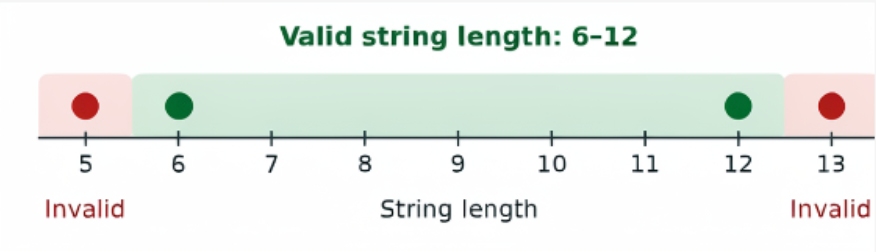
Diagram depicting coverage of the two-value boundaries.
Input Length
Expected validation outcome
aB#@5 5
Rejected aB#@56 6
Accepted bbBb?!bB48bb 12
Accepted abCd?!gH48klm 13
Rejected
Option B includes every one of the four required boundary values: 5, 6, 12 and 13.
Option A uses an eleven-character string in place of the necessary twelve-character value. Option C leaves out the five-character boundary value. Option D leaves out both six and thirteen.
Therefore, option B delivers full two-value boundary coverage for the stated length limit. This confirms coverage of the string-length boundaries only, not complete security coverage of every possible string property.
Source material: ISTQB CT-SEC Syllabus 2016, Section 3.3.1 (Security Test Design) and Section 4.4.2 (Security Test Design at the Component Level). Related technique: ISTQB Foundation Level, Boundary Value Analysis.
Question 7 Domain 6 Human Factors in Security Testing
Max is trying to gather as much information as he can about a particular target. He wants to determine the technology behind its website, its IP addresses, details about its employees, and similar data.
Based on the gathered data, he will select the tools and methods he needs to attack the target.
Which TWO of the following tools could help him carry out this task passively, without directly communicating with the target system?
Select two.
Reconnaissance, also called footprinting, is an information-gathering activity used to build an understanding of a target's publicly visible infrastructure, technologies and related organizational information. Reconnaissance techniques are classified as passive or active depending on whether they interact directly with the target system.
Passive reconnaissance depends on information held in independent repositories, publicly accessible databases and external information services. The ISTQB Security Tester syllabus specifically names Whois and the RIPE database as resources that support passive information gathering.
Whois services supply registration-related information for internet resources, including domain names and IP address allocations. The availability of this information depends on the relevant registry and any applicable privacy restrictions.
The RIPE database holds internet number resource registration data, including IP address allocations, autonomous system numbers and associated organizational or network details.
Both resources can be queried without establishing a direct connection to the target organization's infrastructure.
TCP and UDP scanning generally requires sending network traffic to target systems in order to identify reachable communication ports. Service fingerprinting, as described in the syllabus, involves analyzing responses from discovered services. Xprobe2 identifies operating systems through active network-based techniques.
Therefore, Whois and the RIPE database meet the stated passive reconnaissance requirement. Security testing activities should stay within formally authorized assessment boundaries.
Official Reference: ISTQB CT-SEC Syllabus 2016, Section 6.1.2, Understanding the Attacker Mentality, pages 69 through 70; Chapter 10, references Web-12 and Web-13.
Question 8 Domain 6 Human Factors in Security Testing
Annie is creating a counterfeit email account that impersonates a company's CTO. She is also making use of social media, instant messaging and SMS to trick potential victims into disclosing confidential information.
Which ONE of the following attacks is she preparing to carry out?
Social engineering is an attack approach that takes advantage of human tendencies, trust, authority and psychological pressure to gain unauthorized entry, confidential data or security credentials. Instead of depending only on technical flaws, it focuses on people who already have legitimate access to organizational resources.
The ISTQB Security Tester syllabus characterizes social engineering as the abuse of human behavior as an attack vector. Attackers control, sway or convince people into revealing sensitive details or giving unauthorized help.
Annie poses as a senior executive, namely the Chief Technology Officer, to build credibility and capitalize on the perceived authority of that role. Her use of counterfeit email accounts, social media, instant messaging and SMS points to a coordinated, computer-based social engineering strategy. Depending on the channel used and how precisely victims are selected, these actions could be classified as phishing, spear phishing, executive impersonation or smishing.
Tailgating means gaining unauthorized physical entry by following an authorized person into a restricted area. Eavesdropping means monitoring or listening to private communications without the knowledge of those involved. Fake cryptography does not describe the manipulation technique shown here.
Useful countermeasures include security awareness training, independent verification of sensitive requests, least-privilege controls and established procedures for reporting suspicious communications.
Official Reference: ISTQB CT-SEC Syllabus 2016, Section 6.2, Social Engineering, pages 72 to 73.
Practice every CT-SEC question in the full set, each one with its verified answer and a detailed explanation
Get Full AccessWhat the ISTQB CT-SEC Exam Covers
Exam domains verified against the Official ISTQB CT-SEC exam guide, last checked November 2026.
Domain 1 The Basis of Security Testing
The first area is security risk. Next comes information security policies and procedures. The last area looks at security auditing and its role in security testing.
Above Practice Question from this Domain: Q2
Domain 2 Security Testing Purpose, Goals and Strategies
This section explains the purpose of security testing and the organizational context in which it takes place. It then covers security testing objectives, their scope and coverage, and the approaches used for security testing. The final part looks at improving security testing practices.
Domain 3 Security Testing Processes
Security testing is broken into a set of processes. They are security test process definition, security test planning, security test design, security test execution, security test evaluation and security test maintenance.
Domain 4 Security Testing Throughout the Software Lifecycle
This area looks at where security testing fits in a software lifecycle. It covers the role of security testing in requirements, in design and in implementation activities. It also covers system and acceptance test activities, and finally maintenance.
Domain 5 Testing Security Mechanisms
This area covers testing security mechanisms. The mechanisms are system hardening, authentication and authorization, encryption, firewalls and network zones, intrusion detection, malware scanning and data obfuscation. It ends with training.
Above Practice Question from this Domain: Q5
Domain 6 Human Factors in Security Testing
Human factors play a part in security testing. This area covers understanding the attackers, social engineering and security awareness.
Domain 7 Security Test Evaluation and Reporting
This area deals with security test evaluation and security test reporting. Evaluation comes first and reporting follows it.
Domain 8 Security Testing Tools
This area covers the types and purposes of security testing tools. It also covers how to select a tool.
Domain 9 Standards and Industry Trends
This area covers understanding security testing standards and applying security standards. It ends with industry trends.
CT-SEC Exam FAQ
Common questions about the exam itself
How hard is the CT-SEC exam?
What background do I need before taking CT-SEC?
Which CT-SEC objective area is hardest and how should I approach it?
How long should I prepare for the CT-SEC exam?
What happens on exam day for CT-SEC?
Which job role does the CT-SEC certification suit?
How does CT-SEC relate to other exams in the ISTQB Testing Specialist track?
What kind of practice questions should I work through for the security mechanisms area?
Other ISTQB Exams
Free practice questions for more ISTQB certification exams