Key details for this exam, checked against the published exam outline
Each question shows the correct answer and an explanation of why it is right
Your company just won a contract to create a new sales application and has committed to a very aggressive delivery timeline. Due to the quick turnaround your primary stakeholder wants to be
heavily involved in the design and is very anxious to see the outcome. Because of this, your company has decided to use a spiral development approach. You have a defined test policy and
typically use an analytical approach to testing, however, this approach will not work with the development approach.
What test strategy should be utilized? [3]
A reactive test strategy is a test strategy that uses the actual behavior and results of the software under test to design and execute tests, without prior knowledge or documentation of the software1.A reactive test strategy should be utilized for a project that uses a spiral development approach, which is a type of iterative/incremental approach that adds risk analysis and prototyping activities to each iteration2.A reactive test strategy is suitable for a spiral development approach because it allows for flexibility, adaptability, and creativity in the testing process, as well as for early feedback, risk reduction, and continuous improvement in the software development process3. Therefore, option D is the correct answer. Option A is incorrect because a model-based test strategy is a test strategy that uses models to represent the desired behavior and structure of the software under test, and to derive test cases, test data, test procedures, and test oracles. A model-based test strategy may not work well with a spiral development approach, as it requires the availability and stability of the models, which may not be the case in a spiral development approach that involves frequent changes and refinements of the software under test. Option B is incorrect because a methodical test strategy is a test strategy that uses predefined test methods, techniques, and procedures to design and execute tests, such as equivalence partitioning, boundary value analysis, or decision table testing. A methodical test strategy may not work well with a spiral development approach, as it requires the availability and stability of the test basis, such as the requirements, specifications, or design documents, which may not be the case in a spiral development approach that involves frequent changes and refinements of the software under test. Option C is incorrect because a standard-compliant test strategy is a test strategy that follows a predefined set of standards, guidelines, or regulations to design and execute tests, such as ISO, IEEE, or CMMI.A standard-compliant test strategy may not work well with a spiral development approach, as it requires the compliance and consistency of the testing process, which may not be the case in a spiral development approach that involves frequent changes and refinements of the software under test.Reference:1: ISTQB Glossary, Reactive Test Strategy2: ISTQB Glossary, Spiral Model3: ISTQB Advanced Level Test Manager Syllabus, Section 1.1.1 :Spiral Model in Software Development Life Cycle - Software Testing Material:Spiral Model - Tools QA:Strategic Test Management - ISTQB not-for-profit association: ISTQB Glossary, Model-Based Testing : ISTQB Glossary, Methodical Test Strategy : ISTQB Glossary, Standard-Compliant Test Strategy :ISTQB Foundation Level #39 -- Test Approach and Strategy - Software Testing Mentor
In an Agile project, when Is it acceptable lo not write a formal defect report when a defect is found''
Context Analysis:
Agile emphasizes efficiency and collaboration. If a defect is quickly resolved within the same iteration, documenting it formally may not add value.
Evaluation of Options:
A . Never:
Incorrect. Agile allows flexibility; not all defects require formal reports.
B . If the defect can be fixed in the same iteration in which it was found:
Correct. Aligns with Agile principles of immediacy and adaptability, minimizing overhead (Syllabus section TM-1.2.4).
C . If the defect can be fixed in a later hardening sprint:
Incorrect. Documentation is needed if a defect remains unresolved within the iteration.
D . If the defect must be fixed by another team:
Incorrect. Clear documentation is critical for external team collaboration.
Syllabus Alignment: ISTQB Advanced Test Management highlights Agile principles, including flexibility in defect reporting based on project needs (TM-1.2.4).
ISTQB Advanced Level Test Management Syllabus
Assuming that 'In progress' means that somebody is working on a fix and that 'Resolved' means that the fix passed the confirmation test; which option provides a defect workflow that flows in a sensible way from an initial state to a terminal state?
A typical defect workflow should begin with a newly reported issue ('New'), proceed to investigation, allow for deferral if necessary, move to fixing ('In Progress'), re-testing, and finally confirmation of resolution and closure. According to the ISTQB CTFL Syllabus, valid states of a defect report include: New, Under Investigation, Deferred, In Progress, Re-Test, Resolved, Closed.
Which statement about defect management in hybrid software development is TRUE?
A hybrid approach often necessitates flexible planning across development models. Aligning defect fixes to the specific development characteristics ensures clarity and efficiency.
''The way in which defects are logged may vary depending on... the test level and the software development lifecycle model.''
-- ISTQB-CTFL_Syllabus_2018_V3.1, section 5.6
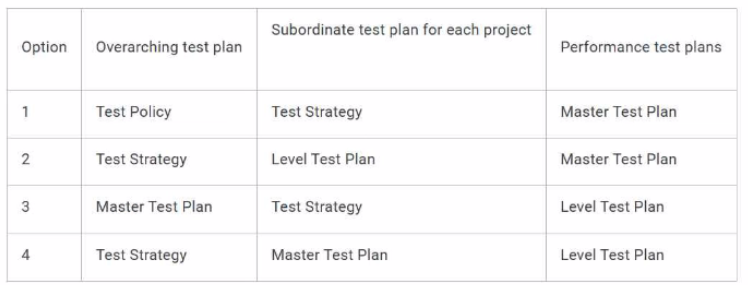
Refer to SCENARIO 2 It has been agreed that the following test planning documents will be produced;
* A single overarching document outlining the general testing methodology for the whole programme of work
* A subordinate test plan for each of the three projects
* A separate test plan for performance testing within each project
Which one of the following options BEST describes the type of test management document that will meet the programme requirements?
It is now the last day of the second iteration and the team has been consistently underestimating the time needed. They estimate intuitively rather than using estimation techniques.
Which two estimation techniques would be BEST for the team in this scenario?
C (3-point estimation): Offers a structured approach to improve accuracy by accounting for uncertainty.
D (Planning poker): Commonly used in Agile; supports collaborative and experiential-based estimation.
''Planning poker is an example of the expert-based approach... team members are estimating the effort to deliver a feature based on their experience.''
-- ISTQB-CTFL_Syllabus_2018_V3.1, section 5.2.6
Which of the following aspects should test progress metrics be mapped to? [1]
Test progress metrics should be mapped to exit criteria to ensure that the testing process aligns with the predefined standards for completion. Exit criteria typically include conditions such as coverage of test cases, pass rates, and the resolution of major defects, which are essential for determining the end of the test phase.
Reference: The ISTQB Advanced Level Test Manager syllabus includes the evaluation of exit criteria as part of the test monitoring and control process1.It is crucial for test managers to define and evaluate these criteria to ensure that the testing objectives have been met and that the product is ready for releas
Exam domains verified against: Official ISTQB CTAL-TM exam guide, last checked October 2026.
Covers test planning, test monitoring and control, and test completion activities. Understand how to manage the testing lifecycle across different project phases and how to define scope, objectives, resources and schedules.
Select metrics that align with test objectives and use them to control progress. Analyze test results to create reports that help stakeholders make decisions about quality and risk.
Sample question from this domain above: Q1
Identify required skills across technical, interpersonal, testing and management competencies. Plan skill development strategies and create motivating work environments for test team members.
Common questions about the exam itself

