
ISTQB CTEL-ITP-ATP Practice Exam Questions & Answers
ISTQB CTEL-ITP-ATP Exam Details
Key details for this exam, checked against the published exam outline
- Exam Code
- CTEL-ITP-ATP
- Full Name
- Certified Tester Expert Level Assessing Test Processes
- Issuing Body
- ISTQB
- Validity
- 7 years
- Full Question Set
- 28 questions Get All Questions
Free CTEL-ITP-ATP Practice Questions
Answer each question, then see the correct answer and why it is right
Question 1 Domain 3 Analytical-based Improvement
You are the test manager for a large bank. A recent release produced 8 defects that surfaced during user acceptance testing and during live operation. Given the business context and the amount of time and money spent on testing, both outcomes are regarded as unacceptable. You must examine the defects and choose a subset to analyze, rather than analyzing all of them.
The defect characteristics are shown below. Exhibit:
Defect ID Phase Detected Phase Injected Severity Developer Root Cause Component
1
UAT
Requirements A
A
Code A
2
Live Development C
C
Data B
3
Live Design A
B
Environment B
4
Live Design D
B
Environment D
5
UAT
Design C
B
Environment A
6
UAT
Development B
C
Data C
7
UAT
Development D
A
Code C
8
Live Requirements B
A
Code D
Which ONE of the following approaches would be MOST suitable for choosing defects to examine further?
The ISTQB syllabus names several techniques for choosing defects for causal analysis, including Pareto analysis, statistical outlier analysis and defect severity classifications. The best choice depends on the data available, how the defects are spread out and the business consequences.
Here only eight defects exist, and their attributes show no dominant concentration that would strongly justify Pareto-based selection.
Review of defect distribution
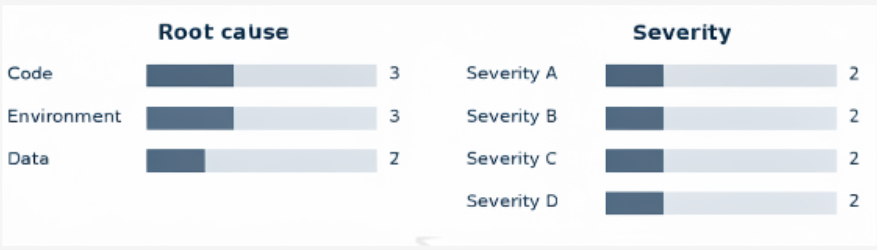
No single root cause category makes up more than 37.5% of the defects. Every severity level contains two defects.
Code-related and environment-related defects each total three incidents, while data-related defects total two. Likewise, the defects are spread equally across the four components.
Given the banking setting, ranking defects by business impact provides a more defensible foundation for picking a limited investigation subset. Taking severity A as the highest level, defects 1 and 3 should be examined first, followed by severity B defects if additional investigation resources are available.
Statistical outlier analysis fits poorly here, because the dataset is small and lacks meaningful continuous measurements needed to identify statistically significant deviations. Fishbone analysis helps investigate the underlying causes of selected defects but is not primarily a defect-selection method.
Severity-based analysis therefore offers the most appropriate risk-oriented selection method for the situation described.
Official Reference: ISTQB CTEL-ITP Syllabus 2011, Section 4.2.4, Selecting Defects for Causal Analysis, page 31; Learning Objective LO 4.2.7 (K4).
Verification correction: The source practice document suggests A. However, the exhibit does not show a category dominant enough to make Pareto analysis the strongest option. C is more defensible given the stated business context, provided the severity categories run from A (highest) to D (lowest). The lack of an explicit severity scale adds slight ambiguity.
Question 2 Domain 5 Process for Improvement
In which stage of the IDEAL improvement model should the assessment be planned?
:
Within the IDEAL improvement framework, the Diagnosing phase is where the present condition of testing processes is established, weaknesses are recognized and possible areas for improvement are identified.
Designing the assessment is a core task in this phase, since it lays out the methodical approach used to gather and judge evidence.
The ISTQB syllabus covers assessment planning directly in Section 6.3.1, Planning the Assessment. An assessment plan sets out and timetables tasks such as initial analysis, creating interview checklists, reviewing existing testware, conducting stakeholder interviews and sharing assessment results.
The assessment needs to address the testing areas set by the objectives and scope agreed earlier in the Initiating phase. Stakeholders involved may include test managers, testers, developers, business analysts, project managers and technical specialists.
The Initiating phase defines the business need, sponsorship, objectives and scope of the improvement effort. The Establishing phase applies diagnostic results to rank improvements and draft an implementation plan. The Acting phase focuses on carrying out, tracking and controlling the approved improvements.
Therefore, assessment planning falls under Diagnosing because it readies the evaluation of current processes before recommendations and implementation plans can be drafted.
Official Reference: ISTQB CTEL-ITP Syllabus 2011, Sections 6.3 and 6.3.1 -- Diagnosing the Current Situation and Planning the Assessment, pages 42--43.
Verification correction: The original practice document incorrectly associates assessment planning with Establishing. The correct phase is Diagnosing.
Testing revealed no defects, yet after the first release of a new application, 50 defects were later reported in the production environment. It was found that the relevant component had not been thoroughly tested, and the component testing process needs to be improved.
Question 3 Domain 1 Basic The Context of Improvement
Of the following tool categories, which ONE would be the MOST suitable to adopt in order to find defects at an earlier stage?
Detailed Explanation:
Code coverage tools supply objective data on how thoroughly software structures are exercised during dynamic testing. They help developers and testers spot statements, decision outcomes, branches and other structural elements that have not been run and may need extra test cases.
The scenario makes clear that the affected component was not tested adequately before release. No defects were found during testing, yet a large number of defects appeared in production, which suggests the existing tests did not sufficiently exercise the component.
Code coverage analysis tackles this shortfall directly by exposing gaps in structural coverage. Additional tests can then be written to run the previously untested code and check how it behaves under suitable conditions.
The ISTQB Expert Level syllabus names code coverage tools as a means of supporting the implementation of component-level exit criteria. Setting appropriate structural coverage targets can strengthen the component testing process by giving measurable criteria for judging how complete the testing is.
Statistical tools may help reveal recurring defect patterns, but they do not directly show which software structures went untested. Regression automation tools improve repeatability and execution speed, yet they may simply run an inadequate test suite over and over. Requirements management tools improve traceability but do not directly measure structural code coverage.
Although high code coverage does not guarantee defect-free software, coverage tools offer the most relevant technical means of identifying the incomplete component testing described in this scenario.
Official Reference: ISTQB CTEL-ITP Syllabus 2011, Section 2.5.4.2, Test Process Improvement by Using Tools, page 19; Section 4.4.6.2, Coverage Indicators, pages 34 and 35.
Get the complete CTEL-ITP-ATP question set
$20$40
Question 4 Domain 2 Model-based Improvement
As a test manager, you are required to adopt an established test process improvement model for your team. Your manager wants a model that does not impose any fixed sequence on implementing improvements, since they already have a clear picture of the priorities.
Which ONE of the following models is the MOST suitable choice?
Detailed Explanation:
The Systematic Test and Evaluation Process (STEP) is a content-based test process improvement model that offers structured guidance on effective testing practices without enforcing a mandatory sequence for carrying out improvements.
The ISTQB Expert Level syllabus clearly states that STEP does not require improvements to take place in a specific order. Its underlying methodology views testing as a lifecycle activity that starts during requirements formulation and continues until the system is retired.
This flexibility makes STEP especially well suited to organizations that have already set their improvement priorities and want to implement changes in line with particular business needs, operational risks and resource constraints.
The improvement characteristics of the available models can be summarized as follows: Model
Improvement representation Implementation order CMMI
Staged or continuous in the syllabus version Depends on representation
STEP
Content-based Non-prescriptive TPI Next
Continuous with improvement clusters
Some prescribed dependencies TMMi
Staged
Predefined maturity progression
Although TPI Next offers considerable flexibility through its continuous representation, its checkpoint clusters introduce dependencies that require certain improvements to occur in a specified order.
TMMi explicitly establishes a staged maturity hierarchy. CMMI offers broader software process improvement guidance rather than the targeted, non-prescriptive testing approach that STEP provides.
Therefore, STEP directly meets management's requirement to implement testing improvements according to established business priorities without following a predefined improvement sequence.
Official Reference: ISTQB CTEL-ITP Syllabus 2011, Section 3.4.1 -- STEP, page 27; Section 3.3.1 -- TPI Next, pages 25 to 26; Section 5.1 -- Selecting Test Process Improvement Approaches, page 36.
Final Answer Verification Summary for Questions 1 to 25 Question
Answer check status 1
D
Verified 2
D
Revised from A 3
A
Verified 4
B
Revised from C
5
B
Unclear question 6
D
Verified 7
---
Incomplete item 8
D
Unclear wording; re-evaluated 9
C
Verified 10
A
Revised from B 11
D
Verified 12
C
Verified 13
C
Verified 14
B
Verified 15
B
Verified 16
D
Verified 17
D
Verified 18
C
Verified 19
A
Revised from D 20
B
Verified 21
D
Verified
22
B
Verified 23
C
Verified, with metric limitation 24
C
Re-evaluated from A; conditional 25
B
Verified
Open quality issues before release:
Question 7 needs rebuilding because metrics I to VI are absent. Questions 5 and 8 need clearer wording to remove ambiguity. Question 23 needs additional metrics for full GQM alignment.
Question 24 should spell out the severity classification scale.
Question 5 Domain 1 Basic The Context of Improvement
Select the ONE statement that offers the least appropriate rationale for enhancing the testing process.
:
Improving the testing process aims to raise the effectiveness and efficiency of testing work while supporting broader organizational quality goals. Enhancement efforts should produce measurable business value, such as greater product reliability, fewer operational failures, reduced development and maintenance costs, and higher customer satisfaction.
Lowering the number of defects that customers report is a valid goal, since effective testing should uncover significant defects before software reaches production. Catching defects earlier also cuts the costs and elapsed time tied to corrective maintenance, so option B is a sound business rationale.
Satisfying third-party certification requirements is another legitimate objective. An organization may have to show adherence to relevant standards or reach a defined process capability level in order to meet contractual, regulatory or supplier qualification demands.
Enhancing requirements management efficiency, by contrast, mainly falls within requirements engineering and wider software process improvement. Although sound requirements management supports better testability, traceability and test coverage, refining that process is not normally a direct goal of test process improvement.
The ISTQB syllabus acknowledges that testing improvements may expose the need for complementary changes in requirements management and other development processes. Even so, option D remains the least suitable direct justification for improving the testing process itself.
Official Reference: ISTQB CTEL-ITP Syllabus 2011, Sections 2.1 and 2.2 -- Why Improve Testing? and What Can Be Improved?, pages 13--15; Learning Objectives LO 2.1.1 and LO 2.1.2.
Practice every CTEL-ITP-ATP question in the full set, each one with its verified answer and a detailed explanation
Get Full AccessWhat the ISTQB CTEL-ITP-ATP Exam Covers
Exam domains verified against the Official ISTQB CTEL-ITP-ATP exam guide, last checked November 2026.
Domain 1 Basic The Context of Improvement
The reasons for improving testing come first, followed by what can be improved. The topic then covers views of quality and a generic improvement process, with a second look at what can be improved.
Domain 2 Model-based Improvement
Model-based approaches are introduced first. The topic then covers software process improvement models, test process improvement models and content-based models.
Above Practice Question from this Domain: Q4
Domain 3 Analytical-based Improvement
Causal analysis is the first subject. The GQM approach comes next, followed by analysis using measures, metrics and indicators.
Above Practice Question from this Domain: Q1
Domain 4 Selecting the approach for Test Process Improvement
The focus is on selecting test process improvement approaches.
Domain 5 Process for Improvement
The topic starts with initiating the improvement process. It then moves on to diagnosing the current situation.
Above Practice Question from this Domain: Q2
CTEL-ITP-ATP Exam FAQ
Common questions about the exam itself
Which job role does the CTEL-ITP-ATP certificate map to?
What background do I need before taking the CTEL-ITP-ATP exam?
Which objective area is hardest for CTEL-ITP-ATP candidates?
How do I choose between model-based and analytical-based improvement for a test process?
What does the Diagnosing the Current Situation topic cover in CTEL-ITP-ATP?
How does CTEL-ITP-ATP relate to the other Testing Expert exams?
How should I structure my study time for the Assessing Test Processes objectives?
What does the Views of Quality topic ask candidates to explain?
Other ISTQB Exams
Free practice questions for more ISTQB certification exams