Key details for this exam, checked against the published exam outline
Each question shows the correct answer and an explanation of why it is right
During a post-deployment site survey, issues are found with non-Wi-Fi interference. What should the engineer use to identify the source of the interference?
Cisco Spectrum Expert is a dedicated spectrum analysis tool designed to identify and analyze non-Wi-Fi interference sources at Layer 1. During a post-deployment site survey, it can detect interference from various devices such as cordless phones, Bluetooth devices, microwave ovens, video cameras, and other unlicensed RF emitters. The tool provides a visual representation of the RF environment across the frequency spectrum, allowing engineers to pinpoint the exact source of interference and characterize it by duty cycle, frequency, and interference pattern. A network analysis module (Option A) operates at Layer 2 and above, unable to detect non-802.11 RF emissions. Wireless intrusion prevention (Option B) detects rogue APs and 802.11 attacks but not Layer 1 RF noise. Wireshark (Option C) is a packet capture tool for Layer 2-7 analysis and cannot detect non-Wi-Fi RF energy. Reference: WLSD Study Guide --- Layer 1 Spectrum Analysis, Post-Deployment Survey, Non-Wi-Fi Interference Identification.
An engineer is performing an AP-on-a-stick survey and finds that the 5 GHz channel overlap is too high when an appropriate number of APs are used for the density requirements. Which two actions during the survey reduce channel overlap? (Choose two.)
Raising the minimum data rate to 24 Mbps reduces the effective coverage range of each AP because clients at the cell edge operating at low data rates are effectively excluded from the cell. This shrinks cell size, reducing channel overlap between neighboring APs on the same channel. Using directional antennas limits the coverage area of some APs by focusing RF energy in specific directions rather than radiating omnidirectionally, which directly reduces the lateral overlap between adjacent APs. Increasing AP transmit power (Option B) would worsen overlap, not reduce it. Allowing UNII-2e channels (Option C) provides more channel options but does not reduce the physical cell overlap --- it only provides more channels to avoid co-channel interference. Power saving mode (Option E) is a client-side power management feature unrelated to AP cell sizing during a survey. Reference: WLSD Study Guide --- Channel Overlap Mitigation, Data Rate Configuration, Directional Antenna Use Cases.
Refer to the exhibit. A wireless engineer is using the Ekahau Site Survey tool to conduct a post-deployment survey. The engineer analyzes the pictured output to determine if SNR meets the voice requirements. How is the voice support based on the output?
Exhibit --- Q15: Ekahau SNR Heatmap --- Post-Deployment Survey Output
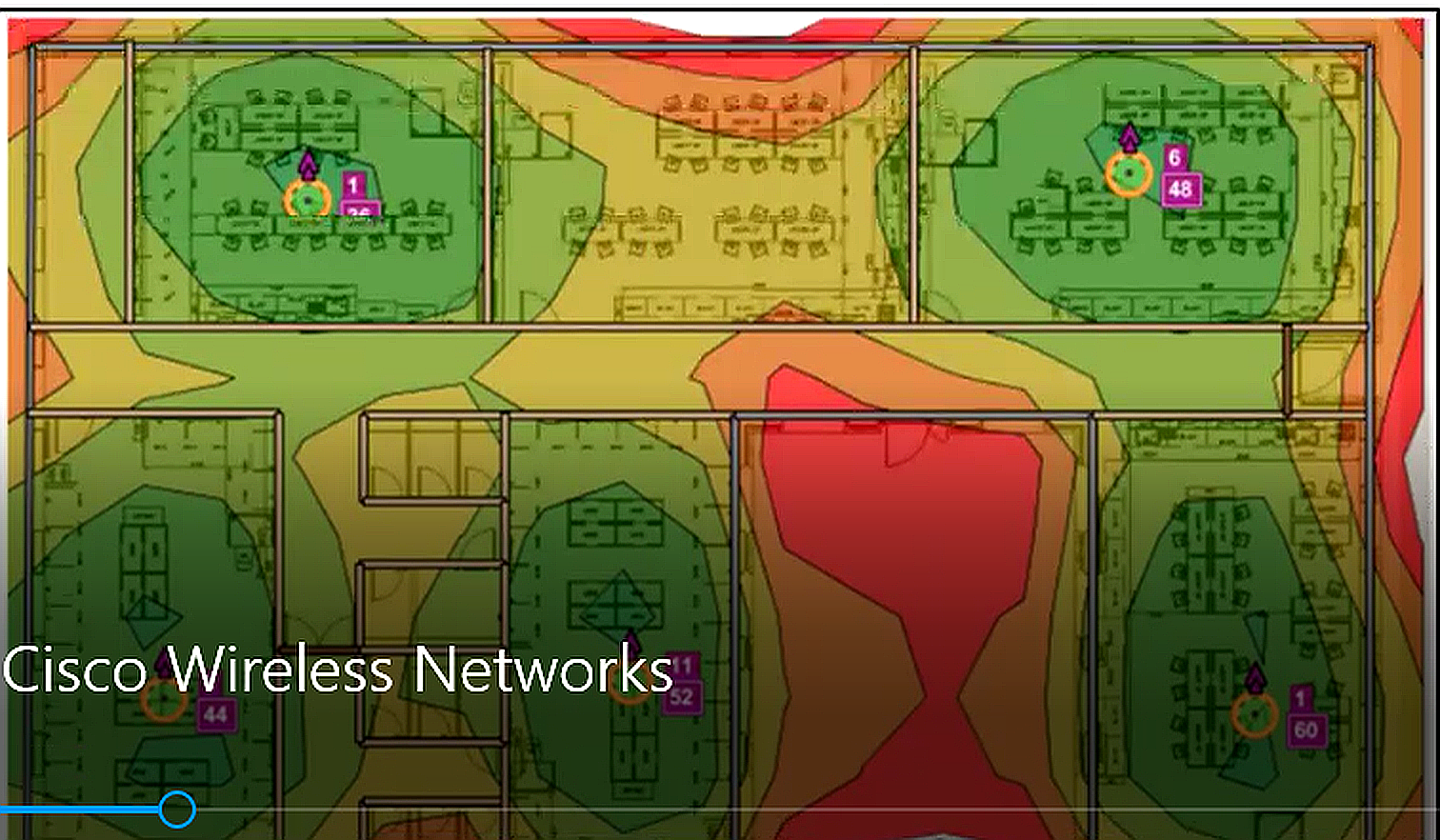
Voice over WLAN (VoWLAN) deployments require a minimum SNR threshold to maintain acceptable Mean Opinion Score (MOS) values for call quality. Cisco's 300-110 WLSD curriculum specifies that VoWLAN requires a minimum SNR of 25 dB throughout the coverage area. In an Ekahau post-deployment survey SNR heatmap, when the heatmap displays a consistent color indicating SNR at or above this threshold across the entire surveyed area --- including all rooms, corridors, and common areas such as the lobby --- the conclusion is that voice service is supported in all locations. The color coding in Ekahau's SNR heatmap uses green tones to indicate adequate SNR (typically 25 dB) and shifts toward yellow and red for degraded conditions. When the exhibit heatmap shows uniform adequate coverage across all surveyed areas without yellow or red zones, it confirms the SNR requirement for VoWLAN is universally met. Options A, B, and C suggest partial or no coverage, which would be indicated by mixed or poor SNR values --- conditions not present in this scenario. The post-deployment survey with Ekahau is the validation step confirming that the predictive design was accurately realized in the physical environment. Reference: WLSD Study Guide --- VoWLAN Design Requirements, SNR Thresholds, Post-Deployment Survey Validation with Ekahau.
An engineer is implementing a wireless design for a manufacturing company with a Catalyst 9800, a stack of two Catalyst 9300-48HX switches, and 9166 APs. Each AP must be named using the Zone-053424189-01X string where X is the area number. The engineer needs to connect the APs to the switch stack using PoE. How many APs must the engineer connect to the stack so that they run with full functionality?
The Cisco Catalyst 9300-48HX is a high-density PoE switch specifically designed for Cisco Catalyst 9100 Series AP deployments. The 48HX variant features 48 Multi-Gigabit PoE ports with IEEE 802.3bt (PoE++) support, providing up to 90W per port. The Cisco 9166 Access Point is a Wi-Fi 6E AP that requires IEEE 802.3bt (PoE++) power to achieve full radio functionality --- enabling all three radios including the 6 GHz radio. In a two-switch stack of 48HX units, the total PoE budget is designed and rated to support full-port utilization with Cisco 9100 series APs simultaneously. The design intent is to connect APs to all ports on all switches --- maximizing the deployment density and ensuring every AP runs with full functionality. Connecting to only half the ports on one switch (Option B), half of each switch (Option C), or all ports on only one switch (Option D) would underutilize the infrastructure and fail to achieve the full deployment density that the switch stack was architected to deliver. The AP naming scheme requiring sequential area numbering requires all APs to be connected and fully operational across the entire stack. Reference: WLSD Study Guide --- Catalyst 9300 PoE Infrastructure, 9166 AP Power Requirements, High-Density Wired Infrastructure Design.
A wireless engineer is getting ready to perform a predictive site survey. The new network needs to support data and voice over wireless. Which two Cisco recommendations should be considered for the design? (Choose two.)
For a network supporting both data and voice over wireless, two key Cisco design recommendations apply. First, the 5 GHz radio band is recommended for voice over wireless due to its wider channel bandwidths, allowing for higher data rates and better quality of service for latency-sensitive applications. 40 MHz channels in the 5 GHz band provide significantly higher throughput than 20 MHz channels in 2.4 GHz, making Option B correct for the bandwidth reason stated. Second, setting the cell boundary to -67 dBm ensures sufficient signal strength for reliable voice communication at the cell edge, which is the Cisco standard threshold for VoWLAN coverage. Options C and E are partially correct (24 non-overlapping channels is accurate, 15-20% overlap is standard) but B and D are the primary Cisco recommendations that define the design targets for a predictive survey supporting voice. Reference: WLSD Study Guide --- VoWLAN Design Requirements, Predictive Survey Design Criteria, 5 GHz Band Selection.
100 questions covering all exam domains, starting from $20
Exam domains verified against: Official Cisco 300-110 exam guide, last checked September 2026.
Collect design requirements, evaluate constraints including client density, real-time applications, AP type, deployment type and security. Analyze material attenuation effects, perform Layer 1 surveys and predictive site surveys using tools like Ekahau and Chanalyzer to measure key network metrics.
Determine physical requirements for AP power, cabling and switch port capacity. Design logical infrastructure including WLC/AP licensing based on wireless architecture type. Apply RRM, RF profiles, RxSOP and design high-density networks, voice and video deployments, location services, and wireless bridging in mesh configurations.
Design mobility groups based on mobility roles to optimize client roaming. Validate mobility tunneling for both data and control path. Describe and implement Site Tags to maintain client context across access points and controllers.
Design controller redundancy through LAG, stateful switchover and controller priority with Anchor designation. Design AP high availability by setting primary, secondary and tertiary fallback assignments, AP prioritization, and embedded wireless controller options for resilient network operation.
Sample question from this domain above: Q3
Common questions about the exam itself

