Key details for this exam, checked against the published exam outline
Each question shows the correct answer and an explanation of why it is right
You're analyzing NetFlow data for a network supporting voice and video traffic. The data shows consistent spikes in delay and jitter during peak hours. Which optimization would you recommend?
In the Designing and Implementing Enterprise Network Assurance (300-445 ENNA) curriculum, capacity planning and optimization are driven by telemetry data such as NetFlow. When NetFlow identifies that delay and jitter---metrics highly impactful to real-time traffic---spike during peak hours, it indicates that high-priority packets are competing for resources with bulk data.
The most appropriate recommendation is to tune the existing QoS configuration (Option C). This involves adjusting the Queuing and Scheduling policies on the routers to ensure that voice and video traffic (typically marked with EF and AF41/AF42 DSCP values) is serviced before other traffic classes during periods of congestion. This solution is targeted, cost-effective, and directly addresses the observed jitter issues without the need for massive capital expenditure.
Reviewing other options:
Option A: A complete QoS redesign is often unnecessary and too invasive for solving peak-hour jitter if a basic QoS framework is already in place.
Option B: Increasing bandwidth on 'all' links is a 'brute force' approach that is expensive and fails to address the underlying problem of traffic prioritization.
Option D: Hardware replacement is a last resort and would not resolve delay/jitter if the new hardware still lacks a properly tuned QoS policy.
Considering the observed network behavior and the information in the exhibits, which action would be the most appropriate next step for the network administrator to take?
The Designing and Implementing Enterprise Network Assurance (300-445 ENNA) framework emphasizes that the goal of internet intelligence is to enable rapid and accurate escalation to the party responsible for a service degradation. Based on the evidence of a BGP Hijack identified in the previous question, the issue is occurring entirely within the public internet ecosystem.
The most appropriate next step is to reach out to the Internet Service Provider (ISP) to report the suspected BGP hijacking incident (Option B). Since the traffic is being misdirected by an external Autonomous System (AS 10297) before it reaches the intended destination (AS 16509), the fix must occur at the routing policy level of the major transit providers. The network administrator should provide the ISP with the ThousandEyes 'Share Link' or screenshots showing the path change and the unauthorized AS announcement, as this data serves as proof to accelerate the ISP's mitigation efforts, such as implementing prefix filters or contacting the offending network.
Other options are ineffective for this specific scenario:
Option A: The path visualization shows that traffic is successfully leaving the local network and reaching the public internet; the problem is many hops away from the internal routers.
Option C: Blocking traffic from AS 10297 does not solve the problem of your traffic being attracted to it. The hijack affects how the rest of the world (including your ISP) sees the route to your destination.
Option D: DNS is not the issue; the agent successfully resolved the hostname to the correct IP, but the BGP layer misdirected the packets at the routing level.
By identifying the issue as an external routing event, the administrator avoids wasting internal resources and directly triggers the necessary external remediation.
Exhibit:
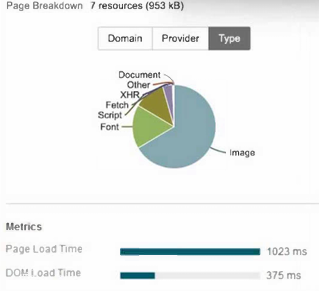
An engineer works to optimize a website by reducing the page-load time to below 500 ms. The engineer set up a Cisco ThousandEyes page-load test to baseline the current website performance. Which action should be recommended to reduce page-load time?
In the context of Designing and Implementing Enterprise Network Assurance (300-445 ENNA), analyzing page-load metrics within Cisco ThousandEyes requires identifying the primary bottlenecks that contribute to the Total Page Load Time. The provided screenshot displays a 'Page Breakdown' of 7 resources totaling 953 kB. A critical observation of the pie chart reveals that Images (the teal-colored segment) constitute the vast majority of the page's payload and resource count.
When the goal is to reduce the page-load time from 1023 ms to below 500 ms, the engineer must target the heaviest components. Lazy loading is a design pattern that defers the initialization of non-critical resources at page load time. Instead of loading all images simultaneously when the user first navigates to the URL, lazy loading ensures that images are only downloaded as they are about to enter the viewport. This significantly reduces the initial DOM load time and the total Page Load Time because the browser does not have to wait for large image files to be fully retrieved before declaring the page 'loaded.'
Alternative options are less effective in this specific scenario based on the data:
AJAX (XHR/Fetch): The chart shows that XHR and Fetch resources represent a negligible sliver of the total weight; optimizing them would yield minimal gains.
Moving IMG elements: While moving scripts to the bottom can help with rendering, moving image elements to the bottom of the body does not stop the browser from initiating the download requests immediately, thus failing to significantly reduce the total load time.
CDN for Fonts: The 'Font' category is also a small fraction of the total 953 kB. While a CDN is a best practice for latency, it does not address the primary 'weight' issue caused by the images.
Therefore, implementing lazy loading (Option C) is the most impactful recommendation. It directly addresses the largest resource consumer (Images) identified in the ThousandEyes Page Breakdown, allowing the engineer to reach the sub-500 ms performance target.
A network administrator wants to establish a baseline for CPU utilization on their core routers. Which data source would be MOST appropriate for this purpose?
In the Designing and Implementing Enterprise Network Assurance (300-445 ENNA) framework, baselining is the process of establishing a 'normal' performance profile for network infrastructure to enable the detection of anomalies. When the metric of interest is the internal health of a physical device, such as CPU utilization on a core router, SNMP (Simple Network Management Protocol) is the industry-standard data source.
SNMP provides direct visibility into the device's control plane and hardware performance. By polling specific Object Identifiers (OIDs) from the router's Management Information Base (MIB), a monitoring system like Cisco Catalyst Center or a third-party NMS can collect granular data on CPU cycles, memory allocation, and temperature. This 'inside-out' telemetry is essential for baselining because it reflects the actual resource consumption of the router during various traffic loads.
Conversely, ThousandEyes tests (Options A, B, and D) provide 'outside-in' synthetic data. While DNS resolution time (Option A), HTTP response times (Option B), and Path Visualization (Option D) are excellent for measuring end-to-end service delivery and network transit health, they do not report on the router's internal hardware state. For instance, a router could have 99% CPU utilization (indicating a potential crash), yet a ThousandEyes path test might still show a 'green' path if the data plane (ASICs) is still forwarding packets efficiently. Therefore, to establish a reliable baseline for hardware-specific metrics like CPU, SNMP data (Option C) is the only appropriate source among the choices.
Refer to the exhibit.
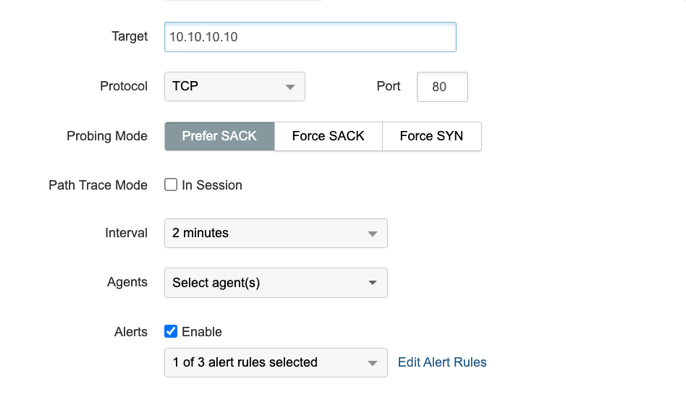
Which setting should be enabled for this network Agent to Server test to avoid test traffic being detected by firewalls as malicious?
In the Designing and Implementing Enterprise Network Assurance (300-445 ENNA) architecture, a critical challenge in active synthetic monitoring is ensuring that test probes accurately reflect user traffic without being dropped by intermediate security appliances. Standard network tests often utilize separate connections for measuring performance metrics (latency/loss) and for path discovery (hop-by-hop visualization). This behavior can be flagged by stateful firewalls or Intrusion Prevention Systems (IPS) as suspicious or malicious scanning activity.
To mitigate this, the engineer should enable Path Trace Mode: In Session (Option A). When this mode is active, ThousandEyes performs path discovery using the exact same TCP session established for the performance measurement. By embedding path discovery probes within an active, established session, the traffic appears to firewalls as part of a legitimate, ongoing communication stream rather than an independent series of probes with varying TTL values that might trigger 'anti-spoofing' or 'scanning' alerts.
Reviewing the alternative options:
Protocol: TCP (Option B): While using TCP is generally more firewall-friendly than ICMP, the exhibit shows TCP is already selected. The issue is not the protocol itself, but how the path discovery probes are handled relative to the session.
Port: 5000 (Option C): Changing the port to a non-standard value like 5000 often makes traffic more likely to be scrutinized or blocked by default firewall policies compared to standard web ports like 80.
Probing Mode: Force SYN (Option D): Forcing SYN packets is a technique used to bypass certain types of load balancers but does not address the fundamental issue of path discovery probes being seen as a separate, malicious scan by stateful inspection engines.
Therefore, enabling In Session path trace mode is the most effective way to ensure consistent visibility through security-hardened environments.
68 questions covering all exam domains, starting from $20
Exam domains verified against: Official Cisco 300-445 exam guide, last checked September 2026.
Determine the right agent types and locations to deploy, whether synthetic, scripting, or local collection agents. Understand active and passive monitoring approaches and how to integrate Cisco technologies like ThousandEyes, Catalyst SD-WAN Manager, Catalyst Center, and Meraki into your architecture.
Sample question from this domain above: Q1
Configure enterprise and endpoint agents across application servers and end-user devices at scale. Set up network, DNS, voice, and web tests in ThousandEyes and Meraki Insights, and implement web authentication methods including basic, digest, bearer tokens, OAuth, SAML, and SSO.
Sample question from this domain above: Q3
Diagnose network problems such as packet loss, congestion, routing, and jitter. Identify end-device issues affecting connectivity and resolve web application performance problems using browser waterfalls and collected telemetry data.
Sample question from this domain above: Q2
Configure alert rules based on TCP behavior, congestion, error counters, BGP state, and end-user experience metrics like CPU and connectivity changes. Select appropriate dashboards and alerts for different audiences and validate configurations work correctly.
Common questions about the exam itself

