At ValidExamDumps, we consistently monitor updates to the Cisco 300-215 exam questions by Cisco. Whenever our team identifies changes in the exam questions, objectives, focus areas or requirements, We immediately update our exam questions for both PDF and online practice exams. This commitment ensures our customers always have access to the most current and accurate questions. By preparing with these up to date and 100% exam domain coverage questions, our customers can successfully pass the Cisco Conducting Forensic Analysis and Incident Response Using Cisco Technologies for Cybersecurity exam on their first attempt without needing additional materials or study guides.
Other certification materials providers often include outdated or removed questions by Cisco in their 300-215 exam. These outdated questions lead to customers failing their Cisco Conducting Forensic Analysis and Incident Response Using Cisco Technologies for Cybersecurity exam. In contrast, we ensure our questions bank includes only precise and up-to-date questions. Our main priority is your success in the Cisco 300-215 exam, not profiting from selling obsolete exam questions in PDF or Online Practice Test.
Refer to the exhibit.
What is occurring?
The command in the image uses schtasks /create with the ONLOGON schedule and System user context to execute test.exe. This is a well-documented persistence technique, where an attacker ensures that a malicious executable is launched automatically at each system logon. This kind of scheduled task creation aligns with persistence techniques in the MITRE ATT&CK framework (T1053).
---
An investigator is analyzing an attack in which malicious files were loaded on the network and were undetected. Several of the images received during the attack include repetitive patterns. Which anti-forensic technique was used?
The use of repetitive patterns in images is a known indicator of steganography, which is an anti-forensics technique used to hide malicious code or files inside seemingly benign content such as image or audio files. The repetitive patterns suggest that the image may contain embedded hidden data. This technique is particularly difficult to detect through conventional scanning or antivirus software.
According to the CyberOps Technologies (CBRFIR) 300-215 study guide, steganography is defined as ''concealing malicious content or instructions within ordinary files such as .jpg, .png, or audio files, allowing the content to bypass security filters and reach the target system without detection''.
---
Refer to the exhibit.
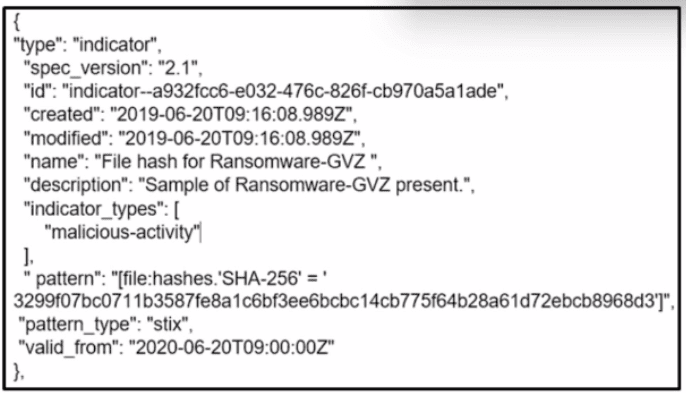
What is the indicator of compromise?
The STIX data structure shows a pattern field with this entry:
file:hashes.'SHA-256' = '3299f07bc0711b3587fe8a1c6bf3ee6cbcc14cb775f64b28a61d72ebcb8968d3'
This value is a SHA-256 file hash, a well-known indicator of compromise (IoC) for identifying malicious files.
Therefore, the correct answer is:
A . SHA256 file hash.
What are YARA rules based upon?
YARA rules are primarily used for malware classification and detection based on binary pattern matching within files. They describe sequences of bytes, strings, and other file characteristics found in malicious binaries.
The Cisco CyberOps Associate guide explains: 'YARA rules operate by inspecting binary data using conditions and string matches to identify specific patterns that indicate known malware samples.'.
Refer to the exhibit.
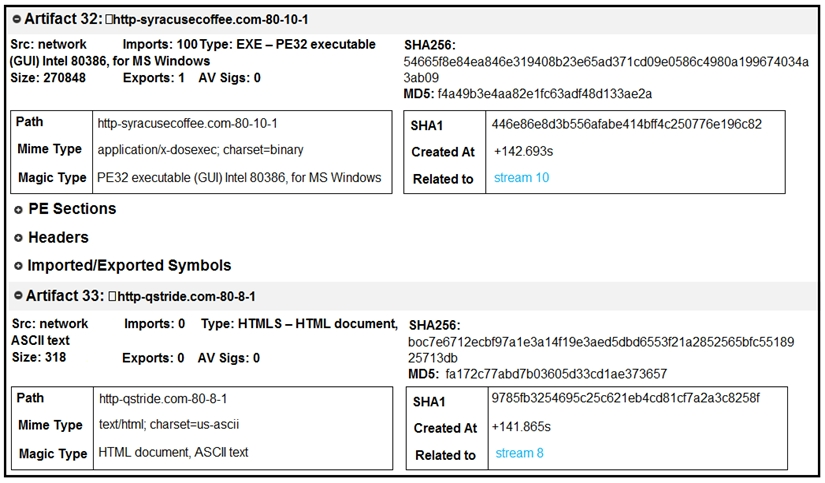
What do these artifacts indicate?
From the exhibit, the first artifact (PE32 executable from syracusecoffee.com) and the second artifact (HTML from qstride.com) suggest a staged malware delivery method. The executable and the HTML file are linked to different domains, often indicating redirection or multi-stage infection strategies, which is common in phishing or malvertising campaigns.
The Cisco guide explains this tactic as: ''One file may appear benign but can initiate downloads or connections to external resources to fetch additional payloads or redirect users''. This pattern of domain redirection strongly supports Option B.

