At ValidExamDumps, we consistently monitor updates to the Cisco 300-420 exam questions by Cisco. Whenever our team identifies changes in the exam questions, objectives, focus areas or requirements, We immediately update our exam questions for both PDF and online practice exams. This commitment ensures our customers always have access to the most current and accurate questions. By preparing with these up to date and 100% exam domain coverage questions, our customers can successfully pass the Cisco Designing Cisco Enterprise Networks Exam exam on their first attempt without needing additional materials or study guides.
Other certification materials providers often include outdated or removed questions by Cisco in their 300-420 exam. These outdated questions lead to customers failing their Cisco Designing Cisco Enterprise Networks Exam exam. In contrast, we ensure our questions bank includes only precise and up-to-date questions. Our main priority is your success in the Cisco 300-420 exam, not profiting from selling obsolete exam questions in PDF or Online Practice Test.
Refer to the exhibit.
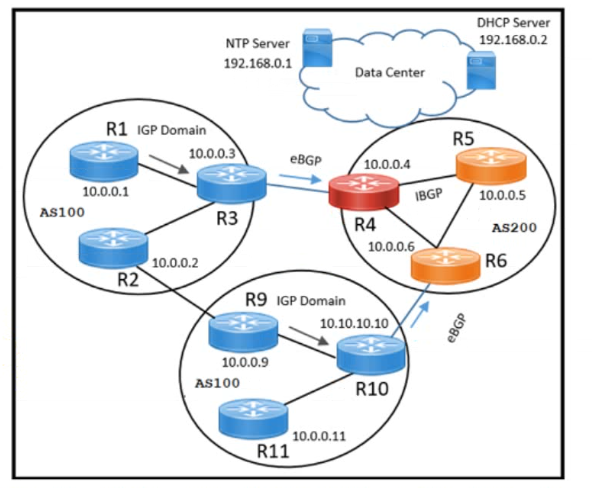
Refer to the exhibit. A network engineer working for a private service provider with an employee ID: 4670:71:451 must design a BGP solution based on:
All traffic originating from AS100 must pass through AS200 to reach the NTP and DHCP server
When a link failure occurs between R3 and R4, traffic must follow the R2-R9 link to reach the NTP and DHCP server.
Which solution must the design include?
A higher local preference on R3 for the relevant routes is the correct method to influence outbound traffic inside the autonomous system. Local preference is a well-known discretionary BGP attribute used within an AS to choose the preferred exit path. A higher local preference is preferred over a lower one, and the attribute is propagated to iBGP peers so routers in the AS make a consistent outbound decision. The requirement says all traffic originating from AS100 must pass through AS200 toward the NTP and DHCP server, and if the R3-to-R4 link fails, the path must move to the R2-to-R9 link. Applying local preference on R3 toward the routers that need to reach the data center establishes R3 as the primary exit while preserving the alternate path through R2 and R9. AS-path prepending is mainly used to influence inbound traffic from other autonomous systems, not the local AS exit choice. Redistributing IGP metrics into BGP is less deterministic and not the right policy control. Reference topics: BGP local preference, outbound traffic engineering, iBGP policy propagation, primary and backup path design.
Refer to the exhibit.
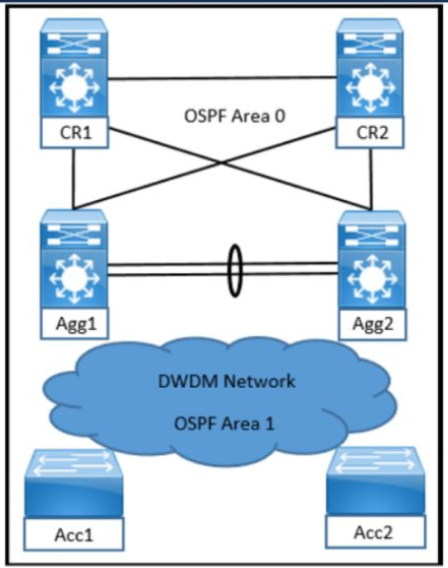
Refer to the exhibit. A network engineer must design a highly available OSPF solution based on these requirements:
Traffic disruptions caused by link or node failures in Area-1 must be resolved in milliseconds.
In the event of a failure, traffic must switch to another path without waiting for the OSPF dead interval.
Which fault detection solution must the engineer choose?
BFD with tuned timers is the correct fault-detection solution when OSPF traffic must fail over in milliseconds and cannot wait for the OSPF dead interval. Cisco describes Bidirectional Forwarding Detection as a lightweight mechanism that detects forwarding-path failures rapidly and notifies the routing protocol. OSPF can then bring down the adjacency and switch to an alternate route without waiting for the normal hello and dead timer process. Tuning SPF delay or LSA timers improves the control-plane calculation phase after OSPF has learned about a failure, but it does not provide the fastest failure detection by itself. IP SLA tracking can detect reachability problems, but it is not the standard per-neighbor OSPF millisecond detection mechanism. Decreasing SPF timers alone does not solve the requirement to avoid waiting for the dead interval. Therefore, BFD with appropriate 100 ms timers is the correct design choice. Reference topics: OSPF high availability, BFD, fast failure detection, dead interval avoidance, subsecond convergence.
Exhibit:
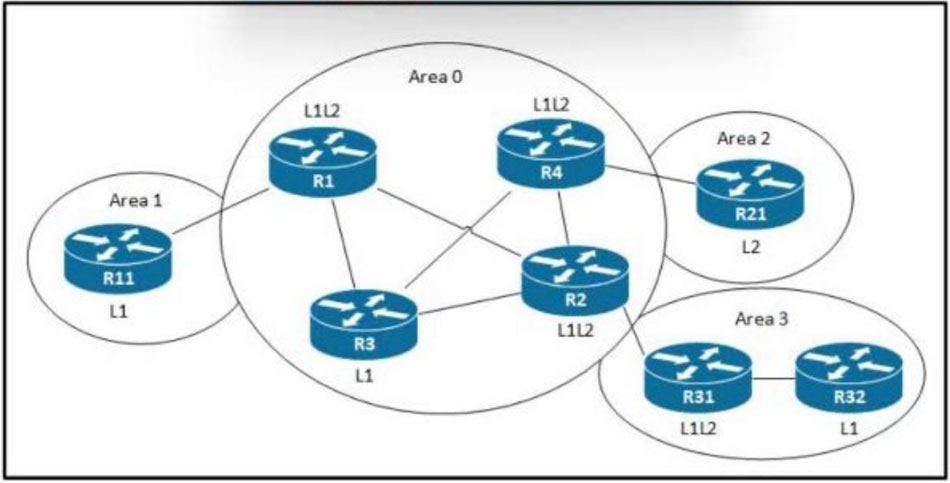
R3 must be made an L1/L2 router so that it can connect the Level 1 area to the Level 2 backbone. IS-IS uses a two-level hierarchy. Level 1 routers know the topology inside their local area, Level 2 routers form the backbone between areas, and Level 1/Level 2 routers provide the boundary between the two. A proper IS-IS backbone cannot have isolated Level 1-only routers positioned between L1/L2 routers that need to exchange interarea reachability. If the link failure exposed an area-continuity problem, converting R3 to L1/L2 gives the area an appropriate attachment point to the backbone and restores interarea forwarding behavior. Making an unrelated router Level 1 or Level 2 only would not necessarily create the required boundary function. Simply making Area 0 L2-only is also not the focused fix if the topology still lacks a correct L1/L2 transition point. The design principle is straightforward: every Level 1 area must have a dependable L1/L2 router through which traffic can reach destinations outside the area. Reference topics: IS-IS Level 1, Level 2 backbone, L1/L2 routers, interarea reachability, hierarchical IGP design.
Refer to the exhibit.
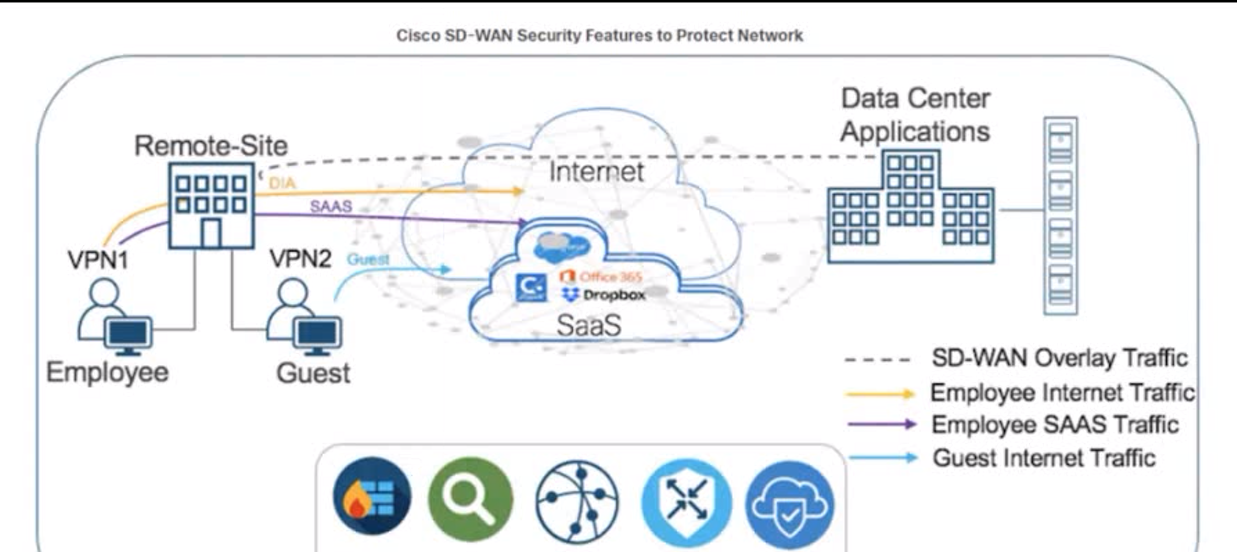
Refer to the exhibit. Which Cisco Catalyst SD-WAN security feature uses global threat intelligence and advanced sandboxing, and continuously analyzes file activity across an extended network?
The described SD-WAN security feature is Cisco Advanced Malware Protection. Cisco Catalyst SD-WAN security documentation identifies AMP as the component that uses global threat intelligence, file reputation, advanced sandboxing, real-time malware blocking, and continuous analysis of file activity across the extended network. That wording maps directly to the question. AMP focuses on detecting malicious files, analyzing unknown files, blocking threats, and performing retrospective analysis if a file is later determined to be malicious. An intrusion prevention system inspects traffic for exploit signatures and known attack behaviors; it does not primarily provide file sandboxing and retrospective malware analysis. Enterprise Firewall with Application Awareness delivers stateful firewall control and application visibility. DNS-layer security, commonly integrated through Cisco Umbrella, blocks threats based on DNS requests before connections are made. The feature that specifically combines global threat intelligence, sandboxing, and continuous file analysis is AMP. Reference topics: Cisco Catalyst SD-WAN security, Advanced Malware Protection, UTD, file reputation, file analysis, sandboxing.
When vEdge router redundancy is designed, which FHRP is supported?
When Cisco SD-WAN edge router redundancy is designed, VRRP is the supported first-hop redundancy protocol in the SD-WAN edge context. VRRP provides a virtual default gateway for LAN-side devices, allowing one WAN Edge router to act as the active gateway while another can take over if the active router or tracked condition fails. Cisco SD-WAN designs use VRRP with tracking and policy alignment so branch LAN traffic can fail over to the appropriate edge router while the SD-WAN overlay handles transport and tunnel selection. HSRP and GLBP are traditional campus first-hop redundancy protocols, but they are not the supported FHRP answer for vEdge router redundancy in this design context. OMP is the SD-WAN control-plane routing protocol used between WAN Edge routers and vSmart controllers; it is not a first-hop redundancy protocol for LAN hosts. Therefore, the correct FHRP for vEdge router redundancy is VRRP. The design should also ensure that VRRP priorities, tracking, and SD-WAN routing preferences align so traffic exits the intended edge during normal and failure conditions.

