
Salesforce Plat-Arch-204 Practice Exam Questions & Answers
Salesforce Plat-Arch-204 Exam Details
Key details for this exam, checked against the published exam outline
- Exam Code
- Plat-Arch-204
- Full Name
- Salesforce Certified Platform Integration Architect
- Issuing Body
- Salesforce
- Question Format (Our Bank)
- Multiple Choice
- Delivery
- Pearson VUE testing centers or online proctored
- Full Question Set
- 129 questions Get All Questions
Free Plat-Arch-204 Practice Questions
Each question shows the correct answer and an explanation of why it is right
Question 1 Domain 4 Design Integration Solutions
Northern Trail Outfitters must transmit order and line item data straight to an existing finance application web service once an order is fulfilled. Each order must arrive at the finance application exactly one time so that invoicing stays accurate. Which solution should an architect recommend?
Delivering each record exactly once while staying highly reliable in a critical finance integration calls for an asynchronous pattern that gives more control and error handling than standard @future methods. Queueable Apex is the approach an architect would favor for this scenario.
Queueable Apex has several advantages over @future methods:
Stateful tracking: Unlike @future, Queueable jobs return a Job ID, so the system can monitor progress and confirm completion.
Chaining: Jobs can be chained to handle records in sequence, which supports the integrity of order and line item data.
Complex Data Types: Queueables can accept complex objects as parameters, making it simpler to pass high-fidelity order data than the primitive types that @future requires.
Option A is unreliable because it depends on a person to perform retries, which invites mistakes and does not scale. Option C is less desirable because @future methods cannot be tracked as effectively and cannot return a Job ID for later tracking.
To ensure accurate invoicing, the architect should design the Queueable class with a custom error handling process that includes logging failures and a retry mechanism. In addition, to prevent duplicate invoicing, the finance application should include an Idempotency check (using a unique Order ID from Salesforce) so that if a retry is sent, the system recognizes the duplicate and does not create a second invoice. Combining Queueable Apex with idempotency provides the highest level of reliability for critical financial transactions.
Question 2 Domain 4 Design Integration Solutions
Northern Trail Outfitters must display shipping costs and estimated delivery times to its customers. The shipping services it relies on differ by region and have similar but not identical service request parameters. Which integration component capability should be used?
When an organization depends on multiple external service providers (such as regional shippers) with different API requirements, the most scalable design choice is an Enterprise Service Bus (ESB) or middleware layer. This scenario matches a typical 'Orchestration' and 'Transformation' use case.
An ESB is particularly strong at:
1. Routing and Mediation: The ESB can accept one uniform request from Salesforce ('Get Shipping Rates') and apply business rules to decide which regional carrier API to invoke.
2. Transformation: Each carrier probably uses its own XML or JSON structure. The ESB can convert the shared data model sent by Salesforce into the exact format needed by the selected shipper.
3. Protocol Bridging: When one shipper relies on SOAP and another on REST, the ESB absorbs these technical gaps so Salesforce only needs to work with one streamlined interface.
Option A (Apex REST) would oblige the Salesforce team to maintain custom code for each new shipping provider, resulting in significant technical debt and upkeep difficulties. Option C is wrong since an ESB is a back-end infrastructure component rather than a user interface tool.
Using an ESB allows Northern Trail Outfitters to separate Salesforce from the intricacies of each shipping provider's API. Under this 'Hub and Spoke' pattern, bringing in a new regional shipper later only calls for configuration inside the ESB instead of a full code release in Salesforce. This delivers the flexibility and architectural separation required for a global retail business.
Question 3 Domain 5 Build Solution
An organization records customer orders and must transmit them to the Order fulfillment system. End users do not need a confirmation response from the fulfillment system. Which system constraint question should the architect consider when designing this integration?
When a business process does not need immediate confirmation from a target system, the architecture can shift from a synchronous Request-Reply pattern to an asynchronous Fire-and-Forget pattern. In this change, the most important 'non-functional' requirement for the Integration Architect is to establish the acceptable latency.
Latency shapes the technology stack. If the fulfillment system must receive the order within seconds (Near Real-Time), the architect may pick Salesforce Outbound Messaging or a Flow-triggered Platform Event. If the order only has to arrive within 4-12 hours, a Batch ETL process is more efficient because it preserves API limits and handles much larger volumes more dependably.
Although address validation (Option B) is a functional requirement, it does not establish the architectural framework. Option C is a specific solution implementation question rather than a fundamental design constraint. By asking about latency, the architect pinpoints the time boundary between 'Data Entry' in Salesforce and 'Processing' in the fulfillment system. This answer directly drives the choice of pattern, the retry logic required, and the error-handling strategy needed to make sure the 'Order-to-Cash' cycle finishes successfully without slowing down the sales rep's productivity.
Get the complete Plat-Arch-204 question set
$20$40
Question 4 Domain 5 Build Solution
A media firm that operates on a subscription model has a system landscape that requires many subscribers to keep several accounts and sign in more than once. To enhance the subscriber experience, an Identity and Access Management (IAM) system that supports SAML and OpenId was recently deployed, offering self-registration and single sign-on (SSO). This IAM system must connect with Salesforce so that new self-service customers can gain immediate access to Salesforce Community Cloud.
Which requirement should Salesforce Community Cloud fulfill to support self-registration and SSO?
Question 5 Domain 5 Build Solution
A client is moving from a legacy platform to Salesforce and intends to connect every existing system that currently interacts with the legacy application. Which limitation or difficulty should an integration architect take into account when selecting the integration pattern/mechanism?
When designing an integration architecture for a legacy migration, the volume of data and the volume of processing are the main technical constraints that determine which integration pattern should be selected.
Salesforce operates as a multi-tenant environment governed by strict governor limits. Large amounts of data can rapidly use up synchronous request limits, API quotas, and storage allocations. An architect needs to assess the following:
Synchronous vs. Asynchronous: High-volume processing frequently calls for asynchronous patterns (such as Batch or Fire-and-Forget) so that user actions are not blocked and concurrent request limits are not reached.
Bulk vs. REST: When millions of records must be migrated or synchronized each day, the Bulk API is the only scalable option, since standard REST or SOAP APIs are not designed for very large datasets.
Data Persistence: Large volumes of read-only data may be better handled through Data Virtualization (Salesforce Connect) so that costly Salesforce storage is not consumed.
Although reporting (Option C) and multi-currency (Option B) are significant business requirements, they are functional configurations within Salesforce and have less influence on the technical 'plumbing' of the integration than volume does. By focusing first on volume and processing needs, the architect helps ensure the integration remains stable, performant, and able to scale as the business grows.
Question 6 Domain 4 Design Integration Solutions
An enterprise architect has asked the Salesforce integration architect to examine the following (refer to the diagram and description) and offer recommendations after weighing every constraint in the enterprise systems and the Salesforce Platform limits.
Several eligibility systems offering this service are hosted externally.34
Even so, their present response times may reach 90 seconds before processing finishes and a reply is returned.
These eligibility systems are reachable through APIs orchestrated by an ESB (MuleSoft).
Every request originating from Salesforce must pass through the customer's API Gateway layer, which enforces a rule of ending requests after 9 seconds.
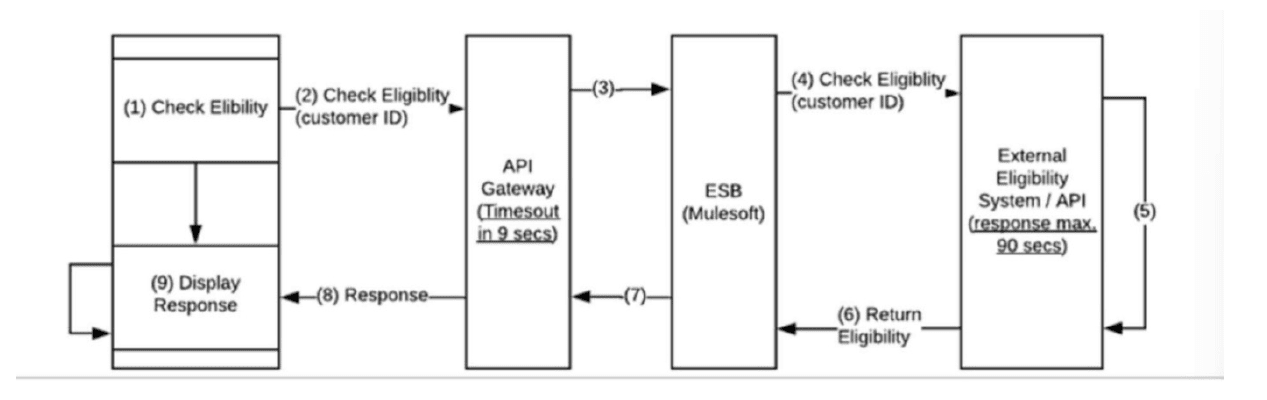
Which recommendation should the integration architect provide?
Question 7 Domain 3 Translate Needs to Integration Requirements
A security review found weaknesses in unmanaged packages, specifically that credentials such as usernames, passwords, and OAuth tokens are kept as clear text. Which storage mechanisms should an integration architect mandate to guarantee that secrets are shielded from intentional or accidental disclosure?
Question 8 Domain 4 Design Integration Solutions
Salesforce serves as the system of record for customer data. UC intends to use middleware to connect Salesforce with external systems (ERP, ticketing, data lake). UC needs changes made to records in Salesforce to be applied to the correct external system, and changes made in those external systems to be applied to the correct Salesforce records. Which solution should an integration architect recommend?
Multi-system environments require a strong Identity Mapping approach to keep data synchronized. Salesforce's standard architectural guidance is to store the unique identifiers from each secondary system in External ID fields.
When the ERP ID, Ticketing ID, and Data Lake ID are saved as External IDs in Salesforce, the middleware can run upsert operations without first querying Salesforce for its internal ID. This lowers the number of API calls and simplifies the integration logic. Likewise, when Salesforce sends a change to the ERP, it includes the stored ERP ID, so the ERP can immediately locate the correct target record.
Option B (caching at the middleware) is a high-maintenance 'anti-pattern' that creates a new point of failure if the cache falls out of sync with the actual systems. Option C (Change Data Capture) is a mechanism for notifying systems of changes, but it does not address the underlying identity mapping problem. External IDs provide a stable, searchable, and performant cross-reference, which is the foundation of any successful 'hub-and-spoke' integration architecture.
What the Salesforce Plat-Arch-204 Exam Covers
Exam domains verified against the Official Salesforce Plat-Arch-204 exam guide, last checked November 2026.
Domain 1 Evaluate the Current System Landscape
8%Map existing systems to identify standards, protocols, and boundaries that will affect your integration design. Look for authentication mechanisms, data formats, and API availability across the current infrastructure.
Domain 2 Evaluate Business Needs
11%Extract functional and non-functional requirements from use cases, then classify data by sensitivity level. Consider CRM adoption factors, scalability needs, and regulatory constraints that shape the integration approach.
Domain 3 Translate Needs to Integration Requirements
22%Build system inventories and document integration patterns. Define performance targets and security rules, matching business processes to concrete technical constraints and response time requirements.
Sample question from this domain above Q7
Domain 4 Design Integration Solutions
28%Select integration patterns that fit the business problem. Choose appropriate Salesforce APIs and define components, then articulate the trade-offs and limitations of your proposed design.
Domain 5 Build Solution
23%Implement APIs as both provider and consumer. Design outbound calls, error handling, security mechanisms, and resilience strategies for production stability and system updates.
Domain 6 Maintain Integration
8%Set up performance monitoring, error escalation procedures, and recovery workflows. Define reporting requirements and rollback plans to keep integrations running smoothly after deployment.
Plat-Arch-204 Exam FAQ
Common questions about the exam itself
How much harder is Plat-Arch-204 than other Salesforce certifications?
What background do I need before attempting Plat-Arch-204?
Which objective area in Plat-Arch-204 do most candidates struggle with?
How long does realistic preparation for Plat-Arch-204 take?
What happens on exam day for Plat-Arch-204?
Can I retake Plat-Arch-204 if I fail, and how long do I have to wait?
How long does a Salesforce Platform Integration Architect certification stay valid?
What job roles does Plat-Arch-204 prepare you for?
How does Plat-Arch-204 relate to other Salesforce architect exams?
Does Plat-Arch-204 assume I know specific Salesforce products like MuleSoft or Heroku?
Other Salesforce Exams
Free practice questions for more Salesforce certification exams