
HP HPE7-A10 Practice Exam Questions & Answers
HP HPE7-A10 Exam Details
Key details for this exam, checked against the published exam outline
- Exam Code
- HPE7-A10
- Full Name
- HPE Network Security Expert Written Exam
- Issuing Body
- HPE / Hewlett Packard Enterprise
- Official Exam Fee
- USD 350 / USD 195
- Delivery
- Proctored, delivered through Pearson VUE
- Eligibility
- 4-5 years of networking experience with 2-3 years in security-focused fields recommended
- Full Question Set
- 75 questions Get All Questions
Free HPE7-A10 Practice Questions
Each question shows the correct answer and an explanation of why it is right
Question 1 Domain 2 Analyze
A hospital uses an AOS-10 architecture managed through HPE Aruba Networking Central. The customer has deployed a pair of HPE Aruba Networking 9000 Series gateways with Security licenses at every clinic. The gateways run IDS/IPS in IDS mode.
The Security Dashboard displays several recent events with the same signature, as shown below:
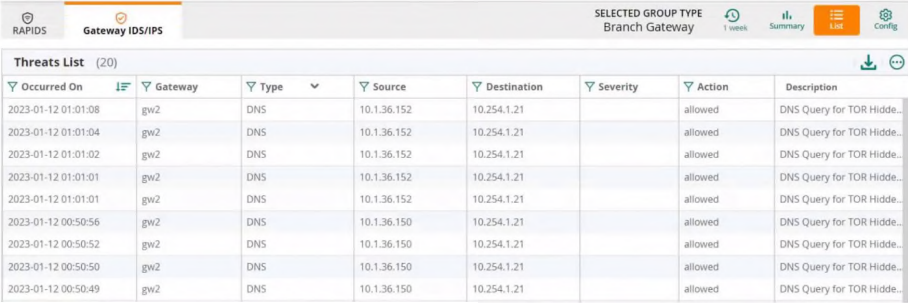
Occurred On: 2023-01-12 | Gateway: gw2 | Type: DNS | Source: 10.1.36.152 | Destination: 10.254.1.21 | Action: allowed | Description: DNS Query for TOR Hidden...
Which action could provide valuable context about the incident?
The Gateway IDS/IPS engine in HPE Aruba Networking Central flags suspicious network activity---such as DNS queries resolving Tor hidden services (.onion)---based on Layer 3--7 signature inspection. However, raw IP addresses alone (e.g., 10.1.36.152) provide insufficient operational context to determine whether an endpoint is a compromised corporate workstation, a malicious guest, or a specialized medical device exhibiting anomalous behavior.
Navigating to the Client Profile in HPE Aruba Networking Central provides comprehensive AI-driven telemetry, detailing the device's profiled category, hardware family, operating system, and MAC vendor. This contextual visibility allows security analysts to immediately understand the device function. For instance, discovering that the IP belongs to an embedded medical device or nurse call station signifies potential malware infection or high-risk compromise, whereas a guest mobile phone requires an entirely different incident response workflow. Viewing AP user tables or RAPIDS provides radio-frequency and rogue AP data, which does not illuminate endpoint identity and role context.
Question 2 Domain 1 Protect and Defend
A customer has an AOS-10 architecture managed by HPE Aruba Networking Central. HPE Aruba Networking infrastructure devices authenticate clients through an HPE Aruba Networking ClearPass cluster.
In HPE Aruba Networking Central, you are reviewing network traffic flows for a wireless IoT device categorized as a ''Raspberry Pi'' client. You observe SSH traffic. You then inspect several additional wireless IoT clients and find that they are also sending SSH traffic.
Refer to the scenario.
You are assisting the customer in evaluating ways to mitigate the potential threat detected. One possible option has been identified: add a rule to the clients' AOS user role that matches SSH traffic and applies denylisting.
What is one benefit of this option?
The Policy Enforcement Firewall (PEF) on HPE Aruba Networking gateways and APs supports dynamic client containment via the `deny-and-blacklist` (or denylist) firewall action. When an access control rule configured with the denylist action matches suspicious traffic (such as an unauthorized SSH session from an IoT endpoint), the gateway or AP immediately places the client's MAC address into the dynamic denylist cache.
While placed on the denylist, all incoming and outgoing frames from that client are dropped at the hardware radio/port level. Crucially, the denylist timer is dynamic and configurable (defaulting to 3600 seconds/1 hour, or adjustable to a shorter penalty duration). Once the penalty timer expires, the client is automatically purged from the denylist and permitted to re-associate. If administrators have remediated the host so that it no longer transmits anomalous SSH packets, the client continues normal operation without requiring manual administrative intervention in the management GUI.
Question 3 Domain 3 Forensics
Refer to the exhibit.
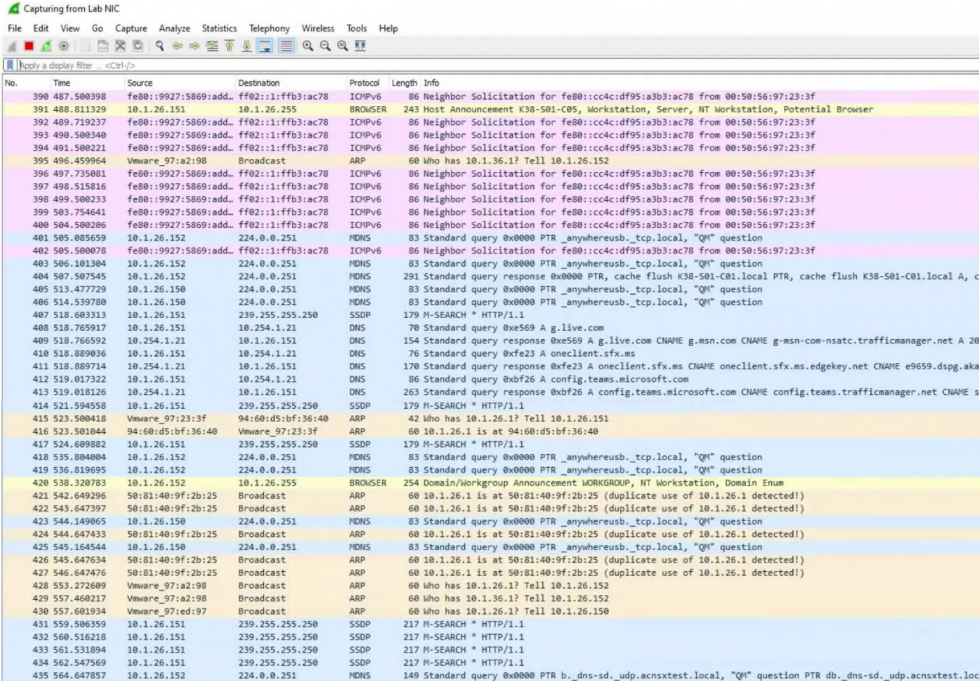
Frame 421: 50:81:40:9f:2b:25 -> Broadcast ARP 60 10.1.26.1 is at 50:81:40:9f:2b:25 (duplicate use of 10.1.26.1 detected!)
Frame 422: 50:81:40:9f:2b:25 -> Broadcast ARP 60 10.1.26.1 is at 50:81:40:9f:2b:25 (duplicate use of 10.1.26.1 detected!)
Frame 424: 50:81:40:9f:2b:25 -> Broadcast ARP 60 10.1.26.1 is at 50:81:40:9f:2b:25 (duplicate use of 10.1.26.1 detected!)
Which device should be documented as potentially malicious and requiring further investigation?
The Wireshark packet capture exhibit highlights repeated unsolicited gratuitous ARP broadcasts containing packet expert analysis warnings: `duplicate use of 10.1.26.1 detected!`
IP address `10.1.26.1` is the authorized default gateway for the subnet segment. In Frames 421, 422, and 424, hardware MAC address `50:81:40:9f:2b:25` is actively broadcasting ARP replies asserting that it owns the default gateway IP address `10.1.26.1`.
This behavior is a primary indicator of Layer 2 ARP Cache Poisoning (ARP Spoofing). An attacker or rogue device attempts to corrupt the ARP tables of adjacent edge hosts and switches by mapping the gateway's IP to the attacker's own MAC address, positioning the rogue device as a man-in-the-middle to intercept, inspect, or tamper with egress traffic. MAC address `50:81:40:9f:2b:25` is the physical source generating these spoofed frames and must be immediately tracked down, isolated, and documented for incident remediation.
Get the complete HPE7-A10 question set
$20$40
Question 4 Domain 1 Protect and Defend
You want to use HPE Aruba Networking ClearPass Device Insight tags as conditions in CPPM role-mapping or enforcement-policy rules.
Which guidelines should you follow?
When ClearPass Device Insight (CPDI) integration is enabled within ClearPass Policy Manager under Server Configuration, CPPM establishes automated synchronization with the cloud telemetry engine.
Device Insight classification tags---including machine learning clusters, user-defined tags, and risk tags---are ingested directly into ClearPass Policy Manager's internal endpoint dictionary schema. Within the ClearPass policy engine (across Service Rules, Role Mapping Rules, and Enforcement Policy Rules), these synchronized attributes are exposed under the standard `Endpoint` namespace (e.g., `Endpoint:Device Insight Tag`).
Because the `Endpoint` namespace is natively exposed to the policy engine for the connecting client MAC address, administrators do not need to add the Endpoints Repository as a secondary authorization source or configure external HTTP REST sources to HPE Aruba Networking Central. Selecting `Endpoint` as the condition type evaluates the synchronized Device Insight tags within policy conditions.
Question 5 Domain 2 Analyze
You are helping a developer create a custom NAE script for an AOS-CX switch. What information might you need to provide so the developer can define the parameters correctly?
The Aruba Network Analytics Engine (NAE) framework separates monitoring logic from operational configuration by allowing developers to write generalized Python scripts that can be instantiated into multiple distinct NAE agents.
To make an NAE script adaptable across different switch roles, access layers, or monitoring points, developers utilize the `ParameterDefinitions` dictionary within the NAE manifest. Parameters define input variables---such as specific interface identifiers, utilization thresholds, target RADIUS server IPs, or BGP autonomous system numbers---that operators configure during agent creation.
To define these parameters accurately, the developer requires input on which operational values must be adjusted on a per-agent basis. This ensures the script provides the necessary input types, default values, and validation boundaries. Actions, Solution Exchange tags, and global switch hardware limits do not govern parameter dictionary construction.
Question 6 Domain 1 Protect and Defend
You are configuring gateway IDS/IPS settings in HPE Aruba Networking Central.
Why would you set the Fail Strategy to Bypass?
On HPE Aruba Networking Branch and Campus Gateways, the Gateway IDS/IPS subsystem executes inline deep packet inspection (DPI) and signature matching using a dedicated software container engine. The Fail Strategy configuration parameter governs the forwarding plane behavior in the catastrophic event that the IPS inspection engine experiences a failure, software crash, internal timeout, or severe memory/processing exhaustion.
ArubaOS provides two operational fail strategies:
Block (Fail-Closed): If the IPS engine fails or becomes unresponsive, all traffic requiring inspection is dropped. This ensures maximum security but risks severe service disruption during engine faults.
Bypass (Fail-Open): If the IPS engine fails or is unable to process incoming packets, the gateway bypasses the inspection pipeline, forwarding packets directly through standard routing and firewall switching paths without deep threat inspection.
Setting the Fail Strategy to Bypass prioritizes business continuity and network availability over strict security enforcement, preventing network downtime in the event of an IPS engine fault.
Question 7 Domain 1 Protect and Defend
You are entering the following command on an AOS-CX switch:
radius-server host clearpass.example.com tls clearpass-username clearpass-password plaintext
Which credentials should you enter for clearpass-username and clearpass-password?
In AOS-CX switches utilizing Dynamic Segmentation and Downloadable User Roles (DUR), client authentication occurs via standard RADIUS, but the actual retrieval of the role definition, classes, and policy ACLs is performed out-of-band via secure RESTful HTTPS API calls back to ClearPass Policy Manager.
When configuring the switch to communicate with ClearPass for downloadable user roles, the radius-server host
ClearPass Policy Manager implements granular role-based administrative privilege controls. Best practice mandates creating an administrative service account in CPPM assigned the restricted administrative privilege profile: HPE Aruba Networking Role Download. These credentials permit the switch to authenticate over HTTPS and download the compiled role configuration without granting broader administrative rights to modify ClearPass policies, server configurations, or user repositories. These credentials are distinct from the RADIUS shared secret or RadSec TLS certificates.
Question 8 Domain 2 Analyze
A customer uses an AOS-10 architecture that includes HPE Aruba Networking APs. Administrators recently enabled WIDS at the High level and also enabled alerts and email notifications for several events.
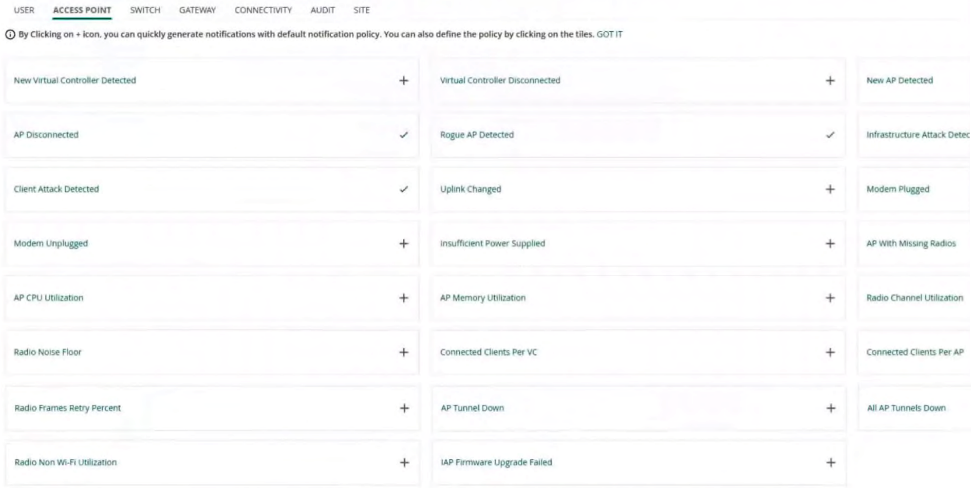
Administrators report receiving so many emails that they must ignore them and are considering disabling all notifications. What is one step you could recommend trying first?
In HPE Aruba Networking Central, configuring Wireless Intrusion Detection System (WIDS) at the High profile enables every available client and infrastructure detection signature. In real-world enterprise environments, aggressive signature sets (such as frame flood detectors, sequence number jumps, and client disconnect thresholds) generate frequent false positives caused by client driver bugs, background roaming, and RF noise. When paired with automated email alerting, this causes alert fatigue, often leading administrators to ignore alerts entirely.
Disabling critical alert classes (such as Rogue AP or Client Attack notifications) removes core defense-in-depth controls. The architecturally sound remediation is to transition the WIDS policy from the pre-packaged "High" profile to the Custom profile.
Under the Custom policy, security teams maintain granular control over individual detection engines. Administrators can disable high-noise, low-fidelity checks (such as EAP handshake timeouts or rate anomaly detection) while keeping high-confidence, actionable threat signatures enabled (such as AP spoofing, rogue AP detection, and evil twin attacks). This eliminates false alarms while preserving visibility into actionable threats.
What the HP HPE7-A10 Exam Covers
Exam domains verified against the Official HP HPE7-A10 exam guide, last checked November 2026.
Domain 1 Protect and Defend
58%Candidates apply forensic techniques and implement Zero Trust Security using Aruba solutions that work with third-party tools. They map Aruba solutions to local compliance requirements. They define PKI best practices and set up certificate-based authentication. Device profiling and risk scoring help measure security efforts. Candidates implement threat hunting and role-based access control. They design detection strategies for rogue wireless devices using Aruba WIPS features.
Domain 2 Analyze
38%Candidates analyze logs, alerts and other data at expert level to detect threats and decide how to fix security risks. They tune alerts to reduce false positives. They design workflows for Network Analytic Engine script development. Candidates implement endpoint classification and device profiling with CPDI, including profiling in Central Network Operations. They integrate CPDI and CPPM to use device profiling data, then tune policies and respond to vulnerabilities or threats.
Domain 3 Forensics
4%Candidates perform comprehensive threat analysis within a set timeframe. They organize and deliver the findings from their analysis.
Sample question from this domain above Q3
HPE7-A10 Exam FAQ
Common questions about the exam itself
What experience do I need before taking HPE7-A10?
How hard is HPE7-A10 compared to other Aruba exams?
What is the Analyze domain and why is it tough?
How long should I study for HPE7-A10?
What happens on exam day for HPE7-A10?
What if I fail HPE7-A10, and can I retake it?
How long is HPE7-A10 certification valid?
What job role does HPE7-A10 prepare me for?
How does HPE7-A10 fit into the Aruba certification track?
Does HPE7-A10 require a prerequisite certification?
Other HP Exams
Free practice questions for more HP certification exams