
CIPS L6M8 Practice Exam Questions & Answers
CIPS L6M8 Exam Details
Key details for this exam, checked against the published exam outline
- Exam Code
- L6M8
- Full Name
- Innovation in Procurement and Supply
- Issuing Body
- CIPS (Chartered Institute of Procurement & Supply)
- Delivery
- Computer-based at CIPS exam venues
- Full Question Set
- 120 questions Get All Questions
Free L6M8 Practice Questions
Each question shows the correct answer and an explanation of why it is right
Question 1 Domain 1 Understand techniques for supplier development
The cost of switching and the scarcity of resources affects which of the following relationship-influencing Key Performance Indicators?
This influences power as these factors affect the level of dependency of the buyer on the supplier. There are 6 relationship-influencing KPIs; transparency, co-operation, trust, power, commitment and co-operation. P.72-73
Domain: 1.4
Question 2 Domain 2 Understand methods to achieve procurement and supply improvement and innovation
Cloud computing provides organisations with the ability to store and process data using a third-party data centre. Which of the following are benefits to an organisation of using this technology? Select all that apply
The correct answers are 3 and 4. This is from p. 61. Cloud computing is storing data on a server that everyone in the organisation can access, from any device. It may require a password. The storing of data doesn't mean purchasing costs are lower, or that risks are reduced or staff are happier- it's just a place you keep your information. It's reported there's a few questio ns on cloud computing in the exam, including different types of cloud computing (public vs private vs hybrid)- see this website for further reading as this isn't covered in the study guide https://www.hpe.com/uk/en/what-is/hybrid-cloud.html?jumpid=ps_uizhwjdib_aid-520061468&ef_id=ffb856c12477145a6edd3471b13a0d80:G:s&s_kwcid=AL!13472!10!81157808966112!81157931525233
Domain: 1.3
Question 3 Domain 2 Understand methods to achieve procurement and supply improvement and innovation
Which of the following types of forecasting would use a line of best fit, and algorithms and data trees to improve accuracy?
This is demand forecasting. The line of best fit is used when plotting data on a graph- you plot time on one axis and sales on the other- the line of best fit finds the corelation between the two and this is your demand forecast. See p. 97 for an example. P.98 talks about improving the accuracy of demand forecasting through the use of algorithms and data trees.
Domain: 2.1
Get the complete L6M8 question set
$20$40
Question 4 Domain 3 Understand the environmental factors which affect supply chain improvement and innovation
Pink Leaf Inc is attempting to make its products more eco-friendly. Which of the following areas would be a good idea for Pink Leaf to focus on?
Design for Disassembly is the only option mentioned that would ensure the products are more eco-friendly. This is discussed on p. 199. Attaining ISO14001 doesn't make products more green- or even ensure that the company is green- all it shows is that you look at environmental performance on a regular basis. This is one of the 'downsides' to the Standard. The other two answers are incorrect because you would want a low ecological rucksack (total amount of material required to make the product) and a low embodied energy (the amount of energy required to make the product). See p.204 for more on that.
Domain: 3.1
Question 5 Domain 3 Understand the environmental factors which affect supply chain improvement and innovation
Which of the following ISO Standards can a company NOT be certified against?
You cannot be certified against 20400. This is the Sustainable Procurement Standard and is for guidance only- you can't get a certificate for this one. P. 214
Domain: 3.1
Question 6 Domain 1 Understand techniques for supplier development
Mohammed has recently been hired as the new CEO of ABC Ltd, a large manufacturing organisation. The organisation has struggled in recent years due to the highly competitive nature of the marketplace and Mohammed has been brought in to radically change the organisation's approach to procurement and supply chain management.
Traditionally the organisation has dictated its requirements to suppliers with stringent penalty clauses for non-compliance. Mohammed is keen to change this approach and leverage the knowledge of suppliers to ABC's advantage.
XYZ is the main supplier to ABC Ltd and Mohammed has set up a meeting to discuss the relationship and contract currently in place. He wishes the relationship to be win-win and wishes to share ideas on potential efficiencies that can be gained for both organisations. He will propose a new mechanism for monitoring the performance of the contract based on four key parameters; cost, customer satisfaction, innovation and operational processes.
XYZ provides raw materials such as iron and steel and Mohammed is keen to gain an understanding of the environmental impact of the extraction, transportation and usage of these materials, the findings of which will impact the company's mission statement, which will be re-written next year.
In terms of other suppliers, where spend is minimal and risk is low, Mohammed plans to introduce Standard Operating Procedures for the procurement of supplies and is looking into various tools which will save the procurement team time and money.
What form of relationship is Mohammed seeking to have with XYZ Ltd?
This is a partnership as he's seeking a 'win win' relationship. It is not a joint venture- this is when two organisations work together equally on a new project. LO 1.4
Domain: Scenario
Question 7 Domain 3 Understand the environmental factors which affect supply chain improvement and innovation
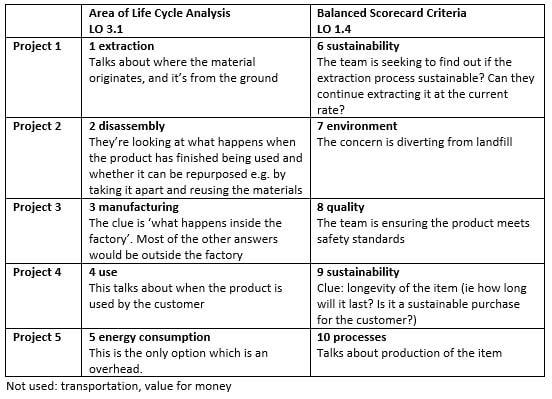
TGY Ltd is a manufacturing organisation which produces five major components for use in the transport sector. Each component is produced by a different Project Team. Below are details of the five projects.
Project 1: The team are looking at where the material originates and how much of this natural resource is left in the ground.
Project 2: The team are focused on what happens when the product is no longer required by the customer and whether the product can be repurposed to save it going to landfill.
Project 3: The team are keen to ensure the customer is happy with the product and that it meets safety standards. The focus of the Life Cycle Analysis is on what happens inside the factory.
Project 4: The team are looking at the longevity of the item once purchased by the customer.
Project 5: The team are exploring the additional overhead costs associated with the production of the item and the way in which the item is produced.
Complete the table below by listing the area of life cycle analysis being looked at, and the area of the Balanced Scorecard this relates to (some options may be used twice); energy consumption, use, disassembly, extraction, manufacturing, transportation, sustainability x2, quality, environment, value for money, processes.

Which of the following will you put into box 9?
The correct answers are as follows:
Question 8 Domain 1 Understand techniques for supplier development
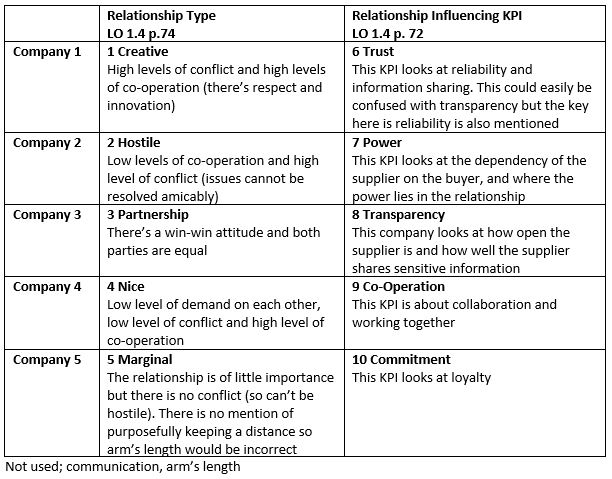
Below are details of five companies who all have different types of relationships with their suppliers. For each company, select the corresponding relationship type and the main relationship- influencing KPI monitored by the company.
Company 1: The relationship is characterised by high levels of conflict, but is one in which there is mutual respect for each other's ideas and innovative solutions are often formed from the conflict. This KPI is measured by the level of information sharing between the buyer and supplier and the level of reliability of both parties.
Company 2: There is a low level of co-operation between Company 2 and its main supplier. The contract is not expected to last much longer due to conflicts that cannot be resolved amicably. There is a low level of dependency on the supplier and a number of alternative providers in the marketplace.
Company 3: The relationship is characterised by a win-win approach and both parties consider themselves equal. The relationship is measured based on its openness, honesty and levels of information sharing, particularly in the disclosure of sensitive information.
Company 4: Company 4 works well with their supplier and there is little conflict. The relationship is important due to the high value of the contract and the two parties work together to meet the same goals. The KPI measures the exchanges and levels of collaboration between the parties.
Company 5: The supplier does not place much importance on the relationship with Company 5 due to the low value of the contract. Company 5 is worried that the supplier is not willing to invest in the contract and therefore are measuring the loyalty of the supplier as a KPI.
Complete the table below with the correct relationship type and relationship influencing KPI: nice, creative, marginal, hostile, partnership arm's length, power, trust, co-operation, communication, commitment, transparency.

Which of the following will you put into box 5?
The correct answers are as follows:
What the CIPS L6M8 Exam Covers
Exam domains verified against the Official CIPS L6M8 exam guide, last checked November 2026.
Domain 1 Understand techniques for supplier development
You need to assess how different functions work together to improve the supply chain. Evaluate techniques that encourage innovation in procurement and supply. Compare how different technologies can be used to enhance supply chains. Also understand how relationship assessment helps with supplier development.
Domain 2 Understand methods to achieve procurement and supply improvement and innovation
Learn where technology fits into improving procurement and supply operations. Evaluate the tools and techniques available to make these areas better. Assess the methods used to encourage improvement and innovation from suppliers and partners.
Domain 3 Understand the environmental factors which affect supply chain improvement and innovation
Understand how environmental factors influence supply chain improvement and innovation. Assess approaches to environmentally sensitive design. Evaluate how green procurement affects improvement and innovation in the supply chain.
L6M8 Exam FAQ
Common questions about the exam itself
What background do I need before taking L6M8?
How is L6M8 different from the other elective modules at Level 6?
How long should I spend preparing for L6M8?
What format is the L6M8 exam?
What score do I need to pass L6M8?
Can I resit L6M8 if I don't pass first time?
Which jobs need the L6M8 certification as part of Level 6?
What happens to my Level 6 certification if I don't use it?
How does L6M8 relate to the core modules in Level 6?
Is innovation in procurement a difficult topic to study?
Other CIPS Exams
Free practice questions for more CIPS certification exams