NetApp NS0-184 Practice Exam Questions & Answers
6 Free Questions
· Last reviewed: September 24, 2026
· Prepared & Reviewed by the ValidExamDumps Editorial Team
Exam Facts
NetApp NS0-184 Exam Details
Key details for this exam, checked against the published exam outline
60
Practice Questions (Our Bank)
90 minutes
Exam Duration
- Exam Code
- NS0-184
- Full Name
- NetApp Certified Storage Installation Engineer, ONTAP
- Issuing Body
- NetApp
- Question Format (Our Bank)
- Multiple Choice
- Delivery
- Pearson VUE test centre or online with OnVUE
- Eligibility
- Six to 12 months hands-on experience with NetApp ONTAP solutions recommended. It is recommended (but not required) to first achieve NetApp Certified Data Administrator (NCDA) certification.
- Validity
- 2 years
Practice Questions
Free NS0-184 Practice Questions
Each question shows the correct answer and an explanation of why it is right
VA
ValidExamDumps Editorial Team
Every question and its answer is checked by our NS0-184 exam
preparation team, who also write the explanation shown with each one.
How we research and review these pages
Your customer is migrating data from a legacy FAS8020 system that runs ONTAP 9.5 software to a new AFF A250 MetroCluster over IP configuration.
In this scenario, which two methods would be supported to migrate the data? (Choose two.)
Correct Answer:
A, D
Explanation
When migrating from legacy systems to new hardware like MetroCluster, two supported approaches are controller swap and SnapMirror replication. A controller swap moves the identity and data directly to new hardware, preserving the system configuration. SnapMirror creates a copy between systems, allowing data replication with minimal disruption. Other migration methods like disk movement or cable conversion are not suitable for this hardware transition scenario.
Click the Exhibit button.
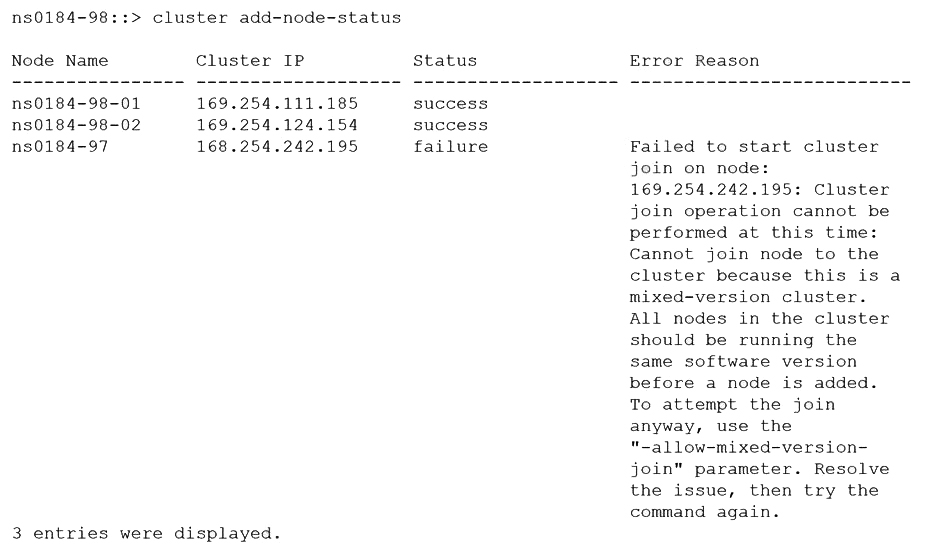
You are attempting to add a new ONTAP 9.7 node to your ONTAP 9.8 NetApp cluster. After attempting to add the node, it fails as shown in the exhibit.
What are two nondisruptive ways to add the new node to your ONTAP cluster? (Choose two.)
Correct Answer:
C, D
Explanation
Adding a node with different ONTAP versions requires matching versions or using a mixed-version parameter. Upgrading the new node to match the cluster's ONTAP 9.8 is the cleanest approach. Alternatively, the -allow-mixed-version parameter lets you add the node as-is without immediate upgrade. Downgrading the cluster or replacing hardware are disruptive and unnecessary.
You want to enable secure communication with the SP or BMC through CA-signed certificates.
Which two certificate types must be installed in this scenario? (Choose two.)
Correct Answer:
B, C
Explanation
Secure SP or BMC communication with CA-signed certificates requires both a server certificate and a root CA certificate. The server certificate authenticates the SP or BMC itself to clients. The root CA certificate allows clients to verify that the server certificate is legitimate and issued by a trusted authority. Without either certificate, the chain of trust cannot be established.
You are deploying a new AFF All SAN Array A250 into a customer's existing data fabric.
In this scenario, which two tools would give insight into their existing Cisco MDS fabric configuration? (Choose two.)
Correct Answer:
B, C
You have a 2-node FAS8300 switchless ONTAP 9.8 cluster that serves NAS volumes. You have a data SVM that connects to the network using multimode LACP with VLAN tags.
In this scenario, which front-end FAS8300 network port would you create the data LIFs?
Correct Answer:
B
Explanation
In a switchless FAS8300 cluster, data LIFs for LACP with VLAN tags must use appropriate ports. Port e0e is a data port on the FAS8300 that can be configured for multimode LACP connections with VLAN tagging. Cluster ports like e0a are reserved for node-to-node communication and cannot be used for data traffic. Management ports are separate from data ports.
A customer is asked to install a new AFF ASA A700 system. During the installation, the customer asks if ONTAP 9.8 is supported with their host's OS version running Windows 2016.
In this scenario, which NetApp tool would verify supportability?
Correct Answer:
A
Explanation
ONTAP System Manager is the primary NetApp tool for verifying system supportability including OS compatibility. It provides real-time access to interoperability matrices and support information. Active IQ is a monitoring and analytics tool. The installation documentation or NetApp website can provide basic info, but System Manager gives the most authoritative and current compatibility verification during installation planning.
Full Access
Get the complete NS0-184 question set
- 60 questions covering all exam domains
- Correct answers with explanations, like the free questions above
- PDF and online practice test
- 90 days of free updates
Domain 1: Basic Installation Topics and Tools
Covers the required tools and documentation needed for preparing a new ONTAP cluster installation. Candidates learn about the physical cabling requirements and procedures for connecting ONTAP nodes, which form the foundation for successful deployment.
Sample question from this domain above:
Q3
Domain 2: ONTAP Concepts
Addresses core ONTAP knowledge including how to identify and manage cluster controller components, create and configure aggregates, and execute the steps required for cluster installation or expansion. Also covers ONTAP software updates and lifecycle management.
Sample question from this domain above:
Q2
Domain 3: ONTAP Networking
Focuses on configuring ONTAP system networking and identifying the different network types used within ONTAP clusters. Candidates learn how to set up network connectivity to ensure proper cluster operation and inter-node communication.
Sample question from this domain above:
Q5
Domain 4: ONTAP Switches
Covers the cabling requirements for switched cluster configurations and identifies the software tools needed to configure cluster switches. This domain ensures candidates understand how to properly set up network infrastructure for ONTAP clusters.
Domain 5: ONTAP Configuration
Addresses practical configuration tasks including adding or removing nodes from an ONTAP cluster, setting up cluster peering for disaster recovery and data replication, and implementing security hardening measures. Also covers identifying support resources for troubleshooting installations.
Sample question from this domain above:
Q1
Domain 6: Customer Handoff
Focuses on the transition of a completed ONTAP installation to the customer, including tools available to validate installation correctness and processes for formal handover. Candidates learn how to create proper documentation and ensure customer readiness for cluster management.
Sample questions from this domain above:
Q4Q6
FAQ
NS0-184 Exam FAQ
Common questions about the exam itself
What work experience do I need before taking NS0-184?
NetApp recommends six to 12 months of hands-on experience with ONTAP solutions, including setting up, configuring, installing, testing, and troubleshooting NetApp storage systems. While not required, achieving the NetApp Certified Data Administrator (NCDA) certification first is recommended to build foundational knowledge.
How difficult is the NS0-184 exam compared to other NetApp certifications?
NS0-184 is a professional-level certification that tests practical installation and configuration skills. It assumes intermediate knowledge of storage concepts and requires hands-on experience, making it moderately challenging for those without prior ONTAP exposure. Most candidates find ONTAP Networking and ONTAP Switches domains require the most focused study.
How long should I prepare for NS0-184?
Preparation time varies based on your existing ONTAP experience. Candidates with six to 12 months of hands-on experience typically need four to eight weeks of focused study covering the exam domains. Those without prior ONTAP experience should plan for longer preparation and consider taking ONTAP training courses first.
What does exam day involve for NS0-184?
The exam is 90 minutes long with 60 scenario-based questions delivered through Pearson VUE either at a test centre or online via OnVUE. You will need a valid government ID to check in. Online testing requires a suitable workspace, webcam, and stable internet connection, with test center testing requiring only a computer with standard peripherals.
What topics do candidates find most challenging on NS0-184?
The ONTAP Networking and ONTAP Switches domains often require the most preparation because they involve practical cabling knowledge and software configuration concepts that vary based on cluster design. Hands-on lab experience with cluster network configuration helps significantly with these areas.
How long is my NetApp Certified Storage Installation Engineer certification valid?
NetApp certifications remain valid for two years from the date they are granted. After two years, the certification expires and you must retake the NS0-184 exam to recertify. There is no renewal process by exam or continuing education.
Can I retake NS0-184 if I don't pass on the first attempt?
Yes, NetApp allows retakes. You must reschedule with Pearson VUE according to their policies, which typically require advance notice for cancellation or rescheduling. Each exam attempt requires a separate exam fee.
How does NS0-184 relate to other NetApp storage certifications?
NS0-184 is designed for installation engineers and assumes foundational knowledge tested in the NetApp Certified Data Administrator (NCDA) exam. After NS0-184, candidates often pursue advanced certifications like NetApp Certified Hybrid Cloud Architect or specializations in FlexPod or data protection.
What job roles should take the NS0-184 exam?
NS0-184 targets storage installation engineers, system administrators, and technical professionals responsible for deploying and configuring ONTAP storage systems in customer environments. It validates expertise needed for roles that handle new cluster installations, expansions, and initial configuration.
What tools do I need to study for ONTAP Networking and ONTAP Concepts domains?
NetApp recommends hands-on experience with ONTAP cluster setup and configuration. Access to NetApp training courses, official documentation, and ideally a lab environment with ONTAP systems helps significantly. Official NetApp training materials and practice exams aligned with exam objectives are the most effective study resources.

