Key details for this exam, checked against the published exam outline
Each question shows the correct answer and an explanation of why it is right
Which statement is correct when deploying an HPE Zerto DR solution where an Extended Journal Copy is required with a one-year retention period?
Detailed Explanatio n:
Rationale for Correct Answe r:
Zerto Extended Journal allows retention up to one year by integrating with secondary storage like HPE StoreOnce. Short-term journals (seconds to days) reside on primary replication storage, while long-term copies (weeks/months/years) are offloaded to StoreOnce for cost-efficient retention.
Distractors:
A: No separate license is required --- it is a standard Zerto feature when integrated.
C: Extended Journals can be sourced from production or target, depending on setup; not ''always'' target.
D: Incorrect --- Zerto supports >30 days retention with Extended Journal.
Key Concept: Zerto + HPE StoreOnce for long-term DR retention.
Refer to the exhibit.
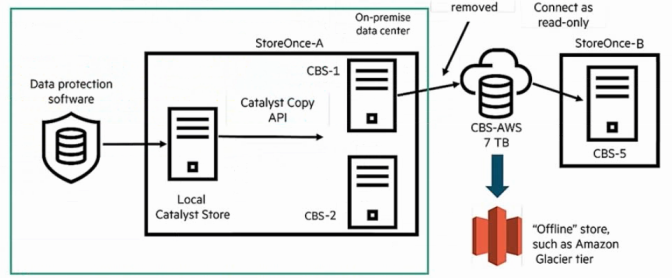
A junior engineer is expanding a StoreOnce deployment for a law firm with a hybrid environment. The customer already has Veeam backing up to StoreOnce 3660 Gen 4 at both primary and secondary sites. They want to add Cloud Bank Storage (CBS) to archive into AWS Glacier tier for compliance. The junior engineer has added Cloud Bank licenses for the 80TB onsite capacity at the primary office.
Question : What does the junior engineer need to add to enable this scenario?
Your customer wants to use their HPE Alletra Storage MP B10000 array to store persistent data for Kubernetes-based applications. After deploying the CSI driver using Helm and creating the secret with the command kubectl create -f hpe-backed.yaml, what is the next required step to enable the containerized applications to consume persistent volumes on the Alletra MP array?
Detailed Explanatio n:
Rationale for Correct Answe r:
After installing the HPE CSI driver and creating backend secrets, the next critical step is to define a StorageClass that references the backend driver and parameters. Without the StorageClass, Kubernetes cannot dynamically provision PersistentVolumes (PVs). Once the StorageClass is created, workloads can request storage using PersistentVolumeClaims (PVCs).
Distractors:
A: Helm repo update only refreshes Helm charts; it does not enable CSI provisioning.
B: A PVC requires a StorageClass to bind dynamically --- it cannot be created successfully beforehand.
C: Manually creating PVs is possible, but not the HPE best practice with CSI, which relies on StorageClass for dynamic provisioning.
Key Concept: Kubernetes CSI workflow: Secret StorageClass PVC Pod.
Your customer has 2 Alletra 6000 arrays configured for asynchronous replication. The facilities team is planning grid maintenance in the datacenter hosting the source array. They want to proactively move all host I/O to the target array.
Which action needs to be done on the Alletra group level to move the host I/O to the other datacenter?
Refer to the exhibit of Zerto Vault architecture.
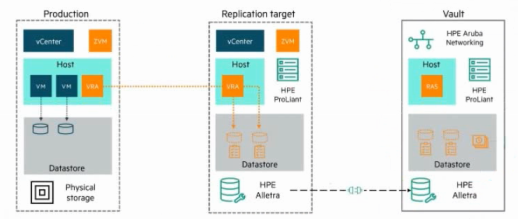
Which statement about the Zerto Vault architecture is correct?
Detailed Explanatio n:
Rationale for Correct Answe r:
In the Zerto Vault architecture, production workloads replicate continuously to a Replication Target (secondary site). From there, data is further replicated periodically and encrypted into the Vault (air-gapped, isolated site). This two-step process ensures ransomware resilience and immutability, as the Vault acts as a hardened third copy.
Distractors:
A: Production-to-replication target traffic is continuous synchronous/asynchronous replication, not periodic. Periodic replication applies to Replication Target Vault.
C: The Resilience Automation Server (RAS) is responsible for orchestrating failover and immutability enforcement, but it does not control port access between production and replication target.
D: Snapshots of Zerto components are not what is replicated --- it's application data VMs/volumes. The Vault ensures immutability of replicated data, not ZVM components.
Key Concept: Zerto Vault = encrypted, periodic replication from replication target to immutable vault.
Refer to the exhibit.
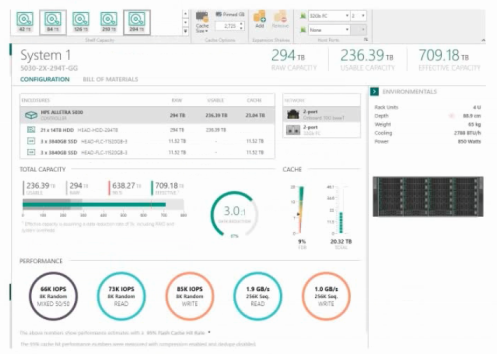
Which action plan would you suggest to correct the issue?
Detailed Explanatio n:
Rationale for Correct Answe r:
Frequent cache misses occur when the working dataset does not fit effectively in cache. Increasing the flash-to-disk ratio ensures a higher portion of hot data is served from flash media rather than backend disk, reducing cache miss penalties. This is the standard HPE recommendation for read-intensive workloads where cache is insufficient.
Distractors:
A: Adding shelves adds capacity, not cache-to-data efficiency.
B: Upgrading controllers increases CPU, but not necessarily cache efficiency.
C: Pinned cache is intended for metadata or specific workloads, not large-scale read caching.
Key Concept: Flash-to-disk ratio optimization reduces cache misses.
Exam domains verified against: Official HP HPE7-J02 exam guide, last checked October 2026.
Use HPE or third-party cloud management and on-premises tools to review customer telemetry. Configure alerts, logging, and reporting to monitor storage performance and health across hybrid environments.
Describe the HPE Storage portfolio as it relates to enterprise infrastructure and explain HPE Storage Hardware. Understand procurement options and position HPE Storage solutions within enterprise-scale strategy.
Common questions about the exam itself

