Key details for this exam, checked against the published exam outline
Each question shows the correct answer and an explanation of why it is right
When troubleshooting a virtual machine, which file is most likely to provide a detailed history of the VM's behavior?
Log files record events and messages related to the operations of a virtual machine. They provide detailed information about the VM's behavior, errors, and system messages, which are crucial for troubleshooting.
What are the two benefits of using sub-LUN tiering?
Sub-LUN tiering allows for the movement of data at a more granular level within a Logical Unit Number (LUN), enabling:
Granular control over data placement: Specific data blocks can be moved to appropriate storage tiers based on access patterns.
Cost optimization: Frequently accessed data resides on high-performance (and more expensive) storage, while less accessed data is moved to cost-effective storage, optimizing overall storage costs.
Other options:
Reduced need for storage capacity: Not directly impacted by sub-LUN tiering.
Reduced need for storage tiering policies: Policies are still required to manage data movement.
Simplified storage management: While sub-LUN tiering adds efficiency, it may introduce complexity in management.
An IT department needs to execute automated tasks to perform a business operation. They require workflows for arranging, coordinating, and managing these tasks. Which layer of the Modern Data Center Architecture provides this functionality?
The orchestration layer in a modern data center architecture is responsible for automating and coordinating complex tasks and workflows. It enables the integration and management of various services and resources to perform business operations efficiently.
Physical infrastructure: Comprises the hardware components.
Virtual infrastructure: Includes virtualized resources like VMs.
Services: Deliver specific functionalities to end-users.
Refer to the exhibit.
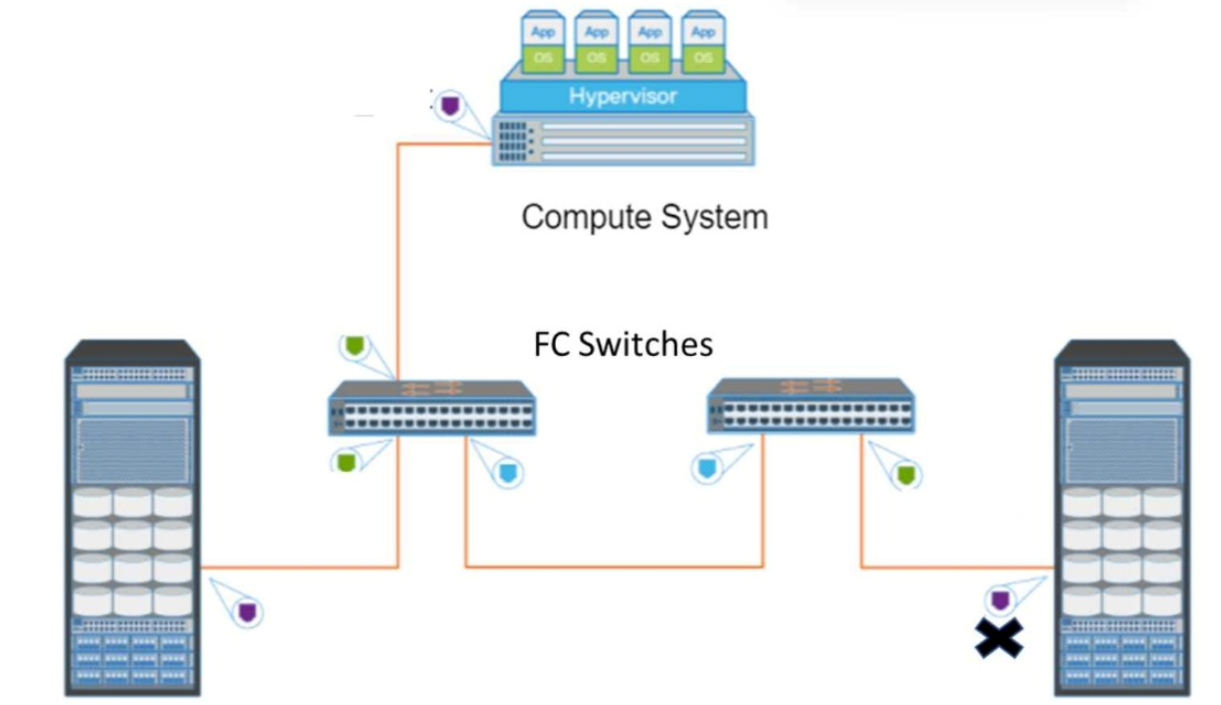
Refer to the Exhibit (Port marked "X"): What type of FC port does the "X" represent?
The exhibit shows a Fibre Channel (FC) switch connected to another FC switch. The port "X" is used for inter-switch link (ISL) connectivity, which is characteristic of an E_port (Expansion Port).
F_port (Fabric port): Connects an N_port (host or storage device) to a switch.
N_port (Node port): End device port in FC networks (like HBA in hosts or storage).
NL_port (Node Loop port): Used for Arbitrated Loop topologies.
E_port: Connects two FC switches together for ISL, which is exactly what's shown in the exhibit.
What is the role of the storage node in a backup architecture?
A storage node is a component in a backup architecture that handles the actual data movement during the backup process:
It organizes the backup data stream.
It writes the data to the backup target (disk, tape, or cloud).
It does not manage policies or schedules (that's the role of the backup server or management console).
Option A: Monitoring is done by the backup server or management tools.
Option C: Backup management (scheduling, policies) is also handled by the backup server.
Option D: Deduplication may be part of the process but is not the primary role of a storage node.
What is true about the FCIP?
FCIP (Fibre Channel over IP) is used to tunnel Fibre Channel traffic over IP networks. Its primary use case:
Connecting local FC SANs to remote FC SANs for disaster recovery and remote data replication.
It encapsulates FC frames into IP packets, transporting them over existing IP infrastructure.
Option B/C/D: iSCSI is not directly involved in FCIP's primary function.
A company wants to implement a security strategy that uses firewall, VPN, malware protection, and encryption. Which approach is most suitable for achieving this goal?
Defense-in-depth is a security strategy that layers multiple security controls throughout the IT environment to protect data and infrastructure.
Firewalls (network layer)
VPN (secure remote access)
Malware protection (endpoint and gateway)
Encryption (data in transit and at rest)
This approach reduces reliance on a single security measure and strengthens overall protection.
Zero trust: Focuses on continuously validating trust.
DMZ: Network architecture, not a full security approach.
Perimeter security: Limited to the outer edge of the network.
Common questions about the exam itself

