Key details for this exam, checked against the published exam outline
Each question shows the correct answer and an explanation of why it is right
In which phase change is energy being released to the surroundings?
Energy is released during phase changes from gas to liquid (condensation). When water vapor in a cloud condenses to form raindrops, it releases energy to the surroundings. This is because the gas phase (water vapor) has higher energy than the liquid phase (raindrops), and the transition to a lower energy state (liquid) releases the excess energy.
Integrated Physical Sciences materials on condensation and energy release.
Concepts of energy changes during phase transitions.
In which state of matter are particles closest together?
In the solid state of matter, particles are closest together. This is due to the fact that solids have a definite shape and volume, meaning the particles are tightly packed in a fixed, orderly arrangement. In comparison:
Liquids have particles that are close together but not in a fixed position, allowing them to flow.
Gases have particles that are far apart and move freely.
Plasma consists of ionized particles and is not typically considered in the context of ordinary matter states at standard conditions.
Integrated Physical Sciences Learning Resources, Chapter on States of Matter
A water molecule consists of two hydrogen atoms bonded to an oxygen atom.
Which type of substance is water?
Understanding Molecular Structure:
Water Molecule: Consists of two hydrogen atoms and one oxygen atom chemically bonded together.
Classification of Substances:
Element (B): A pure substance of one type of atom.
Compound (D): A substance made of two or more different elements chemically bonded.
Isotope (C): Variants of a particular chemical element with different neutron numbers.
Mixture (A): A combination of substances not chemically bonded.
Chemical Bonding in Water: The hydrogen and oxygen atoms in a water molecule are chemically bonded, forming a compound.
Conclusion: Water is a compound.
Chemical Compounds: Definitions and examples of chemical compounds.
Satellites used in a Global Positioning System (GPS) orbit around Earth, sending electromagnetic waves that GPS units in cars can use to determine their location on Earth.
Which type of electromagnetic radiation is used to send information from the GPS satellites to receivers on Earth?
GPS technology: Satellites in the Global Positioning System (GPS) communicate with GPS receivers on Earth using electromagnetic waves.
Microwaves: Microwaves are used in GPS technology because they can travel long distances and penetrate the atmosphere with minimal interference.
Conclusion: The type of electromagnetic radiation used to send information from GPS satellites to receivers on Earth is microwaves.
An electron is transferred from one atom to another.
Which type of bond is formed?
When an electron is transferred from one atom to another, an ionic bond is formed. This type of bond occurs between a metal and a non-metal where one atom donates an electron to another, resulting in the formation of positive and negative ions that attract each other. In comparison:
Covalent bonds involve the sharing of electrons between atoms.
Elemental bonds is not a standard term in chemistry.
Metallic bonds involve the sharing of free electrons among a lattice of metal atoms.
Integrated Physical Sciences Learning Resources, Chapter on Chemical Bonds
Sir Isaac Newton discovered that when one object applies a force to another object, the second object applies an equal force to the first object. Since Newton did his work, numerous investigations have confirmed this relationship.
Which type of scientific statement is this?
Newton's discovery that when one object applies a force to another, the second object applies an equal force back is known as Newton's third law of motion. This statement is a scientific law because it describes a fundamental and consistent principle observed in nature. It has been validated through numerous experiments and observations. Reference:
Integrated Physical Sciences, Chapter 4: Scientific Laws and Theories
Two identical cars travel one behind the other The rear car is traveling faster and stakes the front car in a rear end collision as shown in the figure below
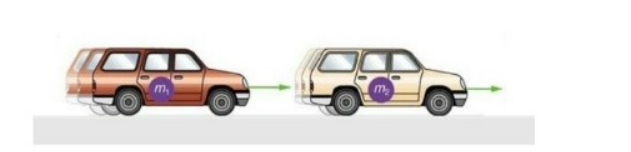
What happens to the velocities of the two cars, assuming that the collision is completely elastic?
**Assumption:** The collision is completely elastic, meaning no kinetic energy is lost. - **Principles of elastic collisions:** In an elastic collision, both momentum and kinetic energy are conserved. - **Velocity changes:** When two identical cars collide elastically, the car that was moving faster (rear car) will transfer some of its kinetic energy to the slower-moving car (front car). As a result, the rear car slows down, and the front car speeds up. - **Conclusion:** The velocities of the two cars will change such that the front car speeds up and the rear car slows down after the collision. **Reference:** Textbooks on classical mechanics, principles of conservation of momentum and energy, and problem-solving resources on elastic collisions.
4 domains from the WGU Integrated-Physical-Sciences exam outline, with approximate weightings. Every sample question above is tagged with the domain it comes from
Investigate how scientific inquiry functions and the core principles that direct scientific investigation. Learn the techniques scientists employ to comprehend the natural world and how scientific knowledge is constructed, evaluated, and enhanced through methodical observation and experimentation.
Sample question from this domain above: Q6
Review the foundational principles that control physical phenomena in daily life. Understand how forces affect motion, how energy changes and moves, and how waves travel through various media, linking these concepts to practical everyday applications.
Explore the basic properties of matter and how substances interact through chemical processes. Study the arrangement of matter at atomic and molecular scales and how matter is preserved during chemical transformations.
Examine the elements that constitute Earth systems and how they operate together. Understand Earth internal composition, atmospheric processes, and how Earth connects to and engages with other celestial bodies in the solar system.
Common questions about the exam itself

