Key details for this exam, checked against the published exam outline
Each question shows the correct answer and an explanation of why it is right
Which term refers to a path from a top-level block to a bottom-level block?
In database indexing, a branch refers to the path from the top-level block (root node) to a bottom-level block (leaf node) in a B-Tree or B+ Tree index structure.
Example Usage in Indexing:
A B-Tree index organizes data hierarchically, with branches leading to different parts of the tree.
When searching for a record, the query follows a branch from the root node down to the correct leaf node.
Why Other Options Are Incorrect:
Option A (Fan-out) (Incorrect): Refers to how many children a node has, not the path.
Option B (Crow's foot) (Incorrect): A notation used in ER diagrams, not indexing.
Option D (Sparse index) (Incorrect): A type of index storing only some entries, not the path itself.
Thus, the correct answer is Branch, as it defines the path from top to bottom in a database index.
Which database operation locates the needed table blocks?
An index scan is a database operation that quickly locates table blocks using an index rather than scanning the entire table. It significantly improves query performance.
Example Usage:
sql
SELECT * FROM Employees WHERE EmployeeID = 105;
If EmployeeID is indexed, the database uses an index scan to quickly find the record.
Why Other Options Are Incorrect:
Option A (Binary search) (Incorrect): A searching algorithm, but not a database operation.
Option B (Table scan) (Incorrect): Scans the entire table, which is slower than an index scan.
Option C (Fan-out) (Incorrect): Refers to branching in B-Trees but does not locate table blocks directly.
Thus, the correct answer is Index scan, as it efficiently locates table blocks.
How many bytes of storage does a BIGINT data type hold in MySQL?
In MySQL, the BIGINT data type is a 64-bit integer that requires 8 bytes (64 bits) of storage. It is used to store large numerical values beyond the range of INT (4 bytes).
Option A (Incorrect): 1 byte corresponds to TINYINT, which can store values from -128 to 127.
Option B (Incorrect): 3 bytes is not a standard integer storage size in MySQL.
Option C (Incorrect): 4 bytes corresponds to INT, which has a range of -2,147,483,648 to 2,147,483,647.
Option D (Correct): BIGINT takes 8 bytes and supports a massive range of numbers from -2^63 to 2^63 -1.
Which description defines a data type?
A data type defines the kind of data a column can store in a database. It ensures data consistency and efficient storage.
Option A (Correct): A data type is a named set of values, such as INTEGER, VARCHAR, DATE, etc.
Option B (Incorrect): A tuple refers to a row in a relational database, not a data type.
Option C (Incorrect): Data types define column values, but they do not correspond directly to columns.
Option D (Incorrect): Data types do not have a varying set of rows; they define attributes for columns.
Which keyword can be used to combine two results into one table?
The UNION keyword in SQL is used to combine the results of two or more SELECT queries into a single result set while removing duplicate rows.
Example:
sql
SELECT Name FROM Employees
UNION
SELECT Name FROM Managers;
Option A (Correct): UNION combines results from multiple queries into one set, removing duplicates.
Option B (Incorrect): MERGE is not a valid SQL keyword for combining result sets (it is used in some database systems for data merging).
Option C (Incorrect): INTEGRATE is not a SQL keyword.
Option D (Incorrect): CONSOLIDATE is not an SQL keyword.
Which property of an entity can become a column in a table?
In database design, attributes of an entity become columns in a relational table.
Example Usage:
For an Employee entity, attributes might include:

CREATE TABLE Employees (
EmployeeID INT PRIMARY KEY,
Name VARCHAR(50),
Salary DECIMAL(10,2),
DepartmentID INT
);
Each attribute (e.g., Name, Salary) becomes a column in the table.
Why Other Options Are Incorrect:
Option A (Modality) (Incorrect): Describes optional vs. mandatory relationships, not table structure.
Option B (Uniqueness) (Incorrect): Ensures distinct values but is not a column property.
Option D (Non-null values) (Incorrect): Ensures that columns must contain data but does not define attributes.
Thus, the correct answer is Attribute, as attributes of entities become table columns.
Which relationship is shown in the following diagram?
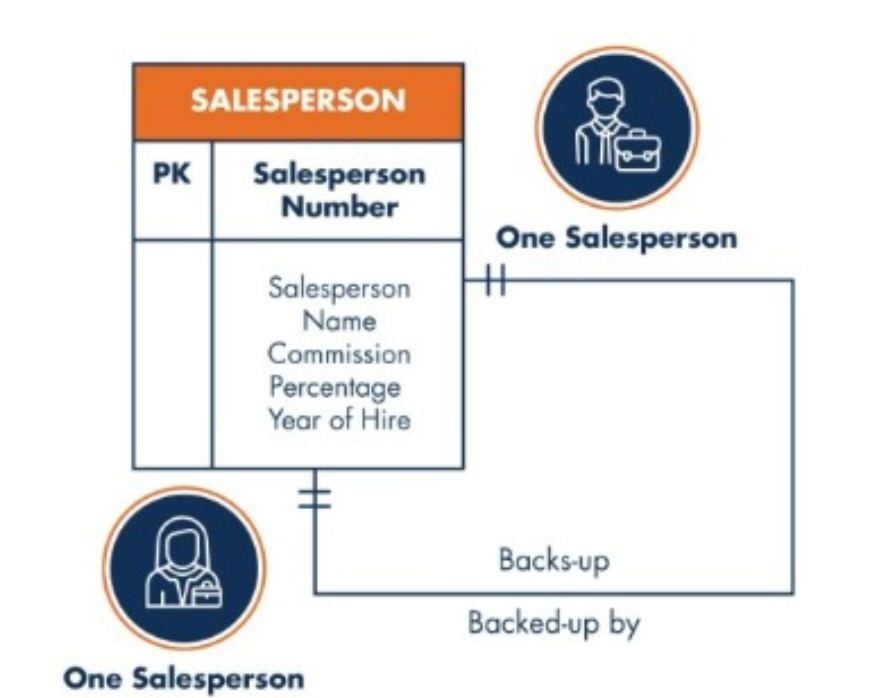
The given diagram represents a unary relationship (also called a recursive relationship), which occurs when an entity is related to itself. In this case, salespersons back each other up, meaning a salesperson is associated with another salesperson from the same entity.
Key Observations from the Diagram:
Single Entity (Salesperson)
The table contains only one entity type, Salesperson, which has attributes such as Salesperson Number, Name, Commission, Percentage, and Year of Hire.
Self-Referencing Relationship (Backs-up and Backed-up by)
The diagram shows that a salesperson can back up another salesperson.
This means that the relationship exists within the same entity rather than between two different entities.
Cardinality (One-to-One Relationship in a Unary Form)
The notation ( |---| ) in the ER diagram indicates a one-to-one recursive relationship.
One salesperson can back up only one other salesperson, and each salesperson is backed up by only one.
Exam domains verified against: Official WGU Data-Management-Foundations exam guide, last checked October 2026.
This section evaluates skills in using SQL commands to define and modify data and structures. Candidates work with creating tables and executing statements to add, change, remove, and read records from relational databases.
Sample question from this domain above: Q5
This section covers specifying primary and foreign keys in a design. Focus is on using these keys to link tables, maintain relationships, and support a well-structured, normalized schema.
This section addresses arranging data through normalization processes. Candidates concentrate on limiting duplicate information, dividing data into related tables, and improving accuracy and clarity.
This section focuses on building databases and tables with SQL in relational systems. Candidates work on selecting suitable table structures, defining columns, and preparing the environment for reliable data storage and organization.
This part covers project leadership, planning, and clear communication with project stakeholders in a data-focused context. Skills relate to directing data-focused projects and teams with business acumen.
This section presents the core ideas of conceptual, logical, and physical data models. Emphasis is on how each type describes data at a different level, from overall business concepts to detailed implementation in a database.
This section outlines the essential characteristics of databases and tables along with key SQL commands. Focus includes understanding rows, columns, data types, and how standard SQL operations work with these elements.
Common questions about the exam itself

