
VEEAM VMCE_v12 Practice Exam Questions & Answers
VEEAM VMCE_v12 Exam Details
Key details for this exam, checked against the published exam outline
- Exam Code
- VMCE_v12
- Full Name
- Veeam Certified Engineer v12
- Issuing Body
- Veeam
- Question Format (Our Bank)
- Multiple Choice
- Delivery
- Online proctored (Pearson VUE)
- Full Question Set
- 109 questions Get All Questions
Free VMCE_v12 Practice Questions
Each question shows the correct answer and an explanation of why it is right
Question 1 Domain 4 Describe Veeam’s replication capabilities
Site A is expected to lose power overnight. The disaster recovery setup has been deployed (refer to the diagram). Which approach should be used to start the replicated VMs on Site B while keeping data loss to a minimum?
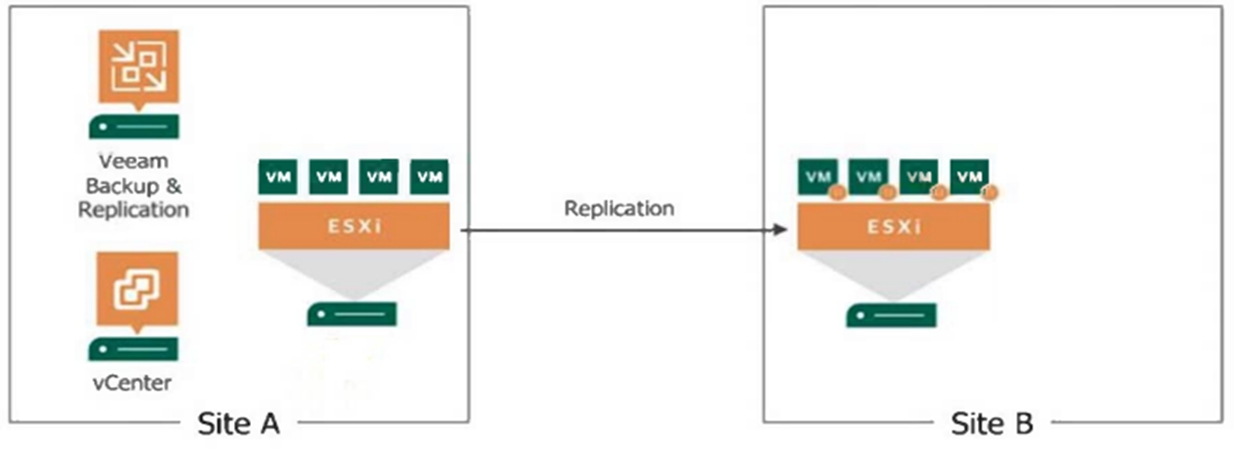
A planned failover is a procedure that enables a smooth transition from the original VMs at Site A to their replicas at Site B without any data loss. This is the appropriate choice when a power outage is anticipated, since it is a controlled operation that makes sure all data is synchronized before the switchover takes place. This step keeps data loss to a minimum and ensures the VMs on Site B are current. Reference:
Veeam Backup & Replication User Guide: Failover and Failback
Veeam Help Center: Planned Failover Procedure
Question 2 Domain 1 Describe Veeam security concepts
A daily backup job covering seven Hyper-V virtual machines runs at the primary site and keeps 14 days of backup files. Copies of these VM backups must be sent to a repository at the disaster recovery site, where six months of backup files must be retained. Administrators must be able to restore the VMs to any single day within the last two months and to any single week within the six-month period. Which backup copy job configuration satisfies these requirements?
Configuring a backup copy job in periodic copy (pruning) mode with 62 days of retention and six monthly Grandfather-Father-Son (GFS) restore points is the most suitable choice. This arrangement provides daily restore points for up to two months and weekly restore points for up to six months, which matches the required recovery capabilities. Reference: Veeam Backup & Replication User Guide, Veeam GFS Retention Policy Explanation
Question 3 Domain 8 Recover data from backups
A mid-sized company depends on Veeam Backup and Replication to protect its mission-critical data against ransomware. The organization wants to verify its backups and strengthen security, while also boosting DevOps productivity.
In what way can a SureBackup Job be used to meet the company's particular requirements?
A SureBackup Job in Veeam Backup and Replication can be used to set up a secure, isolated environment for testing new applications. It lets organizations check their backups by running VMs in a separated environment, so applications, patches, or updates can be tested without affecting the production environment. Reference: Veeam Backup & Replication Documentation, Veeam SureBackup Guide
Get the complete VMCE_v12 question set
$20$40
Question 4 Domain 8 Recover data from backups
Hourly backup jobs point to local repositories. Daily backups need to travel from Site B to the repository on Site
In this scenario, daily backups must reach a repository at Site A from Site B, and the link between the sites is restricted, so a direct backup cannot finish in the backup window. A Backup Copy Job is therefore the suitable choice. It is a Veeam Backup & Replication feature that produces multiple copies of the same backup files in different locations (repositories).
In the provided image, the components used by the Backup Copy Job from Site B to Site A are:
6 (Repository at Site B): This is the source repository holding the hourly backup job data.
4 and 3 (WAN Accelerators at both sites): These components improve data transfer across the WAN.
2 (Repository at Site A): This is the destination repository where the backup copies are kept.
This configuration keeps the impact on the source VMs at Site B low, because the Backup Copy Job operates on backup data instead of the production VMs, which lowers the load on those VMs during processing.
Question 5 Domain 6 Configure backup infrastructure components, including proxy and repository servers
A photography firm sells pictures online. Its main operations depend on an Oracle database that holds every company image. New pictures are added to the database constantly, at irregular intervals. Company policy states that only the database must be protected.
Which Veeam feature will deliver full backup and recovery for this database?
The Veeam Plug-in for Oracle RMAN is built specifically for efficient backup and recovery of Oracle databases. It connects directly with Oracle RMAN (Recovery Manager), which keeps backups consistent and dependable. For a photography company whose business relies on an Oracle database that receives new photos constantly, this capability is a strong fit. Daily database backups keep all new content protected on a regular basis, and archived redo logs backed up every 15 minutes protect recent transactions too. This setup meets the company's requirement to protect only the database. Reference:
Veeam Documentation: Veeam Plug-in for Oracle RMAN
Veeam Help Center: Oracle RMAN Backup and Recovery
Question 6 Domain 5 Determine appropriate use case for backups, replicas and/or continuous data protection
Veeam ONE has been set up and configured. The environment includes five Veeam Backup & Replication servers. The administrator wants to verify the free space available on every backup repository server. Which location in the console shows this data?
Within Veeam ONE, the free capacity of every backup repository server is available in the Data Protection View. This area offers in-depth details on storage consumption and leftover capacity for backup repositories, helping administrators monitor and manage their storage resources efficiently. Reference: Veeam ONE User Guide, Veeam ONE Data Protection View Documentation
Question 7 Domain 1 Describe Veeam security concepts
Which capability is exclusive to Veeam Agent for Microsoft Windows when running Veeam agent backup jobs?
Application-aware processing is available exclusively in Veeam Agent for Microsoft Windows. It enables the creation of consistent backups for Windows-based applications and makes sure that databases and applications such as Microsoft Active Directory, SQL Server, Exchange, and SharePoint are quiesced and in a consistent state during backup. Source:
Veeam Agent for Microsoft Windows User Guide: Application-Aware Processing
Veeam Help Center: Application-Aware Processing in Veeam Agent for Windows
Question 8 Domain 8 Recover data from backups
Some replicated VMs must begin their startup after a time delay during a failover. Which approach accomplishes this?
A failover plan in Veeam Backup & Replication lets you specify the sequence in which VMs power on during a failover operation. It can contain startup delays for selected VMs, so those VMs can be set to begin only after a defined time lag. This satisfies the requirement that some replicated VMs start on a time delay. Reference:
Veeam Backup & Replication User Guide: Failover Plans
Veeam Help Center: Creating Failover Plans
What the VEEAM VMCE_v12 Exam Covers
Exam domains verified against the Official VEEAM VMCE_v12 exam guide, last checked November 2026.
Domain 1 Describe Veeam security concepts
Understand encryption techniques, access control protocols, and data integrity safeguards. Learn how to implement security measures that protect virtualized environments from cybersecurity risks.
Domain 2 Configure a Backup Job and a Backup Copy Job
Set up backup jobs with appropriate schedules and retention rules. Configure backup copy jobs to ensure data reaches secondary destinations for redundancy and disaster recovery.
Domain 3 Explain network-attached storage (NAS) backups and configuration
Learn how NAS devices integrate into backup systems and configure protocols like NFS or SMB. Optimize storage allocation to guarantee effective data safeguarding and recovery.
Domain 4 Describe Veeam’s replication capabilities
Create and manage replica VMs and set up replication tasks. Execute failover and failback processes to maintain data resilience and availability in virtualized environments.
Sample question from this domain above Q1
Domain 5 Determine appropriate use case for backups, replicas and/or continuous data protection
Assess scenarios to determine whether backups, replicas, or continuous data protection best fit the requirements. Consider recovery point objectives, recovery time objectives, and infrastructure needs.
Sample question from this domain above Q6
Domain 6 Configure backup infrastructure components, including proxy and repository servers
Establish proxy servers to facilitate data transfer and repository servers for storage management. Ensure flawless functionality and optimal performance of backup solutions.
Sample question from this domain above Q5
Domain 7 Evaluate when and how to apply immutability settings
Consider data retention policies, compliance requirements, and protection against ransomware attacks. Apply immutability settings strategically to maintain data integrity and resilience.
VMCE_v12 Exam FAQ
Common questions about the exam itself
What prior experience do I need before taking VMCE_v12?
How long should I prepare for the VMCE_v12 exam?
Is VMCE_v12 the only version of the exam currently available?
What makes VMCE_v12 more difficult than previous versions?
Can I take the VMCE_v12 exam online or only at a testing center?
What topics do most candidates struggle with on VMCE_v12?
How does the VMCE_v12 certification relate to the VMCA certification?
Can I retake VMCE_v12 if I fail the first attempt?
How long is the VMCE_v12 certification valid after I pass?
What job roles is VMCE_v12 designed for?
Other VEEAM Exams
Free practice questions for more VEEAM certification exams