Key details for this exam, checked against the published exam outline
Each question shows the correct answer and an explanation of why it is right
Complete the sentence. The ArchiMate standard provides a set of entities and relationships for
Based on the ArchiMate 3 documents or objectives, the ArchiMate standard provides a set of entities and relationships for representing Architecture Description. Architecture Description is a work product used to express an architecture for a system-of-interest. The ArchiMate language is an open and independent modeling language for Enterprise Architecture that is supported by different tool vendors and consulting firms.
What element type is denoted by the symbol below using the standard notation conventions?
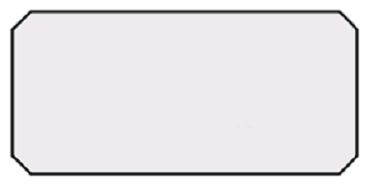
According to the standard notation conventions, a structure element is denoted by a rectangle with rounded corners. A structure element represents an entity that has a state and exhibits some behavior. Examples of structure elements are actors, roles, components, nodes, and objects.
Consider the diagram:

(A diagram showing Chief Marketing Officer connected to Market Share.)
What element represents the Chief Marketing Officer?
Comprehensive and Detailed In-Depth
The Chief Marketing Officer (CMO) in this diagram is depicted as a stakeholder, as it represents an individual or a group with concerns about market share.
In ArchiMate 3.2, a stakeholder is an entity that has an interest in the outcomes of enterprise architecture, business processes, or strategic goals. The Market Share concept represents a business driver or key metric, which directly aligns with stakeholder concerns in an organization.
Analysis of Answer Choices:
A. Business Actor Incorrect.
A Business Actor represents an organizational entity that performs behavior (e.g., a company, department, or system).
The CMO is an individual with a concern (Market Share), not a system or department performing business processes.
ArchiMate 3.2 Specification, Section 6.2.1, states that a Business Actor is an operational entity rather than a strategic role or stakeholder.
B. Role Incorrect.
A Role represents a responsibility or job function assigned to actors, but the diagram does not depict responsibilities or assigned functions.
A role is usually linked to a business actor, while the CMO in this context is linked to a business concern (Market Share).
ArchiMate 3.2 Specification, Section 6.3.1, states that roles are used to define responsibilities, whereas stakeholders are used to define concerns.
C. Stakeholder Correct Answer
The CMO represents a strategic position with concerns about business performance, making it a Stakeholder in ArchiMate.
ArchiMate 3.2 Specification, Section 6.2.1, defines Stakeholder as an entity concerned with outcomes and business goals, exactly fitting the context of this diagram.
D. Actor Incorrect.
An Actor in ArchiMate is used to define entities performing business behaviors (such as a department or a system).
The CMO is not performing an explicit business function but rather has concerns about market performance.
Final Answer: C. Stakeholder
ArchiMate 3.2 Specification: Sections 6.2.1 (Stakeholder), 6.3.1 (Role), and 6.2.1 (Business Actor).
Archi User Guide: Defining stakeholders and their concerns in Enterprise Architecture.
Which of the following is a composite element?
Comprehensive and Detailed in Depth
The Grouping element is a composite element in ArchiMate. It combines multiple elements into a single logical unit to simplify the representation of complex architectures.
Unlike Aggregation, which represents a relationship between a whole and its parts, Grouping allows the modeler to create arbitrary clusters of elements, regardless of their layer or type.
The ArchiMate 3.2 Specification confirms that Grouping is a composite element used for structuring models and can include elements from different aspects and layers.
Archi User Guide
ArchiMate 3.2 Specification
What are the types of elements defined in the top-level language structure of the ArchiMate concepts?
Based on the ArchiMate 3 documents or objectives, the top-level language structure of the ArchiMate concepts defines four types of elements: Behavior, Composite, Motivation, and Structure. Behavior elements represent units of activity performed by one or more active structure elements. Composite elements represent collections of other concepts that belong together based on some criteri
a. Motivation elements represent the reasons for designing and implementing an architecture. Structure elements represent structural concepts that model the static construction or composition of concepts of the same or different types.
What physical element is used to represent tangible matter or energy?
Comprehensive and Detailed in Depth
The Material element in the Physical Layer of ArchiMate represents tangible physical matter or energy that is used or produced within an enterprise. Examples include raw materials, energy sources, or physical substances used in manufacturing.
The ArchiMate 3.2 Specification explicitly states that Material is a passive structure element that represents physical matter or energy.
Archi User Guide
ArchiMate 3.2 Specification
Consider the following entities:
A business partner
A software application for software sales
Server hardware used to host business applications
What ArchiMate aspect describes these entities?
Comprehensive and Detailed in Depth
In ArchiMate, the Active Structure aspect represents elements that perform behavior and act upon other elements.
A Business Partner is an active entity that interacts with a business.
A Software Application is an Application Component, which belongs to the Active Structure aspect.
Server Hardware is part of the Technology Layer but still falls under the Active Structure category.
Since all three elements represent active entities performing tasks, they fall under Active Structure as per the ArchiMate 3.2 Specification.
Archi User Guide
Exam domains verified against: Official The Open Group OGA-031 exam guide, last checked October 2026.
Candidates gain foundational understanding of ArchiMate's syntax and core notation rules that govern how elements are represented and combined. Study the visual grammar, element combinations, and naming conventions essential to creating correct architecture models.
Explore the overarching metamodel that defines how elements and relationships function within ArchiMate. Understanding the metamodel is critical for grasping why certain element combinations are valid and how the language maintains semantic consistency.
Master the different relationship types connecting various elements within ArchiMate models. Be able to distinguish between semantically different relationships and apply them correctly when modeling architecture scenarios and element interactions.
Study the motivation aspects of ArchiMate, including drivers, goals, and stakeholders. These elements form the strategic foundation of enterprise architecture and help bridge the gap between business objectives and technical implementations.
Sample question from this domain above: Q3
Common questions about the exam itself

