At ValidExamDumps, we consistently monitor updates to the SAP C_THR81_2505 exam questions by SAP. Whenever our team identifies changes in the exam questions, objectives, focus areas or requirements, We immediately update our exam questions for both PDF and online practice exams. This commitment ensures our customers always have access to the most current and accurate questions. By preparing with these up to date and 100% exam domain coverage questions, our customers can successfully pass the SAP Certified Associate - SAP SuccessFactors Employee Central Core exam on their first attempt without needing additional materials or study guides.
Other certification materials providers often include outdated or removed questions by SAP in their C_THR81_2505 exam. These outdated questions lead to customers failing their SAP Certified Associate - SAP SuccessFactors Employee Central Core exam. In contrast, we ensure our questions bank includes only precise and up-to-date questions. Our main priority is your success in the SAP C_THR81_2505 exam, not profiting from selling obsolete exam questions in PDF or Online Practice Test.
A customer has scheduled an HRIS sync job, which includes mapping of job titles, to run every Friday. On Tuesday, an employee's job title is changed via Manager Self-Service (MSS) to become effective on Thursday.
When will the synchronization happen?
In SAP SuccessFactors Employee Central, the HRIS synchronization (sync) job is responsible for aligning data between different modules and ensuring consistency across the system. When an employee's job title is changed via Manager Self-Service (MSS) with an effective date set to Thursday, and the HRIS sync job is scheduled to run every Friday, the synchronization will occur on Friday, when the sync job completes.
This means that any changes made effective on Thursday will be synchronized during the next scheduled HRIS sync job on Friday. Therefore, the correct answer is C. Friday, when the sync job completes.
In which entities is Alert Notification supported? Note: There are 2 correct answers to this question.
Alert Notifications in SAP SuccessFactors Employee Central are supported in the following entities:
Job Information: Alerts can be configured to notify relevant parties about changes or updates in an employee's job information, such as position changes, promotions, or transfers.
Pay Component Recurring: Alerts can be set up to inform stakeholders about modifications in recurring pay components, including salary adjustments, bonuses, or other regular compensation elements.
These notifications facilitate proactive management of employee data changes, ensuring that appropriate actions are taken promptly.
Which destination objects do you select for the Valid When and Composite associations? Note: There are 2 correct answers to this question.
* Valid When Association:
This is used to define conditional relationships and is applied to higher-level objects.
* Composite Association:
This is used to create parent-child relationships, where the child object is the destination.
Which condition must be used for the jobinfo_FTE_Comp rule?
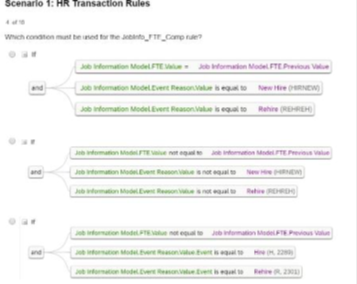
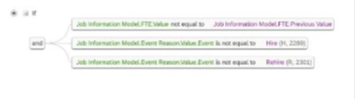
For the Jobinfo_FTE_Comp rule, the correct condition to use is Option D. This ensures that the system evaluates changes in FTE values and event reasons to calculate and adjust compensation data accordingly. The precise conditions are necessary to maintain consistency in how the rule is applied across various HR scenarios.
Scenario 1: HR Transaction Rules
A customer needs to create a custom field that appears only for legal entity France. How do you create the required field?
To create a custom field that appears only for legal entity France:
Use Configure Object Definition to add the field in the Legal Entity object.
Add field criteria to display the field conditionally based on the country being France.
This approach allows you to manage country-specific fields without modifying the Corporate Data Model directly.

