
Free SAP C_SRM_72 Exam Practice Questions & Explanations
Prepared & Reviewed by the ValidExamDumps Editorial Team
At ValidExamDumps, we consistently monitor updates to the SAP C_SRM_72 exam questions by SAP. Whenever our team identifies changes in the exam questions, objectives, focus areas or requirements, We immediately update our exam questions for both PDF and online practice exams. This commitment ensures our customers always have access to the most current and accurate questions. By preparing with these up to date and 100% exam domain coverage questions, our customers can successfully pass the SAP Certified Application Associate - Supplier Relationship Management exam on their first attempt without needing additional materials or study guides.
Other certification materials providers often include outdated or removed questions by SAP in their C_SRM_72 exam. These outdated questions lead to customers failing their SAP Certified Application Associate - Supplier Relationship Management exam. In contrast, we ensure our questions bank includes only precise and up-to-date questions. Our main priority is your success in the SAP C_SRM_72 exam, not profiting from selling obsolete exam questions in PDF or Online Practice Test.
What is used for downloading product categories from SAP ERP to SAP SRM?
SRM offers various types of multilevel hierarchies. You can use hierarchies to group together related product categories and suppliers, making them easier to find and report on. Which of the following multilevel hierarchies come as part of standard delivery?
The following multilevel hierarchies come as part of standard delivery:
Product category hierarchies
Supplier hierarchies
Central contract hierarchies
Product category hierarchies provide the following:
Extended search of product categories
Import of product category hierarchies into the SAP SRM system, for example:
Back-end material categories from SAP ERP
Standard product category hierarchies (such as UNSPC, eClass)
Customer-defined product categories
Supplier hierarchies provide the Structure and model of supplier relationships
Central Contract Hierarchies Group together similar contracts, making them easier to find and process.
You can use the account assignment function in SAP Supplier Relationship Management (SAP SRM) for Purchase Order, Confirmations etc.
To carry out account assignment, you need to make the following settings:
To carry out account assignment in SAP SRM, you need to make the following settings:
You have defined the required account assignment categories in Customizing for SAP Supplier Relationship Management under SRM Server Cross-Application Basic Settings Account Assignment Define Account Assignment Categories.
You have mapped the back-end account assignment categories to the account assignment categories in Customizing for SAP Supplier Relationship Management under SRM Server Cross-Application Basic Settings Account Assignment Define Account Assignment Categories.
You have defined rules according to which the G/L account is determined automatically.
You have defined that the criteria for determining the G/L account are based on the product category and the account assignment category (optional). You have made the settings for this in Customizing for SAP Supplier Relationship Management under SRM Server -> Cross-Application -> Basic Settings -> Account Assignment -> Define G/L Account for Product Category and Account Assignment Category.
You have defined your own criteria for determining the G/L account (optional).
You have made the settings for this in Customizing for SAP Supplier Relationship.
Using Multiple account assignment, You can distribute costs across accounts by percentage, by quantity, or by value.
When data is transferred to an SAP back-end system, the cost distribution by quantity and value is not always retained. Instead, the system changes the cost distribution type as follows:
Cost distribution by quantity: Service items are converted to percentages.
Cost distribution by value: Material and service items are converted to percentages.
Flexible type of account assignment category The account assignment category only defines the type of account assignment data that is entered in the generic fields for account assignment information.
The following account assignment categories are available:
Asset
Cost center
Network
Order
Sales order
WBS element
In the SAP back-end system the account assignment category is part of the item data, whereas in SAP SRM the account assignment category is managed at account level.
In order to distribute the workload of purchasers, SRM offers the so called automatic assignment. In this context, which of the following are true?
Automatic assignment of a purchasing group or purchasing organization can be carried out for the following documents:
External requirements
Purchase orders
Contracts
RFx
Assigned documents automatically appear for processing in the work lists of the purchasers that belong to the purchasing group or organization. The documents are automatically assigned to the purchasing group according to given criteria. This speeds up the entire procurement process, since documents do not have to be assigned manually in order for the purchasers responsible to process them.
It is also possible to reassign documents that have already been assigned to a purchasing group or organization --- if the purchaser responsible for the group or organization is absent, for example.
You need to have implemented and activated the Business Add-In (BAdI)
BBP_PGRP_ASSIGN_BADI. Here the rules covering the assignment of purchasing groups to documents are defined.
This BAdI contains a method for each type of document to be assigned:
BBP_SC_PGRP_ASSIGN for external requirements
BBP_PO_PGRP_ASSIGN for purchase orders
BBP_CT_PGRP_ASSIGN for contracts
BBP_BI_PGRP_ASSIGN for RFx
If you do not define any rules, the system distributes the documents to a standard
purchasing group or organization, as defined in your organizational plan.
You can reassign these documents manually or redefine assignment rules in the abovementioned
BAdI and rerun the automatic workload distribution. To do this, you set the filter value ONLINE in the BAdI BBP_PGRP_ASSIGN_BADI.
Process Flow
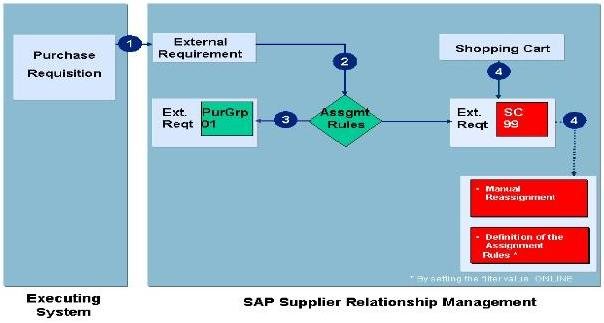
The workload distribution process is outlined below. The two diagrams show the process for requirements. Details of each diagram are described underneath each diagram.
Caution
Documents cannot be assigned to purchasing groups that are themselves assigned to different purchasing organizations. Besides, purchasing groups and organizations must reference the same logical system in the back-end.
Workload
Distribution for Requirements
Part
A
1. A purchasing requisition is sent to SAP SRM, where it is converted into an external requirement.
2. Upon creation of the external requirements, method BBP_SC_PGRP_ASSIGN of the BAdI BBP_PGRP_ASSIGN_BADI applies the distribution rules.
3. If the requirement conforms to the rules, it is automatically assigned to the correct
purchasing group (in this example, purchasing group 01).
4. If no assignment rules are maintained in the BAdI, the standard purchasing group (as defined in the organizational plan --- in this example, 99) is assigned. The standard purchasing group is also assigned to the shopping carts that are created in SAP Supplier Relationship Management. In this case, you can proceed as follows:
Assign a purchasing document manually
Define the assignment rules and have the system automatically reassign a purchasing group.
If you do not redistribute the workload, the requirement retains the standard purchasing group.
Note
One purchase requisition can have multiple lines, each of which is assigned to a different purchasing group.
Which master data is maintained in the SRM system?
Which follow-on documents can be the result of an SRM confirmation of goods in the classic scenario?
What do you need to consider when switching from application-controlled workflow to process-controlled workflow?
The organization structure should be replicated from the SAP HR system to SRM. What do you need to consider?