Key details for this exam, checked against the published exam outline
Each question shows the correct answer and an explanation of why it is right
An IdentityNow engineer needs to find identities with disabled AD accounts by using IdentityNow's search features. Is this the correct search syntax to perform this task?
Solution:

No, the search syntax @accounts( source.name:'AD' AND disabled:true ) is incorrect for SailPoint IdentityNow because the attribute disabled may not be universally recognized or applicable for all sources in the system. Using the state:'disabled' condition (as in previous correct answers) is a more reliable and system-compliant approach to find disabled accounts.
Key Reference from SailPoint Documentation:
Standard Account State Search: The correct search syntax involves using state:'disabled' instead of disabled:true for querying disabled accounts.
An IdentityNow engineer needs to find identities with disabled AD accounts by using IdentityNow's search features. Is this the correct search syntax to perform this task?
Solution:

The search syntax @accounts( source.name:'AD' AND disabled:false ) is not correct for finding disabled AD accounts. This query would return accounts that are not disabled because it is filtering for disabled:false. To find disabled accounts, the filter should specify disabled:true.
Key Reference from SailPoint Documentation:
Search Syntax for Disabled Accounts: To search for disabled accounts, the condition should check for disabled:true.
Is this statement correct about security and/or encryption of data?
Solution: When setting up a virtual appliance cluster. SailPoint creates an asymmetnc key pair based on a user-provided passphrase. and then uses this key pair to communication with the IdentityNow tenant.
Yes, this statement is correct. When setting up a Virtual Appliance (VA) cluster, SailPoint does indeed create an asymmetric key pair based on a user-provided passphrase. This key pair is used for secure communication between the Virtual Appliance and the IdentityNow tenant. The asymmetric encryption model uses a public-private key pair where the private key is stored securely within the VA, and the public key is shared with the IdentityNow tenant to establish a secure, encrypted communication channel. This setup ensures that data exchanged between the VA and the IdentityNow tenant remains protected.
SailPoint IdentityNow Virtual Appliance Security Guide.
SailPoint IdentityNow Asymmetric Encryption and Key Management Documentation.
Refer to the following diagram.
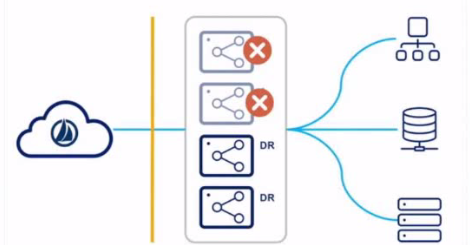
For this strategy, all virtual appliances (VAs) are deployed in a single VA cluster, with all VAs running concurrently. Some of these VAs are in the primary data center, and others {called OR VAs) are deployed in a DR data center.
While using this strategy, is this a disadvantage?
Solution: The disaster recovery VAs are not being utilized at all until a disaster recovery event occurs.
Yes, the fact that the disaster recovery (DR) VAs are not being utilized until a disaster recovery event occurs is a disadvantage. In this strategy, the DR VAs remain idle, leading to underutilization of resources. These VAs could otherwise handle workloads during normal operations to improve efficiency, distribute load, or reduce latency, especially if they are geographically closer to specific target systems. Relying on DR VAs only during failover scenarios limits their potential to optimize performance and balance loads in day-to-day operations.
SailPoint IdentityNow Virtual Appliance Clustering and Disaster Recovery Documentation.
SailPoint IdentityNow High Availability and DR Strategies.
An engineer needs to troubleshoot the following issue:
Incomplete Identities on authoritative source
Is this a reasonable action for the engineer to take?
Solution: Review the All Source Activity report available in Search.
Yes, reviewing the All Source Activity report available in Search is a reasonable action when troubleshooting incomplete identities. This report provides an overview of activity related to source systems, including account aggregations, transformations, and data flow from the source to IdentityNow. By reviewing this report, engineers can identify potential issues such as failed aggregations, data errors, or problems with source connectivity that might be causing incomplete identities.
SailPoint IdentityNow Source Activity Reports Documentation.
SailPoint IdentityNow Troubleshooting Aggregation and Source Issues Guide.
Is this statement true about using the IdentityNow APIs?
Solution: IdentityNow's versioned APIs are fully supported.
Yes, SailPoint IdentityNow's versioned APIs are fully supported. SailPoint uses versioning in their APIs to ensure backward compatibility, allowing clients to continue using older API versions while newer versions are introduced with additional features and improvements. Versioning helps maintain stability for applications that depend on the APIs.
Key Reference from SailPoint Documentation:
API Versioning: SailPoint IdentityNow provides support for versioned APIs, allowing developers to choose specific versions of the API, which are fully maintained and supported, to prevent breaking changes in integrations.
Exhibit.
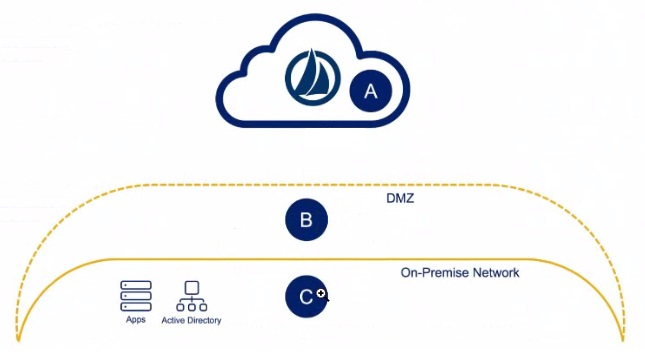
Solution: An engineer has one small production data center with an Active Directory, a database server, and two cloud applications to which they need to connect Where would the virtual appliances (VAs) reside In this scenario?
Solution: B
In this scenario, the Virtual Appliances (VAs) should not reside in the DMZ (B), which is typically used for hosting services that need to be exposed to both internal and external networks, like web servers or email gateways. However, VAs require more direct and secure access to internal resources like Active Directory and databases. The VA needs to reside where it has secure and reliable connectivity to internal resources like Active Directory and database servers, which would be in the internal network.
Key Reference from SailPoint Documentation:
VA Placement Guidance: Virtual Appliances are placed within the internal network, where they can securely connect to Active Directory, databases, and other internal applications for synchronization and provisioning tasks.
Exam domains verified against: Official SailPoint IdentityNow-Engineer exam guide, last checked October 2026.
This introductory section provides implementation engineers with essential knowledge about IdentityNow, focusing on key concepts necessary for effective identity security management. Learn the core architecture and foundational concepts of SailPoint's Identity Security Cloud platform.
Aimed at engineers and developers, this section covers identifying and modeling identity structures to ensure secure user access and adherence to regulatory standards. Understand how to design identity governance solutions using IdentityNow's configuration and modeling capabilities.
Targeted at engineers who specialize in provisioning, this part details the procedures for user onboarding and access control within the IdentityNow framework. Learn to implement provisioning workflows and manage user lifecycle processes effectively.
Designed for security engineers, this segment reviews search functionalities and compliance management within the platform. Master the tools for monitoring compliance status and searching identity data to support governance requirements.
Sample question from this domain above: Q6
This advanced topic is tailored for experienced engineers, delving into methods for customizing and enhancing the capabilities of IdentityNow. Learn to extend platform functionality through custom connectors, integrations, and advanced configurations.
Common questions about the exam itself

