Free PRINCE2 PRINCE2-Practitioner Exam Actual Questions & Explanations

Last updated on: Jul 6, 2026
Author: Zoey Zhang (PRINCE2 Practitioner Certification Specialist)

The PRINCE2 Practitioner (7th Edition) exam validates your ability to apply PRINCE2 project management methodology in real-world contexts. This certification is designed for professionals who have already achieved PRINCE2 Foundation status and are ready to demonstrate practical competency. The exam tests your capacity to tailor PRINCE2 principles, themes, and processes to specific project environments. This page outlines the syllabus, question formats, and effective preparation strategies to help you succeed.

PRINCE2 Practitioner Exam Syllabus & Core Topics

Use this topic map to guide your study for PRINCE2 Practitioner (7th Edition) within the PRINCE2 Practitioner certification path.

  • Apply the PRINCE2 Principles in Context: Demonstrate how to adapt and implement the seven PRINCE2 principles (continued business justification, learn from experience, defined roles and responsibilities, manage by stages, manage by exception, focus on products, tailor to suit the project environment) to different project scenarios and organizational constraints.
  • Apply and Tailor Relevant Aspects of PRINCE2 Themes in Context: Show competency in adapting the seven themes (business case, organization, quality, plans, risk, change, progress) to match project complexity, stakeholder needs, and organizational culture. Interpret how each theme influences decision-making and project governance.
  • Apply and Tailor Relevant Aspects of PRINCE2 Processes in Context: Execute and customize the seven processes (starting up a project, initiating a project, directing a project, controlling a stage, managing product delivery, managing a stage boundary, closing a project) according to project scale, risk profile, and delivery constraints. Determine appropriate process entry and exit criteria for your environment.

Question Formats & What They Test

The PRINCE2 Practitioner exam combines knowledge-based questions with scenario-driven items that require practical reasoning and contextual judgment. Questions progress in difficulty and emphasize real-world application over memorization.

  • Multiple Choice: Test recall of PRINCE2 definitions, theme interactions, process sequences, and key terminology. Questions often ask you to identify the correct principle or theme in a given situation.
  • Scenario-Based Items: Present realistic project situations (e.g., a change request during stage execution, a risk escalation, or a stakeholder conflict) and ask you to select the most appropriate PRINCE2 response. These require you to weigh multiple factors and justify your choice.
  • Context Matching: Require you to match tailoring decisions to project characteristics. For example, determine which processes to streamline for a small, low-risk project versus a large, regulated program.

Questions reflect progressive difficulty and emphasize the ability to adapt PRINCE2 to diverse project environments rather than apply a one-size-fits-all approach.

Preparation Guidance

Efficient preparation maps the three core topic areas to a structured weekly schedule, allowing time for both conceptual learning and scenario practice. Integrate hands-on application by relating each principle, theme, and process to real project workflows you know or can research.

  • Break the syllabus into three phases: first, master the seven principles and how they interact; second, study the seven themes and their interdependencies; third, focus on process tailoring and decision criteria.
  • Complete practice question sets weekly; review explanations for both correct and incorrect answers to identify knowledge gaps and reasoning patterns.
  • Create a "tailoring matrix" that links project characteristics (size, risk, regulatory environment) to specific principle, theme, and process adaptations. This reinforces practical judgment.
  • Work through 2-3 full scenario case studies that require you to plan and justify tailoring decisions across multiple themes and processes.
  • Complete a timed practice test under exam conditions (typically 60 questions in 90 minutes) to build pacing confidence and identify time management weak points.

Explore other PRINCE2 certifications: view all PRINCE2 exams.

Get the PDF & Practice Test

Strengthen your preparation with up-to-date resources from validexamdumps.com. These materials align to PRINCE2 Practitioner (7th Edition) and cover practical scenarios with clear explanations.

  • Q&A PDF with Explanations: Topic-mapped questions that clarify why correct options are right and others aren't, with focus on principle application, theme integration, and process tailoring decisions.
  • Practice Test: Realistic scenario-based items, timed and untimed modes, progress tracking, and detailed review to build confidence before exam day.
  • Focused Coverage: Aligned to applying PRINCE2 principles in context, tailoring PRINCE2 themes, and adapting PRINCE2 processes, so you study what matters most.
  • Regular Updates: Content refreshes that reflect syllabus changes and evolving PRINCE2 guidance.

Visit the exam page to download the PDF, Online Practice Test, or get a bundle discount for both formats: PRINCE2 Practitioner (7th Edition).

Frequently Asked Questions

What is the main difference between PRINCE2 Foundation and PRINCE2 Practitioner?

Foundation focuses on understanding PRINCE2 terminology, principles, themes, and processes. Practitioner requires you to apply and tailor these elements to real project scenarios. The Practitioner exam emphasizes judgment and contextual decision-making rather than simple recall, making it a significant step up in difficulty and practical value.

How do the seven PRINCE2 principles, themes, and processes work together in a real project?

Principles guide your overall approach (e.g., continued business justification ensures the project remains viable). Themes address specific management areas like risk, quality, and change. Processes define the sequence of activities from project start to closure. In practice, you apply principles throughout all themes and processes; for example, the "manage by exception" principle shapes how you set tolerances in the controlling a stage process. Understanding these relationships is critical for scenario-based questions.

How much hands-on project experience do I need to pass PRINCE2 Practitioner?

While Foundation requires no experience, Practitioner benefits greatly from exposure to real projects or case studies. You don't need to have managed a PRINCE2 project yourself, but you should be able to understand and reason through common project situations (scope changes, risk events, stakeholder conflicts). If you lack direct experience, focus on the scenario practice tests and case studies in your study materials to build this capability.

What are the most common mistakes candidates make on the PRINCE2 Practitioner exam?

The most frequent errors are: (1) applying PRINCE2 rigidly rather than tailoring it to the project context; (2) confusing similar processes or themes (e.g., managing product delivery vs. controlling a stage); (3) overlooking the business case as a driver of decisions; and (4) misinterpreting scenario details that signal when to escalate or adjust tolerances. Read scenarios carefully and ask yourself "what is the question really asking me to tailor or decide?"

How should I structure my final week of preparation before the exam?

In the final week, shift from learning new content to reinforcing weak areas and building exam stamina. Complete one full-length timed practice test every 2-3 days, review explanations thoroughly, and focus your study time on topics where you scored below 70 percent. Avoid cramming new material; instead, use active recall and spaced repetition on flashcards or quick-reference guides covering the tailoring decision points you find most challenging. Get adequate sleep the night before the exam.

Question No. 1

Scenario

Additional Information

Product Description
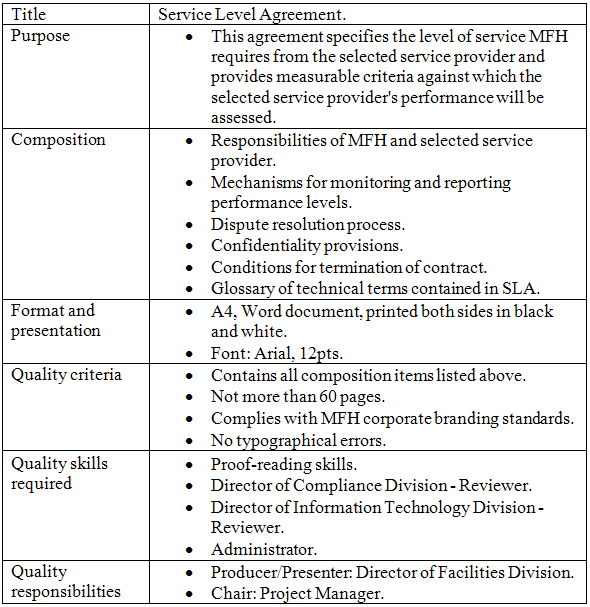
Quality notes from the Daily Log

The Director of Information Technology Division (DIT) has been asked to ensure that any changes to the outsourced staff employment contracts adhere to employment law. The DIT will review future job descriptions of the transferred staff before the final contract is signed with the selected service provider.

The service level agreement between MFH and the selected service provider will specify the type and quality of service required. The selected service provider must follow the industry standards for providing outsourced services.

MFH has a quality management system which contains a document control procedure for all its documentation, however this does not include change management.

All project documents will be subject to a quality review. Nominated products will require a formal approval record signed-off by the quality review chair.

Extract from the draft Quality Management Strategy (may contain errors)

Introduction

1. This document defines the approach to be taken to achieve the required quality levels during the project.

2. The Project Board will have overall responsibility for the Quality Management Strategy.

3. Project Assurance will provide assurance on the implementation of the Quality Management Strategy.

Quality management procedure - Quality standards

4. The selected service provider will operate to industry standards for providing outsourced services.

5. MFH document standards will be used.

Records

6. A Quality Register will be maintained to record the planned quality events and the actual results from the quality activities.

7. Configuration Item Records will be maintained for each product to describe its status, version and variant.

8. Approval records for products that require them will be stored in the quality database.

Roles and responsibilities

9. The DIT will check that the employment contracts for outsourced staff adhere to employment law.

10. Team Managers will provide details of quality checks that have been carried out.

11. Team Managers will ensure that the Quality Register is updated with the names of team members who are involved in the review process.

12. The Senior User will review the Product Descriptions of the products to be produced by the selected service provider to ensure that they can be achieved.

None of the reviewers have proof-reading skills.

Show Answer Hide Answer
Correct Answer: A

Question No. 2

Project Scenario -- Health and Safety Training Project:

ABC Company is a well-established training company that uses a standard model to develop training materials and deliver courses to customers.

ABC Company has commissioned a project in response to recent changes in government legislation relating to health and safety on construction sites. The project will deliver ''capability to provide health and safety training'', including the materials needed for classroom-based training and e-learning. The expected benefits for construction companies include a reduction in lost days and legal costs due to accidents.

The e-learning course will be developed by a specialist external consultancy. The materials for classroom-based training will be delivered by ABC Company's development team. All course materials will be piloted before they are used. ABC Company will deliver training to its customers and also hopes to sell the course materials to other training companies as part of their operational business. ABC Company will use their own sales and marketing departments to promote the courses.

The legislation requires construction companies to comply with the new legislation within two years. The course materials and trainers have to be accredited by a government agency before courses can be delivered. ABC Company is planning to deliver pilot courses within five months of starting the project.

The ABC Company standard development model for new courses recommends the following stages:

End of the Project scenario.

Additional Information:

The Chief Executive Officer (CEO) founded the company five years ago. Under her leadership, ABC Company has grown quickly into a successful training company. It delivers a range of accredited professional training.

The Finance Director is also a founder member of ABC Company and is responsible for authorizing budgets for the Operations and Development Teams. She authorizes all large contracts personally.

The Purchasing Manager reports to the Finance Director and is responsible for managing and monitoring supplier contracts.

The Operations Director is responsible for the delivery off all training and for the training development budget. His department organizes courses, venues and trainers. They work with the Product and the Sales teams to provide a comprehensive training schedule. ABC Company's IT manager reports to the Operations Director.

The Business Development Director has recently been appointed to identify new training needs and propose new products. She will work with the Operations. Director to ensure a cost-conscious approach and that appropriate development technologies are used for the health and safety course.

The Training Development Manager reports to the Business Development Director and is responsible for developing training materials and gaining accreditation, in accordance with the standard course development model. Course developers in his team have skills in a range of development technologies and are allocated to projects as needed.

The Training Delivery Manager, who reports to the Operations Director, is responsible for ensuring that internal and external trainers deliver ABC Company training courses to the required standard. He also checks course materials to ensure they are fit for purpose and of the required quality.

The Central Services Director has responsibility for corporate communications, facilities management and configuration management. He recently led a project to consolidate all company quality systems into one quality management system and set up a corporate quality department, now managed by the Corporate Quality Manager.

The Corporate Document Manager reports to the Central Services Director. She helped establish the company's document management system and now operates it across the business. She manages a team of administrators and contracts staff when workload is high.

The Sales Director joined ABC Company two months ago and is keen to establish himself by suggesting new markets for the courses and material. All account managers and the marketing team report to him. They promote existing training courses to other training companies and existing customers.

End of the additional information.

The project is now closed. The expected increase in revenue is not being achieved. It has been agreed with the team manager for the 'marketing materials' that additional marketing activities will be undertaken to achieve the expected increase in revenue.

Who should be responsible for monitoring the results of the marketing activities, and why?

Show Answer Hide Answer
Correct Answer: A

Question No. 3

The project is part of a program to develop more training courses that respond to new legislation. The project manager has requested that project support be made available from the program. As a result, the executive has confirmed that this will be carried out by the program office.

Is this appropriate, and why?

Show Answer Hide Answer
Correct Answer: A

Question No. 4

The project is using PRINCE2's recommended risk management procedure. In the 'identify' step, a risk was recorded in the risk register: ''If the 'accredited classroom-based course' is delayed, there is a threat that work on the 'e-learning course' will be delayed, resulting in the 'accredited e-learning course' not being ready for the 'pilot courses'.''

In the 'implement' step, a risk response was decided: ''Work will start incrementally on the 'e-learning course' whenever a part of the 'classroom-based training materials' gains accreditation''.

Is this appropriate, and why?

Show Answer Hide Answer
Correct Answer: B

Question No. 5

Project Scenario -- Health and Safety Training Project:

ABC Company is a well-established training company that uses a standard model to develop training materials and deliver courses to customers.

ABC Company has commissioned a project in response to recent changes in government legislation relating to health and safety on construction sites. The project will deliver ''capability to provide health and safety training'', including the materials needed for classroom-based training and e-learning. The expected benefits for construction companies include a reduction in lost days and legal costs due to accidents.

The e-learning course will be developed by a specialist external consultancy. The materials for classroom-based training will be delivered by ABC Company's development team. All course materials will be piloted before they are used. ABC Company will deliver training to its customers and also hopes to sell the course materials to other training companies as part of their operational business. ABC Company will use their own sales and marketing departments to promote the courses.

The legislation requires construction companies to comply with the new legislation within two years. The course materials and trainers have to be accredited by a government agency before courses can be delivered. ABC Company is planning to deliver pilot courses within five months of starting the project.

The ABC Company standard development model for new courses recommends the following stages:

End of the Project scenario.

Additional Information:

The Chief Executive Officer (CEO) founded the company five years ago. Under her leadership, ABC Company has grown quickly into a successful training company. It delivers a range of accredited professional training.

The Finance Director is also a founder member of ABC Company and is responsible for authorizing budgets for the Operations and Development Teams. She authorizes all large contracts personally.

The Purchasing Manager reports to the Finance Director and is responsible for managing and monitoring supplier contracts.

The Operations Director is responsible for the delivery off all training and for the training development budget. His department organizes courses, venues and trainers. They work with the Product and the Sales teams to provide a comprehensive training schedule. ABC Company's IT manager reports to the Operations Director.

The Business Development Director has recently been appointed to identify new training needs and propose new products. She will work with the Operations. Director to ensure a cost-conscious approach and that appropriate development technologies are used for the health and safety course.

The Training Development Manager reports to the Business Development Director and is responsible for developing training materials and gaining accreditation, in accordance with the standard course development model. Course developers in his team have skills in a range of development technologies and are allocated to projects as needed.

The Training Delivery Manager, who reports to the Operations Director, is responsible for ensuring that internal and external trainers deliver ABC Company training courses to the required standard. He also checks course materials to ensure they are fit for purpose and of the required quality.

The Central Services Director has responsibility for corporate communications, facilities management and configuration management. He recently led a project to consolidate all company quality systems into one quality management system and set up a corporate quality department, now managed by the Corporate Quality Manager.

The Corporate Document Manager reports to the Central Services Director. She helped establish the company's document management system and now operates it across the business. She manages a team of administrators and contracts staff when workload is high.

The Sales Director joined ABC Company two months ago and is keen to establish himself by suggesting new markets for the courses and material. All account managers and the marketing team report to him. They promote existing training courses to other training companies and existing customers.

End of the additional information.

MANAGING PRODUCT DELIVERY

The team manager for the production of the 'marketing materials' has identified that they will not be ready within the timescale agreed in the work package. The team manager has sufficient tolerance to take corrective action. As a result, additional resources have been assigned to this work package.

Which theme is being applied?

Show Answer Hide Answer
Correct Answer: A
