Pegasystems PEGACPDC25V1 Practice Exam Questions & Answers
6 Free Questions
· Last reviewed: September 26, 2026
· Prepared & Reviewed by the ValidExamDumps Editorial Team
Exam Facts
Pegasystems PEGACPDC25V1 Exam Details
Key details for this exam, checked against the published exam outline
106
Practice Questions (Our Bank)
120 minutes
Exam Duration
70%
Passing Score
USD 190
Official Exam Fee
- Exam Code
- PEGACPDC25V1
- Full Name
- Certified Pega Decisioning Consultant 25
- Issuing Body
- Pegasystems
- Question Format (Our Bank)
- Multiple Choice, Hotspot, Drag & Drop, Order List
- Delivery
- Online proctored or at a Pearson VUE test centre
- Eligibility
- No prerequisites mentioned
Practice Questions
Free PEGACPDC25V1 Practice Questions
Each question shows the correct answer and an explanation of why it is right
VA
ValidExamDumps Editorial Team
Every question and its answer is checked by our PEGACPDC25V1 exam
preparation team, who also write the explanation shown with each one.
How we research and review these pages
A mortgage company defines a new suppression policy to limit promotional emails for home loan offers. The policy is complete, but it must be applied to all to home loan actions. The implementation team must associate this policy with the appropriate business structure.
Where should the team associate the contact policy to apply it to home loan promotions?
Correct Answer:
A
Explanation
Contact policies control how and when customers receive actions across all touchpoints. When you want a suppression policy to apply to home loan promotions, you associate it with the Engagement policy tab. This is where you configure which policies govern an action group. The other options would not achieve the intended result. You would not apply it to individual treatments or actions, as that would be inefficient and harder to maintain.
l)+ Bank uses Pega Customer Decision Hub to approve credit card limit changes requested by customers automatically. A scorecard model determines the customer credit score. The automatic approval of credit card limits are processed based on the following criteria set by the bank.
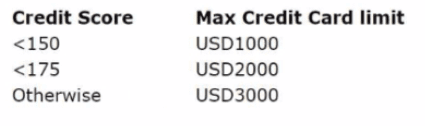
The bank wants to change the threshold value for the USD2000 credit limit from <175 to <200. How do you implement this change?
Correct Answer:
D
Explanation
The scorecard model determines the customer credit score based on various factors, such as income, expenses, assets, liabilities, etc. The scorecard model has a Results tab where you can define the cutoff values for different segments based on the credit score. To change the threshold value for the USD2000 credit limit from <175 to <200, you need to change the cutoff value in the Results tab of the scorecard model. Changing the cutoff value in the scorecard decision component, changing the condition in the strategy, or mapping the score value in the decision strategy will not affect the credit score calculation or segmentation.
MyCo, a telecom company, wants to send promotional SMSs with data plan offers to their qualified customers. The business intends to use the same action flow template with their target flow pattern for all the data plan actions.
What do you configure to implement this requirement?
Correct Answer:
D
Explanation
An SMS treatment is the correct configuration for this requirement. Treatments define how actions are delivered across different channels, including SMS. By creating an SMS treatment, you specify the delivery method and can apply it to multiple data plan actions with the same flow pattern. Email treatments or general action configurations would not provide the SMS-specific delivery mechanism needed.
A financial institution's NBA team discovers that they need to modify their risk assessment strategy and edit a scorecard used for loan approvals. The team lead reviews the available options in 1:1 Operations Manager to determine the most appropriate approach to implementing these changes.
Which approach should the team lead use to implement these strategy and scorecard modifications?
Correct Answer:
B
Explanation
The Other request type in the Customer Decision Hub portal is designed for changes that fall outside standard maintenance tasks, such as modifying risk assessment strategies and editing scorecards. This approach ensures proper change management and documentation. Direct edits without going through the request process could bypass necessary reviews and approvals. Revision Manager handles different types of changes but the portal request is the appropriate entry point for strategic modifications.
What is the name of the property that the system computes automatically when you use an Adaptive Model decision component?
Correct Answer:
B
Explanation
Propensity is the name of the property that the system computes automatically when you use an Adaptive Model decision component. Propensity is a measure of how likely a customer is to accept an action, based on their past behavior and profile. An Adaptive Model component uses machine learning to calculate the propensity for each action and store it in a property with the same name as the action. Verified Reference:Pega Academy - Decisioning Consultant - Using adaptive models
As a Customer Service Representative, you present an offer to a customer who called to learn more about a new product. The customer rejects the offer. What is the next step that Pega Customer Decision Hub takes?
Correct Answer:
C
Explanation
Pega Customer Decision Hub is a dynamic and adaptive system that constantly reevaluates the Next-Best-Action for each customer based on their interactions and feedback. If a customer rejects an offer, the system will update the customer profile and the offer performance, and then reapply the Next-Best-Action strategy to select and prioritize another offer that is more relevant and valuable for the customer. Verified Reference: [Pega Decisioning Consultant | Pega Academy]
Full Access
Get the complete PEGACPDC25V1 question set
- 106 questions covering all exam domains
- Correct answers with explanations, like the free questions above
- PDF and online practice test
- 90 days of free updates
Domain 1: Next-Best-Action concepts
12%
Master one-to-one customer engagement by designing customer engagement blueprints and optimizing customer value in contact centers. Learn how to define starting populations and create strategies that deliver the right action to each customer at the right time.
Sample question from this domain above:
Q6
Domain 2: Actions and treatments
12%
Define and manage customer actions across channels, from presenting single offers on web interfaces to designing outbound actions. Understand how to structure treatments that drive meaningful customer interactions and business outcomes.
Sample question from this domain above:
Q3
Domain 3: Engagement policies
15%
Create customer engagement policies and strategies that guide how your system selects and presents actions. Build customer journeys that move people through meaningful interactions while respecting business rules and customer preferences.
Sample question from this domain above:
Q1
Domain 4: Contact policy and volume constraints
13%
Prevent customer fatigue by implementing policies that limit action exposure both inbound and outbound. Set up volume constraints that balance your operational capacity against customer preferences and regulatory requirements.
Domain 5: AI and Arbitration
8%
Apply action arbitration and AI-driven prioritization to select the best actions from multiple candidates. Use business levers to adjust how the system ranks and prioritizes actions based on your organization's goals.
Domain 6: Channels
10%
Design real-time containers that deliver actions across channels including web and email. Learn how to share action details with third-party distributors to extend your reach beyond your direct channels.
Domain 7: Decision strategies
15%
Create and understand decision strategies that orchestrate how Pega selects actions for each customer. Use customer attributes like credit score to build engagement strategies that reflect real business decision logic.
Sample questions from this domain above:
Q2Q5
Domain 8: Business agility in 1:1 customer engagement
15%
Manage the lifecycle of changes in a decisioning project, from change requests through implementation. Use Revision Manager and the enhanced email editor to update offers and actions in bulk while maintaining brand voice with Pega GenAI.
Sample question from this domain above:
Q4
FAQ
PEGACPDC25V1 Exam FAQ
Common questions about the exam itself
What background do I need to take the PEGACPDC25V1 exam?
The exam is classified as Beginner level and targets professionals participating in the design and development of Pega Customer Decision Hub solutions. You should have hands-on experience with Pega's Next-Best-Action Designer, 1:1 Operations Manager, Decision Strategies, and Predictive Analytics tools. No formal prerequisites are published, but practical experience with Pega systems is essential.
How long should I prepare for PEGACPDC25V1?
Preparation time varies based on your existing Pega experience. Pega recommends combining authorized training, hands-on practice with the tools, and study materials. Most candidates benefit from several weeks of focused preparation, particularly if they are new to Pega's decisioning platform.
What is the hardest part of the PEGACPDC25V1 exam?
Decision strategies and engagement policies typically challenge candidates most because they require understanding how Pega orchestrates complex business logic across multiple rules and conditions. The exam tests your ability to design end-to-end decisioning flows rather than just understanding individual components.
What happens on exam day for PEGACPDC25V1?
You can take the exam online proctored from home or office, or at a Pearson VUE test centre. The exam is delivered through Pearson VUE's platform. You will need a valid ID, a quiet uninterrupted environment for online delivery, and a functioning webcam if taking the exam remotely.
What score do I need to pass PEGACPDC25V1?
You must achieve a minimum passing score of 70% to pass the exam. This is the published threshold set by Pegasystems and applies to all candidates taking this exam version.
Can I retake PEGACPDC25V1 if I fail?
Yes, you can retake the exam. If you fail, you must wait three calendar days before a second attempt. If you fail a second time, you must wait fourteen calendar days before a third attempt. You can take the exam a total of three times in a 12-month period from your first attempt date, with a fourth attempt available one year later.
How much does PEGACPDC25V1 cost?
The exam fee is USD 190 per attempt. This covers all Pega exams administered by Pearson VUE. You pay during registration on the Pearson VUE site using credit card or exam voucher, and in some countries tax may be added.
How long is the PEGACPDC25V1 certification valid?
Pegasystems does not publish an expiration date for this certification, indicating the certification does not expire. However, you should verify current validity policies with Pega Academy or Pearson VUE, as renewal or recertification requirements may apply to maintain professional standing.
What role is PEGACPDC25V1 designed for?
The certification targets Decisioning Consultants, Pega Developers, Customer Engagement Architects, and Marketing Operations Managers. It validates your ability to design and implement Pega Customer Decision Hub solutions that deliver personalized next-best-action decisioning at scale.
How does PEGACPDC25V1 relate to other Pega certifications?
PEGACPDC25V1 is a specialized certification focused on decisioning and customer engagement within Pega CDH. It complements broader certifications like Pega System Architect (CPSA) and Pega Lead System Architect (CLSA) by providing deep expertise in the decisioning domain rather than general application architecture.

