Each question shows the correct answer and an explanation of why it is right
VA
ValidExamDumps Editorial Team
Every question and its answer is checked by our XSIAM-Engineer exam
preparation team, who also write the explanation shown with each one.
How we research and review these pages
A file for a support exception that needs to be updated locally on a Linux endpoint has been supplied.
Which cytool command will upload this support exception file to the endpoint?
Correct Answer:C
Explanation
The correct command is cytool import suex -path </local/file/path>, which imports a supplied support exception (suex) file onto a Linux endpoint, ensuring the exception is applied locally.
Which common issue can result in sudden data ingestion loss for a data source that was previously successful?
Correct Answer:D
Explanation
A sudden data ingestion loss for a previously successful data source commonly occurs when the API key used for the integration has expired, breaking authentication and preventing further log collection.
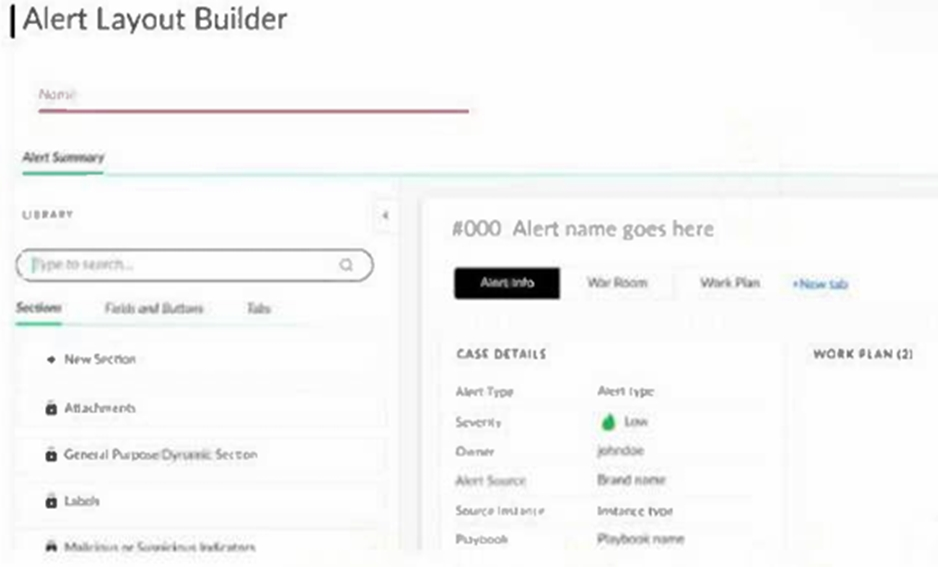
Based on the image below, which statement applies to the ability to remove tabs when creating a new alert layout?
Correct Answer:C
Explanation
In Cortex XSIAM's Alert Layout Builder, the 'War Room' and 'Work Plan' tabs are optional and can be removed, while the 'Alert Info' tab is mandatory and cannot be deleted. This ensures that essential alert details are always retained, while collaboration and workflow tabs can be customized.
Which types of content may be included in a Marketplace content pack?
Correct Answer:C
Explanation
A Marketplace content pack in Cortex XSIAM can include scripts, playbooks, integrations, and correlation rules. These packaged content items extend platform functionality, automate workflows, and enhance detection and response capabilities.
Which field is automatically mapped from the dataset to the data model when creating a data model rule?
Correct Answer:A
Explanation
When creating a data model rule, the field _event_type is automatically mapped from the dataset to the data model. This ensures events are categorized correctly in alignment with the Cortex XSIAM Data Model (XDM).
An application which ingests custom application logs is hosted in an on-premises virtual environment on an Ubuntu server, and it logs locally to a .csv file.
Which set of actions will allow the ingestion of the .csv logs into Cortex XSIAM directly from the server?
An application which ingests custom application logs is hosted in an on-premises virtual environment on an Ubuntu server, and it logs locally to a .csv file.
Which set of actions will allow the ingestion of the .csv logs into Cortex XSIAM directly from the server?
Correct Answer:A
Explanation
The correct approach is to install a Broker VM in the environment and configure its CSV Collector applet to ingest the .csv log files directly from the Ubuntu server. This enables secure ingestion of custom application logs into Cortex XSIAM without modifying the application or requiring an XDR agent on the server.
Full Access
Get the complete XSIAM-Engineer question set
59 questions covering all exam domains
Correct answers with explanations, like the free questions above
Evaluate existing IT infrastructure and security posture to align with XSIAM architecture. Identify deployment requirements for hardware, software, data sources, and integrations that support the Cortex XSIAM environment.
Onboard data sources from endpoints, networks, clouds, and identity systems. Configure automation and feed integrations including messaging, SIEM, authentication, and threat intelligence sources to extend platform capabilities.
Deploy parsing rules for custom data formats and data modeling rules for normalisation. Manage detection rules including correlation, indicators of compromise, behavioral indicators, and scoring to align security requirements with platform detections.
Manage exception and exclusion configurations and XSIAM software component updates including content and agents. Troubleshoot data management issues such as ingestion and parsing failures, and resolve problems with Cortex XSIAM components and integrations.
What background do I need to attempt the XSIAM-Engineer exam?
You should have a solid understanding of security operations concepts, familiarity with SIEM and SOAR technologies, and preferably some hands-on experience with incident response and threat detection. Working knowledge of Python, PowerShell, SQL, and XQL is expected, especially for the Content Optimization domain where you deploy parsing and data modeling rules.
How long should I prepare for XSIAM-Engineer?
Most candidates need 6 to 12 weeks of focused preparation. If you have active hands-on experience deploying and managing Cortex XSIAM in production, you may be ready in 4 to 6 weeks, but this is the exception rather than the rule.
Which domain of XSIAM-Engineer is the hardest to pass?
Integration and Automation carries 30% of the exam weight and challenges candidates who lack hands-on experience configuring data sources, automation workflows, and marketplace content packs. Invest extra study time in practical scenarios involving playbook tasks and debugging automation failures.
What happens during the XSIAM-Engineer exam?
You have 90 minutes to complete 50 to 60 scenario-based questions at a Pearson VUE test centre. Questions use multiple-choice, matching, and ordering formats grounded in real-world XSIAM engineering situations. You must score 860 on a scaled range of 300 to 1,000 to pass.
What is the passing score for XSIAM-Engineer?
The passing score is 860 on a scaled score ranging from 300 to 1,000. This scaled score reflects your overall performance across all four domains rather than a simple percentage of correct answers.
How much does the XSIAM-Engineer exam cost?
The exam fee is USD 250 and must be paid to Pearson VUE when you register your testing appointment.
How long is the XSIAM-Engineer certification valid?
The Palo Alto Networks Certified XSIAM Engineer certification is valid for 3 years from the date you pass the exam.
What job roles does XSIAM-Engineer prepare you for?
This certification targets security operations engineers, SOC engineers, and security engineers responsible for deploying, configuring, managing, and troubleshooting Cortex XSIAM environments. It validates day-one capabilities in platform deployment and initial configuration work.
Can I reschedule or retake the XSIAM-Engineer exam?
You can reschedule your exam appointment if you contact Pearson VUE at least 48 hours before your scheduled test time. Palo Alto Networks allows retakes after a mandatory waiting period as outlined in the official Certification Candidate Handbook on the certification portal.
How does XSIAM-Engineer differ from XSIAM-Analyst?
XSIAM-Engineer focuses on deployment, configuration, and playbook creation for day-one operations, while XSIAM-Analyst covers investigation, response, alert handling, and threat hunting for day-two SOC operations. Choose based on whether your role involves setting up platforms or running daily security operations.