Palo Alto Networks Cybersecurity-Practitioner Practice Exam Questions & Answers
5 Free Questions
· Last reviewed: September 14, 2026
· Prepared & Reviewed by the ValidExamDumps Editorial Team
Exam Facts
Palo Alto Networks Cybersecurity-Practitioner Exam Details
Key details for this exam, checked against the published exam outline
225
Practice Questions (Our Bank)
90 minutes
Exam Duration
860 out of 1000
Passing Score
USD 150
Exam Fee
- Exam Code
- Cybersecurity-Practitioner
- Full Name
- Palo Alto Networks Cybersecurity Practitioner
- Issuing Body
- Palo Alto Networks
- Question Format (Our Bank)
- Multiple Choice, Drag & Drop
- Delivery
- In-person at Pearson VUE test centres
- Validity
- 2 years
Practice Questions
Free Cybersecurity-Practitioner Practice Questions
Each question shows the correct answer and an explanation of why it is right
VA
ValidExamDumps Editorial Team
Every question and its answer is checked by our Cybersecurity-Practitioner exam
preparation team, who also write the explanation shown with each one.
How we research and review these pages
Which product from Palo Alto Networks enables organizations to prevent successful cyberattacks as well as simplify and strengthen security processes?
Correct Answer:
D
Explanation
From a business perspective, XDR platforms enable organizations to prevent successful cyberattacks as well as simplify and strengthen security processes.
What is a reason IoT devices are more susceptible to command-and-control (C2) attacks?
Correct Answer:
B
Explanation
IoT devices often have constant internet connectivity and increased data sharing, making them more vulnerable to command-and-control (C2) attacks. Their limited security features and exposure to external networks provide attackers more opportunities to compromise and control them remotely.
Which type of malware takes advantage of a vulnerability on an endpoint or server?
Correct Answer:
D
Explanation
An exploit is a type of malware that takes advantage of a vulnerability on an endpoint or server to execute malicious code, gain unauthorized access, or perform other malicious actions.Exploits can be categorized into known and unknown (i.e., zero-day) exploits, depending on whether the vulnerability is publicly disclosed or not12.Exploits can target various types of software, such as operating systems, browsers, applications, or network devices3.Reference:Malware vs. Exploits,Top Routinely Exploited Vulnerabilities,12 Types of Malware + Examples That You Should Know,Palo Alto Networks Certified Cybersecurity Entry-level Technician
Which component of cloud security uses automated testing with static application security testing (SAST) to identify potential threats?
Correct Answer:
B
Explanation
Code security in cloud environments involves using tools like Static Application Security Testing (SAST) to automatically analyze source code for vulnerabilities before deployment. This helps identify and remediate potential threats early in the software development lifecycle.
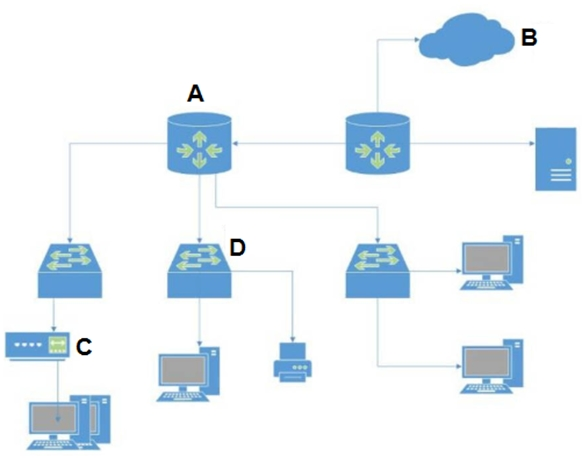
In the attached network diagram, which device is the switch?
Correct Answer:
D
Explanation
A switch is a network device that connects multiple devices on a local area network (LAN) and forwards data packets between them. A switch can be identified by its icon, which is a rectangle with four curved lines on each side. In the attached network diagram, device D is the switch, as it matches the icon and connects three computers to device A, which is another network device.Reference:
[What is a Network Switch and How Does it Work?]
[Network Diagram Symbols and Icons | Lucidchart]
Domain 1: Cybersecurity
19%
Covers the authentication, authorization, and accounting framework, malicious actor techniques from MITRE ATT&CK, and Zero Trust principles including continuous monitoring and breach assumption. Examines advanced persistent threats, identity providers, IAM, MFA, and secure email gateways.
Domain 2: Network Security
19%
Focuses on Zero Trust Network Access, stateless and next-generation firewalls, microsegmentation, and network security technologies such as IPS, URL filtering, and DNS security. Covers NGFW deployment options, OT and IoT security concerns, and Cloud-Delivered Security Services.
Sample question from this domain above:
Q3
Domain 3: Secure Access
14%
Addresses SASE and Secure Service Edge concepts, confidentiality and integrity challenges for data, private applications, and SaaS. Explores Secure Web Gateway, Enterprise Browser, Remote Browser Isolation, DLP, and CASB technologies.
Domain 4: Cloud Security
20%
Examines cloud architectures, application security, cloud posture management, and cloud runtime protection. Covers Cloud Native Application Protection Platform concepts and Cortex Cloud features.
Sample questions from this domain above:
Q2Q4
Domain 5: Endpoint Security
15%
Explores Indicators of Compromise, User and Entity Behavior Analytics, EDR and XDR technologies, behavioral threat prevention, and endpoint protection tools including host-based firewalls, device control, and disk encryption. Includes Cortex XDR capabilities.
Domain 6: Security Operations
13%
Covers threat hunting, incident response processes, SIEM platform functions, SOAR automation capabilities, and Attack Surface Management. Includes Cortex XSOAR, Xpanse, and XSIAM features.
Sample questions from this domain above:
Q1Q5
FAQ
Cybersecurity-Practitioner Exam FAQ
Common questions about the exam itself
What background do I need before taking the Cybersecurity Practitioner exam?
The Practitioner is an entry-level foundational exam requiring no formal prerequisites. It is designed for people moving into cybersecurity careers and those within the Palo Alto ecosystem seeking a recognized starting point, though basic networking and cybersecurity familiarity helps.
How does the Cybersecurity Practitioner exam differ from the Cybersecurity Apprentice?
The Practitioner sits one level above the Apprentice and introduces Palo Alto Networks products such as Cortex XDR and Prisma Cloud. Both cost USD 150 and take 90 minutes, but the Apprentice is product-agnostic while the Practitioner validates knowledge of how Palo Alto solutions fit into real security architectures.
What is the passing score on the Cybersecurity Practitioner exam?
The passing score is 860 on a scaled score range from 300 to 1000. Because this is not a percentage-based scale, you cannot convert it directly to correct answers, so every domain carries weight toward your final score.
How long is the Cybersecurity Practitioner certification valid?
The certification is valid for 2 years from the date you earn it. You can renew by retaking the exam, earning a higher-level credential in the same track, or completing continuing education activities.
What exam format should I expect on test day?
The exam contains 75 questions delivered over 90 minutes and is administered in-person only at Pearson VUE test centres. Question types include multiple choice, multiple response, drag and drop, and case study formats.
How much time should I spend preparing for the Cybersecurity Practitioner?
Preparation time varies based on your existing cybersecurity knowledge. Most candidates studying part time invest 4 to 8 weeks of focused study, though the exact duration depends on how familiar you are with the six exam domains.
Is there an online or remote option for taking the Cybersecurity Practitioner exam?
No. As of August 1, 2025, all Palo Alto Networks exams including the Cybersecurity Practitioner are administered in person at Pearson VUE test centres only. Online proctored testing is no longer available.
Which domain is typically hardest for candidates taking the Cybersecurity Practitioner?
Cloud Security often challenges candidates because it requires understanding multiple cloud architectures and protection strategies such as CSPM and CWPP. Focus on CNAPP concepts and Cortex Cloud features, as they tie together application, posture, and runtime protection.
Can I retake the Cybersecurity Practitioner exam if I fail?
Yes, you can retake the exam. Palo Alto Networks allows exam retakes, though specific wait periods and retake policies are managed through Pearson VUE at the time of registration and rescheduling.
What job role does the Cybersecurity Practitioner certification prepare me for?
This credential is designed for early-career SOC analysts, IT support technicians, and professionals entering security roles within organizations using Palo Alto Networks products. It proves foundational knowledge and positions candidates for entry-level security operations and analyst roles.

