Free Oracle 1Z0-900 Exam Actual Questions & Explanations

Last updated on: Jul 14, 2026
Author: Aubrey Ramirez (Oracle Certified Associate Java Programmer & Enterprise Architect)

The Oracle 1Z0-900 exam validates your ability to build and maintain enterprise Java applications using Java EE 7. This certification is designed for developers with solid Java fundamentals who are ready to work with application servers, messaging systems, web services, and modern web frameworks. This page maps the exam syllabus, explains question formats, and guides you through an effective study plan. Whether you are preparing for your first attempt or refining weak areas, the resources and strategies here will help you approach the exam with confidence.

1Z0-900 Exam Syllabus & Core Topics

Use this topic map to guide your study for Oracle 1Z0-900 (Java EE 7 Application Developer) within the Oracle Java path.

  • Understand Java EE Architecture: Learn the layered structure of Java EE, including the role of containers, application servers, and how components interact across tiers. You must recognize when to use specific technologies for different architectural concerns.
  • Manage Persistence using JPA Entities and Bean Validation: Create and configure entity classes, define relationships (one-to-one, one-to-many, many-to-many), and apply validation constraints. Understand how JPA handles transactions and object-relational mapping in production environments.
  • Implement Business Logic by Using EJBs: Develop session beans (stateless and stateful), understand bean lifecycle and dependency injection, and apply EJB interceptors. Know when to use EJBs versus plain Java objects for transactional and remote access scenarios.
  • Use Java Message Service API: Design and implement asynchronous messaging with JMS queues and topics. Configure message-driven beans and handle message delivery guarantees in distributed systems.
  • Implement SOAP Services by Using JAX-WS and JAXB APIs: Build and consume SOAP web services, marshal and unmarshal XML using JAXB, and manage WSDL contracts. Apply WS-Addressing and understand service-oriented architecture patterns.
  • Create Java Web Applications using Servlets: Develop HTTP request handlers, manage servlet lifecycle, handle form submissions, and work with request and response objects. Understand filter chains and dispatcher behavior in real-world request flows.
  • Create Java Web Applications using JSPs: Write dynamic pages using JSP syntax, leverage tag libraries (JSTL), and separate presentation logic from business logic. Recognize best practices for maintainability and performance.
  • Implement REST Services using JAX-RS API: Build RESTful endpoints with proper HTTP methods, content negotiation, and URI design. Apply path parameters, query parameters, and understand stateless resource-oriented architecture.
  • Create Java Applications using WebSockets: Implement bidirectional communication for real-time applications using WebSocket API. Manage connection lifecycle and handle message encoding and decoding.
  • Develop Web Applications using JSFs: Build component-based user interfaces with JSF, manage backing beans, handle form validation, and navigate between views. Understand the JSF request-response lifecycle and managed bean scopes.
  • Secure Java EE 7 Applications: Apply authentication and authorization mechanisms, use security realms and roles, and protect sensitive data. Implement SSL/TLS and understand JAAS configuration in application servers.
  • Use CDI Beans: Leverage Contexts and Dependency Injection for loose coupling and flexible component management. Apply scopes, qualifiers, and interceptors to build modular applications.
  • Use Concurrency API in Java EE 7 Applications: Manage asynchronous tasks using managed executors and thread pools. Handle concurrent operations safely without managing threads directly in application code.
  • Use Batch API in Java EE 7 Applications: Design batch jobs with readers, processors, and writers. Manage job execution, checkpoints, and error handling in long-running processes.

Question Formats & What They Test

The 1Z0-900 exam measures both conceptual knowledge and practical reasoning through a mix of question types that reflect real-world development challenges.

  • Multiple choice: Test core definitions, API behavior, configuration options, and key terminology. These questions verify that you understand when and how to use each Java EE technology.
  • Scenario-based items: Present realistic application requirements and ask you to choose the best implementation approach. For example, deciding between JMS topics and queues for a given business need, or selecting the right bean scope for a JSF backing bean.
  • Code analysis: Show code snippets and ask you to identify correct behavior, spot errors, or predict output. These items test your ability to read and reason about Java EE code patterns.

Questions progress in difficulty and emphasize practical application over memorization, so understanding the "why" behind each technology choice is essential.

Preparation Guidance

A structured study routine that maps topics to weekly goals and includes hands-on practice yields the best results. Start by reviewing the architecture and foundational concepts, then move through each technology area with both reading and coding exercises. Finish with full-length practice tests to build pacing and confidence.

  • Organize your study into 4-6 week blocks, assigning 2-3 topics per week. Create a checklist for Understand Java EE Architecture, Manage Persistence using JPA Entities and Bean Validation, Implement Business Logic by Using EJBs, Use Java Message Service API, Implement SOAP Services by Using JAX-WS and JAXB APIs, Create Java Web Applications using Servlets, Create Java Web Applications using JSPs, Implement REST Services using JAX-RS API, Create Java Applications using WebSockets, Develop Web Applications using JSFs, Secure Java EE 7 Applications, Use CDI Beans, Use Concurrency API in Java EE 7 Applications, and Use Batch API in Java EE 7 Applications to track progress.
  • Work through practice questions daily and review explanations for every incorrect answer. Identify patterns in your weak areas and revisit those topics with fresh study materials.
  • Build small projects that combine multiple technologies: for example, a REST service backed by JPA entities and secured with authentication, or a JSF form that submits data to an EJB with validation.
  • Take a full-length timed practice test in the final week to simulate exam conditions. Review your performance by topic and spend remaining time on the lowest-scoring areas.

Explore other Oracle certifications: view all Oracle exams.

Get the PDF & Practice Test

Strengthen your preparation with up-to-date resources from validexamdumps.com. These materials align to 1Z0-900 and cover practical scenarios with clear explanations.

  • Q&A PDF with explanations: Topic-mapped questions that clarify why correct options are right and others aren't.
  • Practice Test: Realistic items, timed and untimed modes, progress tracking, and detailed review.
  • Focused coverage: Aligned to Understand Java EE Architecture, Manage Persistence using JPA Entities and Bean Validation, Implement Business Logic by Using EJBs, Use Java Message Service API, Implement SOAP Services by Using JAX-WS and JAXB APIs, Create Java Web Applications using Servlets, Create Java Web Applications using JSPs, Implement REST Services using JAX-RS API, Create Java Applications using WebSockets, Develop Web Applications using JSFs, Secure Java EE 7 Applications, Use CDI Beans, Use Concurrency API in Java EE 7 Applications, and Use Batch API in Java EE 7 Applications so you study what matters most.
  • Regular reviews: Content refreshes that reflect syllabus and product changes.

Visit the exam page to download the PDF, Online Practice Test or get Bundle Discount offer for both Formats: Java EE 7 Application Developer.

Frequently Asked Questions

Which Java EE 7 topics carry the most weight on the 1Z0-900 exam?

Java EE Architecture, persistence with JPA, and web application frameworks (Servlets, JSPs, JSFs, and REST services) typically represent a significant portion of the exam. However, all 14 topic areas are testable, so a balanced study approach is important. Focus extra effort on topics where you have less hands-on experience.

How do Servlets, JSPs, JSFs, and REST services relate in a typical Java EE application?

Servlets form the foundation of web request handling; JSPs provide a templating layer for dynamic HTML generation; JSFs add component-based abstraction and managed state; and REST services handle API requests with JSON or XML payloads. In practice, modern applications often combine REST services for backend APIs with JSF for administrative interfaces. Understanding the role and lifecycle of each technology helps you choose the right tool for each layer.

How important is hands-on coding experience for passing 1Z0-900?

Hands-on experience is valuable because scenario-based questions often require you to reason about real code patterns and configuration choices. You don't need to memorize syntax, but you should be comfortable reading code, understanding bean lifecycles, and recognizing when to apply specific APIs. Building small projects covering persistence, messaging, and web services will deepen your understanding significantly.

What are common mistakes that cost points on this exam?

Confusing bean scopes (request, session, application, dependent) is frequent, as is misunderstanding JPA relationship cardinality and cascade options. Another common error is mixing up REST and SOAP design principles or forgetting that JMS is asynchronous while EJB remote calls are synchronous. Review the behavioral differences between technologies, not just their syntax.

What is an effective review strategy in the final week before the exam?

In the final week, focus on weak topic areas identified in your practice tests rather than re-reading everything. Take one full-length timed test to assess pacing and confidence. Review explanations for all incorrect answers and create a quick reference sheet of key APIs, annotations, and configuration patterns. Avoid learning new material in the last few days; instead, reinforce what you already know.

Question No. 1

Given the code fragments:

Which action completes this composite primary key implementation?

Show Answer Hide Answer
Correct Answer: D

Question No. 2

Given:

How often does the submitted task run?

Show Answer Hide Answer
Correct Answer: A

Question No. 3

Given the following code:

What should you do at line 1 to enable this servlet receive request data without blocking?

Show Answer Hide Answer
Correct Answer: D

Question No. 4

Which statement is true about the WS-Security standard?

Show Answer Hide Answer
Correct Answer: C

Question No. 5

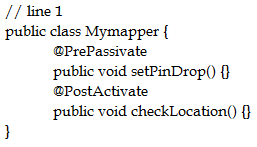
Given:

What code needs to be added to line 1 for MyMapper bean instances to be correctly passivated?

Show Answer Hide Answer
Correct Answer: D