Free Oracle 1Z0-808 Exam Actual Questions & Explanations

Last updated on: Jul 2, 2026
Author: Donette Foller (Oracle Certification Curriculum Specialist)

The Oracle 1Z0-808 exam validates your foundational knowledge of Java SE 8 programming. This certification is ideal for developers beginning their Java journey or those seeking formal recognition of core language skills. The Java SE 8 Programmer I credential demonstrates competency across fundamental concepts, object-oriented principles, and standard library usage, all essential for professional Java development. This page maps the exam syllabus and provides actionable preparation strategies to help you study efficiently and pass with confidence.

1Z0-808 Exam Syllabus & Core Topics

Use this topic map to guide your study for Oracle 1Z0-808 (Java SE 8 Programmer I) within the Oracle Database and Oracle Java certification path.

  • Java Basics: Understand the Java platform architecture, JVM concepts, and how to compile and run Java programs. You must recognize the role of the JDK and distinguish between source code, bytecode, and runtime execution.
  • Working With Java Data Types: Declare, initialize, and use primitive types (int, double, boolean, char) and reference types (String, arrays, objects). Apply type casting and understand memory behavior for each data type category.
  • Using Operators and Decision Constructs: Apply arithmetic, logical, and comparison operators correctly. Implement conditional logic with if-else statements, switch expressions, and ternary operators in real-world scenarios.
  • Creating and Using Arrays: Declare single and multi-dimensional arrays, populate them with data, and access elements safely. Understand array bounds and iteration patterns needed for data processing tasks.
  • Using Loop Constructs: Write for, while, and enhanced for loops to iterate over collections and perform repetitive operations. Control loop flow with break and continue statements.
  • Working with Methods and Encapsulation: Define methods with appropriate access modifiers, parameters, and return types. Apply encapsulation principles using private fields and public accessors to protect object state.
  • Working with Inheritance: Create class hierarchies using extends, override methods in subclasses, and call parent constructors. Understand polymorphism and the liskov substitution principle in inheritance chains.
  • Handling Exceptions: Use try-catch-finally blocks to handle checked and unchecked exceptions. Distinguish between exception types and apply appropriate error recovery strategies.
  • Working with Selected classes from the Java API: Use String manipulation methods, ArrayList for dynamic collections, and wrapper classes (Integer, Double, Boolean). Know when and how to apply these standard library classes in practical programs.

Question Formats & What They Test

The 1Z0-808 exam uses multiple-choice and scenario-based questions to assess both conceptual understanding and practical reasoning. Questions progress in difficulty and require you to apply knowledge to realistic coding situations.

  • Multiple Choice: Test core definitions, operator precedence, keyword behavior, and API method signatures. You must identify correct syntax and predict program output.
  • Scenario-Based Items: Present code snippets or real-world requirements. You analyze logic flow, spot errors, and choose the best implementation approach for a given problem.
  • Code Analysis: Evaluate code segments to determine compilation errors, runtime behavior, or logical correctness. These items demand close attention to syntax rules and object lifecycle.

As difficulty increases, questions blend multiple topics, for example, combining inheritance with exception handling or arrays with loop constructs, to mirror actual development work.

Preparation Guidance

An effective study plan allocates time to each topic proportionally and includes hands-on coding practice. Plan 4-6 weeks of consistent study, with daily review and weekly practice tests to build confidence and identify gaps.

  • Map each topic (Java Basics, Data Types, Operators, Arrays, Loops, Methods, Inheritance, Exceptions, API Classes) to weekly study blocks and track completion.
  • Write small programs for each topic: simple data type exercises, loop-based calculations, class hierarchies, and exception handling demos. Hands-on coding reinforces syntax and logic.
  • Practice question sets regularly; review explanations for every incorrect answer to understand the reasoning, not just the answer.
  • Link concepts across topics: for example, use arrays in loops, apply inheritance in method overrides, and handle exceptions in API calls to see how topics interconnect.
  • Complete a full-length, timed practice test in the final week to assess pacing, reduce test anxiety, and refine weak areas under exam conditions.

Explore other Oracle certifications: view all Oracle exams.

Get the PDF & Practice Test

Strengthen your preparation with up‑to‑date resources from validexamdumps.com. These materials align to 1Z0-808 and cover practical scenarios with clear explanations.

  • Q&A PDF with explanations: Topic-mapped questions that clarify why correct options are right and others aren't.
  • Practice Test: Realistic items, timed and untimed modes, progress tracking, and detailed review of each question.
  • Focused coverage: Aligned to Java Basics, Data Types, Operators, Arrays, Loops, Methods, Inheritance, Exceptions, and API Classes so you study what matters most.
  • Regular updates: Content refreshes that reflect syllabus and product changes.

Visit the exam page to download the PDF, Online Practice Test, or get a bundle discount for both formats: Java SE 8 Programmer I.

Frequently Asked Questions

Which topics carry the most weight on the 1Z0-808 exam?

Data Types, Operators, Methods, and Inheritance typically account for a larger portion of the exam. However, all nine topics are tested, so balanced preparation across each domain is essential. Focus extra effort on areas where you struggle during practice tests.

How do these topics connect in real Java development workflows?

In practice, you declare data types and use operators to process values, store results in arrays, and loop through collections. Methods encapsulate logic and enable code reuse, while inheritance creates maintainable class hierarchies. Exceptions protect against runtime failures across all these operations. Understanding these connections helps you write cohesive, professional code.

How much hands-on coding experience helps, and which labs should I prioritize?

Hands-on practice is invaluable; writing code reveals syntax errors and logic gaps that reading alone cannot. Prioritize labs that combine multiple topics: build a small class hierarchy with methods and exception handling, or create a program that reads data into arrays and processes it with loops. These integrated exercises build confidence faster than isolated drills.

What are the most common mistakes that cost candidates points?

Frequent errors include misunderstanding operator precedence, confusing method overloading with overriding, forgetting to initialize arrays or objects, and mishandling exception types (checked vs. unchecked). Careless reading of code output questions also leads to lost points. Review explanations for every practice question mistake to avoid repeating these patterns on exam day.

What is an effective review strategy for the final week before the exam?

In your final week, focus on weak topics identified in practice tests rather than re-reading strong areas. Take one full-length timed practice test mid-week, review all incorrect answers, and spend the remaining days on targeted drills for those gaps. On the day before the exam, do a light review of key definitions and code patterns, avoid heavy studying that causes fatigue.

Question No. 1

Given the definitions of the Bird class and the Peacock class:

and the code fragment:

Which code snippet can be inserted to print Fly.Dance. ?

Show Answer Hide Answer
Correct Answer: B

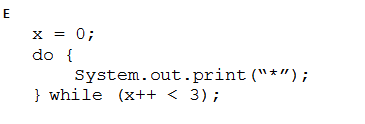
Question No. 2

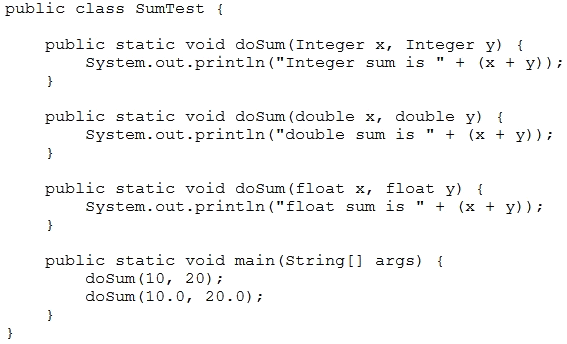
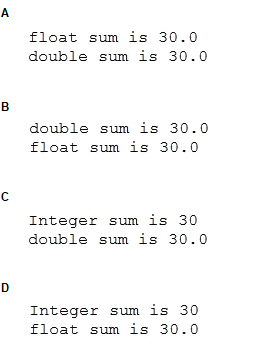
Given:

What is the result?

Show Answer Hide Answer
Correct Answer: B

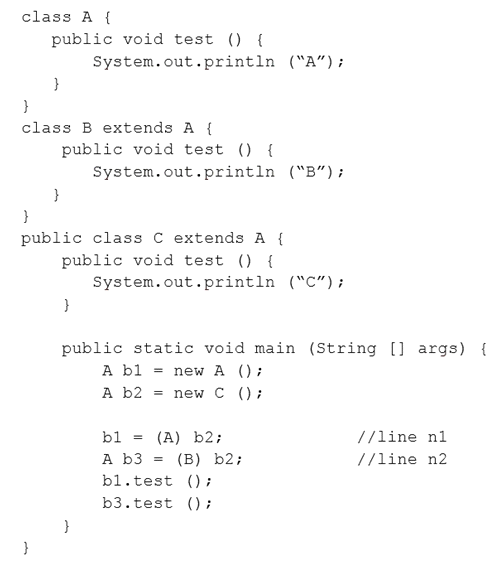
Question No. 3

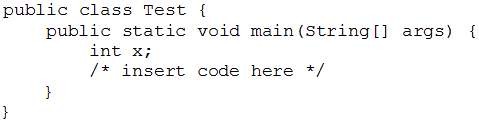
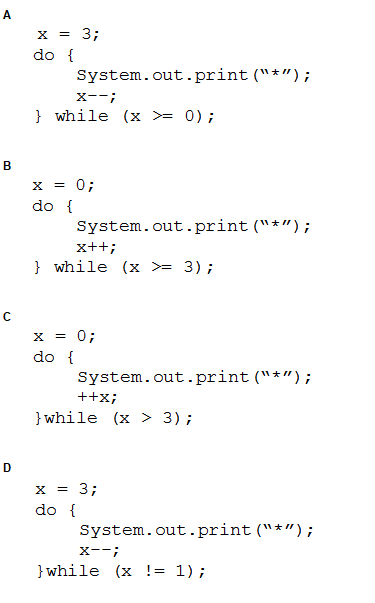
Given:

What is the result?

Show Answer Hide Answer
Correct Answer: B

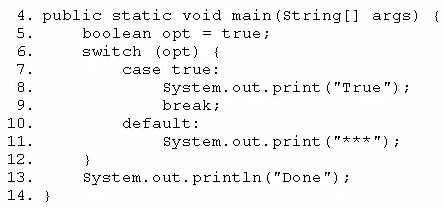
Question No. 4

Given:

What is the result?

Show Answer Hide Answer
Correct Answer: B

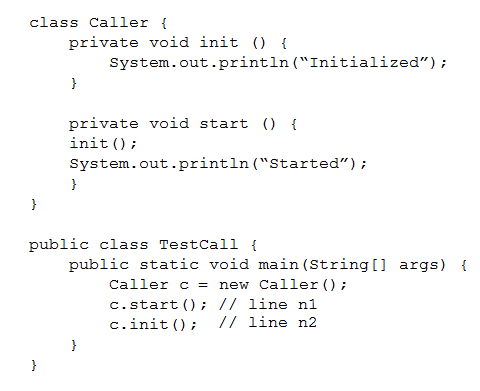
Question No. 5

You are asked to develop a program for a shopping application, and you are given this information:

The application must contain the classes Toy, EduToy, and ConsToy. The Toy class is the superclass of the other two classes.

The int calculatePrice (Toy t) method calculates the price of a toy.

The void printToy (Toy t) method prints the details of a toy.

Which definition of the Toy class adds a valid layer of abstraction to the class hierarchy?

Show Answer Hide Answer
Correct Answer: A