- Home
- OMG
- OMG-OCSMP-MBA400 Exam Questions
OMG OMG-OCSMP-MBA400 Practice Exam Questions & Answers
5 Free Questions
· Last reviewed: September 12, 2026
· Prepared & Reviewed by the ValidExamDumps Editorial Team
Exam Facts
OMG OMG-OCSMP-MBA400 Exam Details
Key details for this exam, checked against the published exam outline
90
Practice Questions (Our Bank)
- Exam Code
- OMG-OCSMP-MBA400
- Full Name
- OMG-Certified Systems Modeling Professional - Model Builder - Advanced
- Issuing Body
- Object Management Group
- Question Format (Our Bank)
- Multiple Choice
Practice Questions
Free OMG-OCSMP-MBA400 Practice Questions
Each question shows the correct answer and an explanation of why it is right
VA
ValidExamDumps Editorial Team
Every question and its answer is checked by our OMG-OCSMP-MBA400 exam
preparation team, who also write the explanation shown with each one.
How we research and review these pages
Choose the correct answer
An engineer wants to place formal pre-conditions and post-conditions on an activity diagram.
Which language is suitable and most compatible with SysML?
Correct Answer:
F
Choose the correct answer
How does SysML support systems engineering methodologies?
Correct Answer:
B
Explanation
SysML is a general-purpose modeling language for systems engineering that can support various systems engineering methodologies. The stereotype and profile mechanisms are features of SysML that enable customizing and extending the language for a specific domain or purpose. By using stereotypes and profiles, SysML can be adapted to fit different methodologies and conventions without changing the core language semantics
Choose the correct answer
Which statement about working in UPDM compliance level 1 is true?
Correct Answer:
B
Choose the correct answer
A system modeler exports requirements from a requirements management tool into a spreadsheet and then imports the requirements into a system modeling tool.
Which type of data exchange is this considered?
Correct Answer:
B
Choose the correct answer.
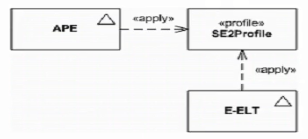
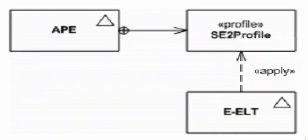
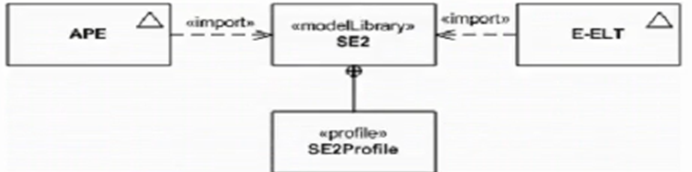
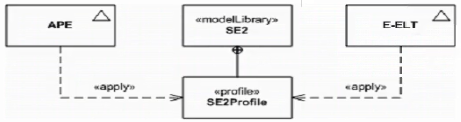
An engineer has defined a profile, SE2Profile, for the APE model. Another model, E-ELT, requires the same profile.
What is the best way to share the profile?
A)
B)
C)
D)
Correct Answer:
B
Study Guide
What the OMG OMG-OCSMP-MBA400 Exam Covers
4 domains from the OMG OMG-OCSMP-MBA400 exam outline, with approximate weightings. Every sample question above is tagged
with the domain it comes from
Domain 1: Concepts for Adapting SYSML Including METAMODELING, Profiles, Model Libraries, and Viewpoints
25%
Master SysML language customization through metamodel-based extensions and profile creation. Learn how to develop model libraries, define viewpoints, and extend SysML to meet specific organizational and project requirements.
Sample question from this domain above:
Q4
Domain 2: Integrating SYSML With Other Modeling Languages Such as UML MARTE, UPDM & MODELICA
20%
Understand how to integrate SysML with complementary modeling languages and tools across engineering disciplines. Study model interchange standards including XMI, RIF, and AP233 to enable effective collaboration across platforms.
Sample question from this domain above:
Q1
Domain 3: Methodology-Related Concepts and Practices Including Assessments of the Quality of Model
35%
Grasp system development methodologies from project inception through final design stages. Learn to apply OCL for formal constraints, evaluate model quality, and select appropriate methodologies for complex engineering projects.
Sample questions from this domain above:
Q2Q3Q5
Domain 4: Integrating SYSML MODELING Tools With Other Types of Tools and Tools Selection Criteria
20%
Learn to configure and integrate SysML modeling tools with requirements management, software, and hardware development tools. Understand configuration management integration and model interchange mechanisms to support enterprise-scale systems engineering.
FAQ
OMG-OCSMP-MBA400 Exam FAQ
Common questions about the exam itself
How does the Advanced level differ from earlier OCSMP levels?
The MBA400 Advanced exam assumes you have already passed the Model User and Model Builder - Fundamental and Intermediate certifications. It focuses on sophisticated topics like SysML adaptation, integrating multiple modeling languages, tool integration, and rigorous quality assessment. This level prepares you to architect and champion model-based systems engineering approaches across complex organizations.
Which objective area of the MBA400 exam do most candidates find most challenging?
Methodology and model quality assessment, at 35% of the exam weight, tends to be the most demanding because it requires hands-on experience with OCL formal specifications and real-world judgment about design decisions. Candidates benefit from practical project experience where they have evaluated and improved model quality across iterative development cycles.
What background and prerequisites do I need for the MBA400?
You must have already passed the OCSMP Model User certification, then the Model Builder - Fundamental level, and then the Model Builder - Intermediate level before sitting MBA400. You should have substantial hands-on experience building and refining SysML models in a real modeling tool, and familiarity with at least one other engineering modeling language such as UML, MARTE, or UPDM.
How long should I budget for preparation for the Advanced exam?
Most candidates with prior OCSMP certifications and SysML modeling experience require 40 to 60 hours of focused study, though this varies based on your depth of experience with model integration, OCL, and quality assessment practices. If you need to refresh prior OCSMP material or are new to tool integration, budget additional time.
What can I expect on MBA400 exam day?
The exam consists of scenario-based questions that assess your ability to make design decisions, solve integration problems, and evaluate modeling quality in realistic contexts. You will need to think through trade-offs in methodology selection, tool choices, and how to extend or adapt SysML for specific engineering challenges.
Are there prerequisites I need to pass first, or can I take the Advanced exam immediately?
No, you cannot take MBA400 directly. You must first pass the Model User exam, then the Model Builder - Fundamental, and then the Model Builder - Intermediate certifications. Each level builds on the previous one, and lower-level certifications are mandatory prerequisites.
How long does the MBA400 certification remain valid after I pass?
OMG does not publish a standard expiration date for OCSMP certifications in most of their marketing materials. You should check the official OMG certification website or contact OMG directly to confirm the current validity period and any renewal requirements.
What job roles or career paths does the MBA400 certification support?
The Advanced certification positions you for roles such as SysML architect, model-based systems engineering lead, or systems engineering consultant. Organizations value candidates who can customize SysML for their specific needs, integrate multiple modeling tools, and establish quality assurance practices for model-based development across teams.
How does the MBA400 relate to the other OCSMP certifications?
The OCSMP program has four levels: Model User (foundation), Model Builder - Fundamental, Model Builder - Intermediate, and Model Builder - Advanced (MBA400). MBA400 is the highest level and assumes mastery of all prior levels. It is designed for professionals who want to lead and champion sophisticated model-based systems engineering cultures within their organizations.

