Each question shows the correct answer and an explanation of why it is right
VA
ValidExamDumps Editorial Team
Every question and its answer is checked by our OMG-OCEB2-FUND100 exam
preparation team, who also write the explanation shown with each one.
How we research and review these pages
Explanation
This question tests your understanding of token flow in BPMN diagrams. When a token reaches activity B, it gets consumed by that activity as it processes. The token moves through the sequence flow into B, and B consumes it as part of normal BPMN execution semantics. Understanding how tokens flow through activities is fundamental to reading and creating BPMN models correctly.
Which process discovery technique obtains a detailed process topology definition?
Correct Answer:C
Explanation
Embedded sub-processes in BPMN have specific rules about their start events. An embedded sub-process can contain any type of start event, including None, Message, Timer, Conditional, Signal, Multiple, and Parallel Multiple start events. The answer reflects that there is no single required type, meaning all types are permitted. This is a core BPMN element rule.
Explanation
This question assesses your ability to interpret BPMN diagrams showing message flows between participants. When a message flow is shown connecting A to B in a BPMN diagram, it represents A sending a message to B. Message flows are distinct from sequence flows and illustrate communication between different pools or participants in the process model.
According to James F. Chang in Business Process Management Systems, which statement is a BPM principle?
Correct Answer:A
Explanation
The Business Motivation Model defines a mission statement as having four essential components. The key market part identifies where the organization operates. The customer part specifies who benefits from the organization. The contribution part describes what value the organization provides. The distinction part explains what makes the organization unique or different from competitors.
The chief economist of an airline projects increasing costs for jet fuel and believes those costs will hurt the airline's business.
This belief is modeled as which BMM noun concept?
Correct Answer:C
Explanation
The Business Motivation Model addresses the Planner's perspective of the Motivation aspect in the Zachman Architecture Framework. BMM specifically focuses on business motivation, strategy, goals, and vision, which corresponds to what planners need to understand about an organization's direction and intentions. This connection shows how BMM fits within broader enterprise architecture frameworks.
Explanation
This scenario describes a process with a time-based exception handling requirement. Step C must complete within 3 days, or the process should terminate with a failure. This is handled in BPMN using an Intermediate Timer Catch Event combined with an Error End Event or Exception Flow. The diagram would show the timer attached to a step or gateway and a flow leading to process termination when the timeout occurs.
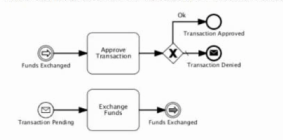
Which statement describes the execution flow shown in the diagram?
Correct Answer:A
Explanation
A run chart is a fundamental quality management tool used to track process performance over time. It displays data points in sequence, making it easy to spot trends, shifts, or patterns in process behavior. Run charts help identify whether a process is stable or showing signs of improvement or degradation, making them practical for quality monitoring in process governance frameworks.
Full Access
Get the complete OMG-OCEB2-FUND100 question set
90 questions covering all exam domains
Correct answers with explanations, like the free questions above
Covers BPMN v2.0.2 basics and all BPMN elements in the descriptive and analytic conformance subclasses. You will learn activities, grouping elements, and how to apply them in process models. Attributes are not covered.
Based on the Business Motivation Model v1.3, covering business vision, goals, objectives, means and ends, mission, strategies, and tactics. This domain connects business strategy to process modeling practice.
Tests your ability to work with BPMN scenarios presented as diagrams or text descriptions. All BPMN elements from Descriptive and Analytic Conformance Subclasses apply. You will analyze real-world situations and select appropriate modeling approaches.
Domain 4: Process Quality, Governance, and Metrics Frameworks 15%
Covers industry reference models including APQC, SCOR, Value Chain, BPMM, Six Sigma, Balanced Scorecard, COBIT, Basel II, and Sarbanes-Oxley. This domain shows how quality and governance practices support process improvement.
Domain 5: Business Process Concepts and Fundamental 11%
Focuses on identifying and discovering business processes, understanding process characteristics, and comparing As-Is versus To-Be process states. You will learn how to connect processes to business goals and objectives.
Domain 6: Business Process Management Concepts and Fundamentals 10%
Covers functional versus process-centric organization, styles of process management, and stakeholder roles. This domain explains how BPM works in practice and the tools that enable it.
Domain 7: Business Goals, Objectives 8%
Examines business fundamentals including strategy, planning, goal-setting, project management, marketing, staffing, and finance. Understanding these foundations helps you align process improvements with business outcomes.
FAQ
OMG-OCEB2-FUND100 Exam FAQ
Common questions about the exam itself
What background do I need before taking the OMG-OCEB2-FUND100 exam?
There are no formal prerequisites for the Fundamental exam. However, you should have a basic understanding of business operations and a genuine interest in process improvement. The exam is designed as an entry point to BPM certification for business analysts, process owners, project managers, and IT professionals.
How much time should I spend preparing for OMG-OCEB2-FUND100?
Most candidates need between 4 to 8 weeks of focused study, depending on their existing BPM knowledge and background. The exam covers seven distinct domains, so allocating time proportionally to the published weightings helps. Official OMG training courses typically run 3 to 5 days and provide structured preparation.
What makes the Process Quality, Governance, and Metrics Frameworks domain difficult?
Candidates often struggle with this 15% domain because it requires familiarity with multiple frameworks like BPMM, COBIT, Six Sigma, and Sarbanes-Oxley. The best approach is to focus on understanding the purpose and key characteristics of each framework rather than memorizing all details. Practice questions that compare frameworks help.
How is the exam delivered and what should I expect on test day?
The OMG-OCEB2-FUND100 is delivered online and proctored by Pearson VUE. You will answer 90 multiple-choice questions, some with BPMN diagrams embedded. English speakers get 90 minutes and non-English speakers get 120 minutes. You must schedule your exam through your Pearson VUE account and perform a system test before the exam date.
What is the passing score for OMG-OCEB2-FUND100 and how is it calculated?
You need 62 correct answers out of 90 questions to pass, which equals approximately 69%. This is a fixed score, not a curve. All questions are weighted equally, so there are no bonus or penalty questions.
How long is the OMG-OCEB2-FUND100 certification valid and how do I renew it?
Your certification stays valid for 3 years from your exam date. To extend it, you must pass the same level Fundamental exam or move to a higher level exam such as Business Intermediate or Technical Intermediate. There is no separate renewal process.
What is the cost of the OMG-OCEB2-FUND100 exam and are there regional differences?
The exam costs USD 250 in English-speaking countries and USD 260 in all other countries. Retakes cost USD 175 or USD 185 respectively. Some training providers bundle exam vouchers with courses at higher prices, so compare options before purchasing.
Can I reschedule or cancel my OMG-OCEB2-FUND100 exam after booking?
Yes, you can cancel or reschedule your exam through your Pearson VUE account. If you cancel more than 24 hours before your scheduled exam date, you get a full refund. Cancellations within 24 hours forfeit the exam price. Rescheduling requires cancelling your current booking and creating a new one.
How does OMG-OCEB2-FUND100 relate to the other OCEB 2 exams?
Fundamental is the entry level in OMG's three-tier BPM certification track. After passing it, you can pursue either the Business Intermediate or Technical Intermediate exam, depending on your career direction. The Advanced level exams come after Intermediate. Each level builds on the previous one.
Which job roles benefit most from the OMG-OCEB2-FUND100 certification?
This certification is valuable for business analysts, process owners, project managers, consultants, IT professionals, and students who work with or study business processes. It demonstrates that you can participate as a productive member of a BPM project team on either the business or technical side.
OMG-OCEB2-FUND100 · Full question set$20$4050% OFF