Nutanix NCP-NS Practice Exam Questions & Answers
7 Free Questions
· Last reviewed: October 13, 2026
· Prepared & Reviewed by the ValidExamDumps Editorial Team
Exam Facts
Nutanix NCP-NS Exam Details
Key details for this exam, checked against the published exam outline
106
Practice Questions (Our Bank)
120 minutes
Exam Duration
3000 out of 6000
Passing Score
USD 200
Official Exam Fee
- Exam Code
- NCP-NS
- Full Name
- Nutanix Certified Professional - Network & Security (NCP-NS) 7.5
- Issuing Body
- Nutanix
- Question Format (Our Bank)
- Multiple Choice
- Delivery
- Online proctored or at a Pearson VUE test centre
- Eligibility
- Approximately two years of experience in a Network or Security capacity and at least six months of hands-on experience with Nutanix Flow. Training such as Nutanix Network & Security Administration (NNSA) course is recommended.
Practice Questions
Free NCP-NS Practice Questions
Each question shows the correct answer and an explanation of why it is right
VA
ValidExamDumps Editorial Team
Every question and its answer is checked by our NCP-NS exam
preparation team, who also write the explanation shown with each one.
How we research and review these pages
An administrator has a VPC with a single active gateway node that successfully peers with an external router using a single BGP GW and session.
To eliminate a single point of failure, the administrator deploys a second BGP gateway to the VPC. After the second gateway is added and shows a healthy state, the external router still only sees a single BGP session.
What is the most likely reason for the second session not being established on the external router?
Correct Answer:
D
Explanation
When you add a second BGP gateway to a VPC, the gateway itself becomes available on the cluster, but it doesn't automatically establish a BGP session with external routers. Each BGP session requires explicit configuration that specifies which gateway node should peer with which external router and what BGP parameters to use. Simply having a healthy gateway node means the infrastructure is ready, not that peering relationships exist. You must create a separate BGP session configuration pointing to the external router from the second gateway for the session to be established.
An administrator manages a four-node cluster Each node has a 4 available 10GB uplinks, and all four are configured as an Active/Active bundle.
They want to use Flow Virtual Networking to provide networking to the VMs in the cluster with the following requirements:
VMs should be in a single VPC.
VMs should be reachable by their real IP addresses.
The VPC should have access to the most north/south bandwidth possible.
No changes can be made to the physical infrastructure.
How can this best be achieved?
Correct Answer:
C
Explanation
A single No-NAT External Network with all four gateway nodes allows VMs to use their real IP addresses without address translation, which satisfies the reachability requirement. Using four gateway nodes distributes the traffic load equally across all available uplinks, maximizing north-south bandwidth capacity. This approach avoids routing asymmetry that could occur with fewer gateways and doesn't require any physical infrastructure changes. A NAT configuration would translate addresses and reduce available bandwidth, while single or dual gateway options would underutilize the available uplinks.
An administrator has been tasked with creating a security policy to protect specific virtual network interfaces (vNICs) within a VM in a Flow Virtual Networking setup.
How can the administrator ensure that only a specific vNIC is protected by the policy?
Correct Answer:
B
Explanation
In Flow Network Security, policies are typically applied at the subnet level through categorization rather than individual vNIC selection. When you categorize a specific subnet, any vNIC connected to that subnet automatically falls under the policy protection. Since vNICs are identified by their network membership, applying subnet-level categorization effectively protects only the specific vNIC or vNICs connected to that categorized subnet. This approach is simpler and more maintainable than trying to create vNIC-specific rules directly.
An enterprise has deployed a VPC called FinanceVPC using Nutanix Flow Virtual Networking. The Finance team needs the following connectivity:
Internal servers in the VPC must reach an on-premises corporate data-center via a point-to-point encrypted link.
Some servers in the VPC must also access the public internet with source NAT and receive inbound access via floating IPs.
The corporate network uses overlapping IP space with other VPCs in the environment, so address translation is necessary for those workloads.
The networking design must support routing via BGP for future site expansions and provide low-latency north-south connectivity.
Which actions should the administrator take to satisfy this requirement?
Correct Answer:
C
Explanation
This scenario requires two separate external networks because the traffic patterns and requirements differ. A No-NAT External Network preserves the real IP addresses needed for the point-to-point encrypted link to the on-premises datacenter. A NAT External Network handles source NAT for internet traffic and manages the floating IPs for inbound access. Configuring a VPN tunnel and enabling BGP on the No-NAT external network allows secure, low-latency connectivity to the corporate datacenter while supporting future expansion. This dual approach elegantly separates the routing logic needed for each connectivity model.
Flow Network Security Next-Gen is supported in which two environments? (Choose two.)
Correct Answer:
A, C
Explanation
Identity-based policies in Flow rely on accurate Active Directory group membership mapping. If specific AD group members cannot access VMs while others can, the issue is that those affected users are either not in the mapped AD group or the group membership is incorrect. Verifying AD group membership confirms whether the identity policy is mapped to the right group and whether those users are actually members. This directly addresses the identity-based policy troubleshooting needed here.
An administrator has configured two VPCs with overlapping externally routable prefixes (ERPs). The two VPCs are associated to separate external networks that are part of the same physical routing domain.
What outcome should the administrator expect?
Correct Answer:
A
Explanation
When two VPCs have overlapping externally routable prefixes and both external networks belong to the same physical routing domain, the routing infrastructure cannot distinguish which VPC should receive traffic destined for that prefix. This creates ambiguity in the routing tables. External paths become unreachable because routers don't know whether to forward packets to one VPC's gateway or the other. The overlapping address space in the same routing domain makes it impossible to reliably deliver traffic to the correct destination.
Refer to th exhibit.
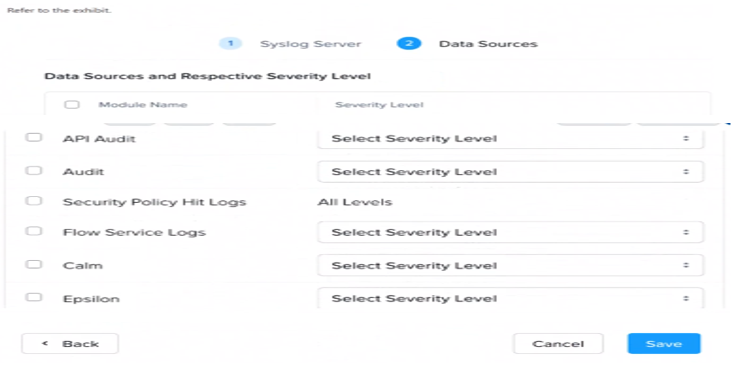
An administrator needs to setup a Syslog server to capture the Flow Network Security Hit logs.
Which module name should be selected?
Correct Answer:
C
Full Access
Get the complete NCP-NS question set
- 106 questions covering all exam domains
- Correct answers with explanations, like the free questions above
- PDF and online practice test
- 90 days of free updates
Domain 1: Configure Flow Virtual Networking
Build virtual private clouds and overlay networks by creating VPCs, configuring external networks, defining routes, and setting up connectivity options including NAT, BGP peering, and network load balancers. You'll determine when to use tenant versus transit VPCs and associate appropriate routed and private CIDR ranges.
Sample questions from this domain above:
Q2Q4Q6
Domain 2: Configure Flow Network Security
Analyze application flows and design security policies by monitoring traffic in detection mode, defining isolation and application policies, and configuring identity-based rules. You'll use policy visualization tools to document flows before enforcing rules and understand policy lifecycle management across different security scenarios.
Sample questions from this domain above:
Q3Q5
Domain 3: Troubleshoot Flow Virtual Networking
Diagnose and resolve connectivity issues within VPCs and external networks by analyzing gateway health, BGP session logs, IPFIX exports, and network controller alerts. You'll identify why VMs cannot reach destinations and verify the status of infrastructure components that support virtual networking.
Sample question from this domain above:
Q1
Domain 4: Troubleshoot Flow Network Security
Investigate denied and allowed traffic using security policy hitlogs and audit trails. You'll identify policy priority conflicts, diagnose identity-based policy failures related to Active Directory configuration, and troubleshoot service insertion and MTU-related issues affecting North-South traffic.
Sample question from this domain above:
Q7
Domain 5: Deploy and Upgrade a Flow Environment
Prepare clusters for Flow deployment by enabling Network Controller and Flow Network Security, confirming version compatibility, and setting virtual switch MTU. You'll plan upgrade paths, configure role-based access control with appropriate user roles and permissions, and manage cluster dependencies during upgrades.
FAQ
NCP-NS Exam FAQ
Common questions about the exam itself
What experience level is required before attempting the NCP-NS 7.5 exam?
Successful candidates have approximately two years of experience in a Network or Security capacity and at least six months of experience with Nutanix Flow. Candidates are typically Network Engineers, Network Administrators, Network Architects, Security officers, or Security Administrators.
How difficult is the NCP-NS exam compared to other Nutanix professional certifications?
The NCP-NS tests five operational domains across Flow Virtual Networking and Flow Network Security on Nutanix AHV infrastructure. The exam emphasizes applied skills over memorization, requiring hands-on understanding of deploying, managing, and troubleshooting Nutanix Flow in production environments.
What is the structure of the NCP-NS 7.5 exam?
The exam consists of 75 multiple-choice questions across a two-hour window, with a passing score of 3000 on a 6000-point scale.
Which objective area on NCP-NS do candidates typically find most challenging?
Troubleshooting objectives require interpreting logs, alerts, and network states to diagnose complex connectivity and security issues. Success here demands hands-on experience with actual Flow deployments, not just theoretical knowledge of how VPCs and policies work in isolation.
How long does it typically take to prepare for NCP-NS 7.5?
Candidates should most likely have taken training courses, such as the Nutanix Network & Security Administration (NNSA) course. Most professionals with the required six months of Flow experience can prepare in 2-4 weeks using official documentation, practice labs, and hands-on configuration of VPCs, policies, and troubleshooting scenarios.
What should I expect on exam day for NCP-NS?
You'll sit a proctored online exam or attend a Pearson VUE test centre. The exam is delivered through the standard Nutanix testing platform and is available in English and Japanese. You receive 120 minutes to complete 75 scenario-based questions that simulate real Flow operations.
What is the relationship between NCP-NS 7.5 and the other Nutanix professional certifications?
NCP-NS focuses specifically on Nutanix Flow for network virtualization and security. It sits alongside other professional certifications like NCP-MCI (infrastructure administration) and NCP-CN (Kubernetes), allowing specialists to validate expertise in their domain while building on foundational skills.
What is the exam fee and what payment options are available?
The exam costs $200 per attempt. Nutanix pricing is typically fixed per exam attempt. Check the official Nutanix certification store or contact Nutanix University to confirm accepted payment methods and any regional variations.
Can I retake NCP-NS if I fail, and is there a waiting period?
Nutanix allows retakes after a failed attempt, though specific rescheduling policies are managed through the exam delivery platform. Contact Nutanix University or your exam provider directly to confirm current retake policies, waiting periods, and any applicable restrictions.
What job roles benefit most from the NCP-NS certification?
The certification suits Network Engineers, Network Administrators, Network Architects, Security officers, and Security Administrators who have experience in deploying, managing, and troubleshooting network virtualization and network security using Nutanix Flow.

