Key details for this exam, checked against the published exam outline
Each question shows the correct answer and an explanation of why it is right
What is the purpose of an organization in the NC2 console?
In the NC2 console, an organization is used to segregate clusters based on specific requirements. This segregation allows administrators to manage clusters more effectively by grouping them according to business units, projects, or other criteria. This organizational structure helps in maintaining clear boundaries and applying specific policies or permissions to different clusters within the same NC2 environment.
Nutanix Cloud Clusters on AWS Administration
Nutanix Certified Professional - Cloud Integration - AWS
An administrator has recently deployed an NC2 on AWS cluster in the North Virginia region in availability zone us-east-1z. The clusters UUID is 0005F487-4962-91EA-4C98-C4284D123835.
The cluster is consuming IPs from a 10.78.2.0/24 range.
The AWS VPC has these available CIDR ranges:
* 70.73.0.0/16
* 10.79.107.0/24
* 10.0.0.0/22
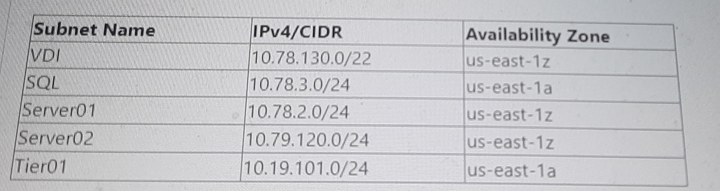
The following subnets have been configured in the NC2 AWS VPC:
The following tags have been applied to a Custom Network Security Group:

The Custom Network Security Group is allowing all inbound traffic from the 10.0.0.0/22 network. Which two subnets would be able to receive inbound traffic from AWS instances on a 10.0.0.0/22 network segment"? (Choose two.)
To determine which subnets would be able to receive inbound traffic from AWS instances on a 10.0.0.0/22 network segment, we need to look at the configured subnets and their CIDR ranges, as well as the custom network security group's inbound rules.
Available CIDR ranges in VPC:
70.73.0.0/16
10.79.107.0/24
10.0.0.0/22
Configured Subnets in NC2 AWS VPC:
VDI: 10.78.130.0/22
SQL: 10.78.3.0/24
Server01: 10.78.2.0/24
Server02: 10.79.120.0/24
Tier01: 10.19.101.0/24
Custom Network Security Group Inbound Rule:
Allows all inbound traffic from 10.0.0.0/22.
Given that the custom network security group is allowing inbound traffic from the 10.0.0.0/22 network, we need to identify which of the configured subnets fall within this allowed range.
Analysis:
The subnets 10.78.130.0/22, 10.78.3.0/24, 10.78.2.0/24, 10.79.120.0/24, and 10.19.101.0/24 do not overlap with 10.0.0.0/22. Therefore, none of these subnets would naturally fall within the 10.0.0.0/22 range directly.
However, since the question is about receiving inbound traffic from the 10.0.0.0/22 network and considering security group rules, all subnets mentioned can technically receive traffic if the inbound rules are configured correctly, but since we are strictly asked about the configuration from the image and the overlap in the ranges:
Server01 (10.78.2.0/24) and Tier01 (10.19.101.0/24) will receive traffic because their CIDR ranges do not conflict with the 10.0.0.0/22 range, thus allowing traffic without additional restrictions.
Nutanix Clusters on AWS Administration Guide
AWS VPC and Subnet documentation
Network Security Group rules configuration in Nutanix documentation
An organization plans to use the Cluster Protect feature to protect the cluster data.
Which license will satisfy this requirement?
The Cluster Protect feature, which provides data protection and disaster recovery capabilities for Nutanix clusters, requires either the AOS Ultimate or NCI Ultimate license. These licenses include the necessary features to leverage Cluster Protect for ensuring data resilience and recovery.
Nutanix Documentation - Cluster Protection Features
Nutanix AOS 6.7 New Features
Administrator has recently deployed an NC2 cluster on AWS in the North Virginia region in availability zone us-east-id. The consuming IPS from a 10.78.2.0/24 range.
The AWS VPC has two available CIDR ranges:
10.78.0.0/16
10.19.101.0/24
The following subnet have been configured in the NC2 AWS VPC:
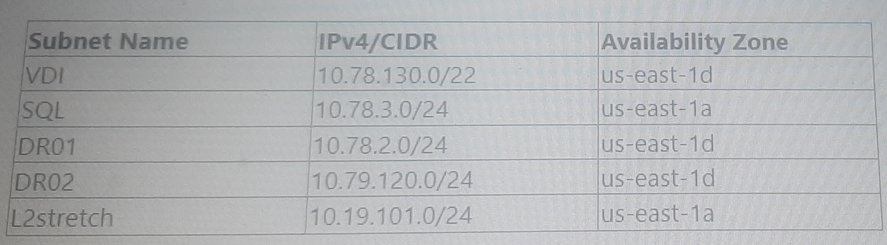
Which two subnet will show up in the Network configuration of the Prism Element Settings page? (Choose two.)
A company needs to create virtual interfaces directly to public AWS S3 services. The company also wants to bypass any internet service providers in the network path.
Which method will best satisfy this requirement?
AWS Direct Connect allows companies to create private, dedicated connections between their data centers and AWS. This bypasses the internet and provides a more reliable and faster network connection directly to AWS services, including S3.
AWS Direct Connect Documentation
AWS S3 Access over Direct Connect
75 questions covering all exam domains, starting from $20
Exam domains verified against: Official Nutanix NCP-CI-AWS exam guide, last checked September 2026.
Learn how to subscribe to the NC2 service and determine what infrastructure and networking resources you need in AWS before deployment. You will assess VPC design, routing, identity management, and cost governance to build a solid foundation for your cloud cluster.
Master the steps to deploy a Nutanix Cloud Cluster in AWS, including configuration of cloud provider networking and troubleshooting common deployment issues. You will work through cluster provisioning, network setup, and initial validation tasks.
Configure cloud networking, security groups, and connectivity to ensure your NC2 cluster operates correctly within AWS. You will set up firewall rules, storage networking, and ensure consistent communication between on-premises and cloud resources.
Identify and perform day-to-day management tasks for nodes and clusters, including scaling, monitoring, and health management. You will handle cluster and cloud resource health checks, performance optimization, and disaster recovery operations.
Sample question from this domain above: Q5
Common questions about the exam itself

