Nokia 4A0-C04 Practice Exam Questions & Answers
7 Free Questions
· Last reviewed: October 12, 2026
· Prepared & Reviewed by the ValidExamDumps Editorial Team
Exam Facts
Nokia 4A0-C04 Exam Details
Key details for this exam, checked against the published exam outline
298
Practice Questions (Our Bank)
120 minutes
Exam Duration
USD 375
Official Exam Fee (United States)
- Exam Code
- 4A0-C04
- Full Name
- Nokia NRS II Composite Exam: OSPF version
- Issuing Body
- Nokia
- Question Format (Our Bank)
- Multiple Choice
- Delivery
- Online proctored or at a Pearson VUE test centre
- Eligibility
- None
Practice Questions
Free 4A0-C04 Practice Questions
Each question shows the correct answer and an explanation of why it is right
VA
ValidExamDumps Editorial Team
Every question and its answer is checked by our 4A0-C04 exam
preparation team, who also write the explanation shown with each one.
How we research and review these pages
Click on the exhibit.
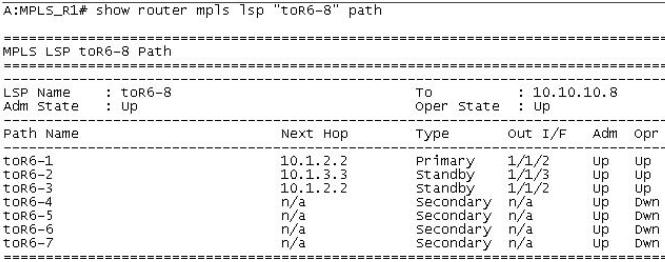
If the primary path fails, which backup LSP path will the head-end router pick first?
Correct Answer:
C
Explanation
When a primary LSP fails, the head-end router needs to select a backup path. Among available standby LSPs, the router chooses the one with the longest uptime because this indicates the most stable and reliable backup path. An LSP with longer uptime has proven its stability over time, making it the safer choice compared to newer standby paths that may not have been tested under sustained traffic conditions.
Which of the following best describes downstream on demand label distribution?
Correct Answer:
C
Explanation
Downstream on demand is a label distribution mode where an LSR waits for an explicit request before it sends label mappings for a particular FEC. This differs from unsolicited downstream mode, where labels are distributed proactively without waiting for a request. In on demand mode, the LSR only acts when asked, which can help reduce the number of labels in the network and make the process more controlled.
Which of the following statements regarding area border routers in an OSPF network is true?
Correct Answer:
C
Explanation
Area border routers serve a specific architectural function in OSPF networks. They connect different OSPF areas together and link non-backbone areas to the backbone area. ABRs run multiple OSPF processes and advertise routes between areas. Without ABRs, areas would be isolated from each other, so they form the critical connections that enable communication across the entire OSPF domain.
By default, how does a VPLS handle a tagged frame received at the ingress of a null SAP on an Nokia 7750 SR?
Correct Answer:
C
Explanation
A null SAP is a service access point that matches all traffic regardless of VLAN tag. When a tagged frame arrives at a null SAP ingress, the Nokia 7750 SR verifies the frame check sequence for data integrity and then removes it since it will be recalculated at egress. However, the VLAN tag itself is preserved and travels with the frame across the network so that it can be used at the egress point for proper frame forwarding.
Click the exhibit button.
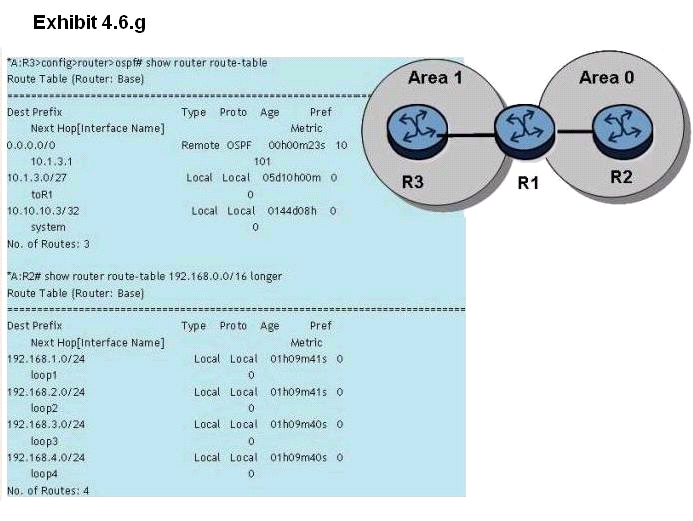
Given the topology and the show commands, and assuming that router R2 advertises all of its loopbacks into OSPF, what is the correct router R1 configuration?
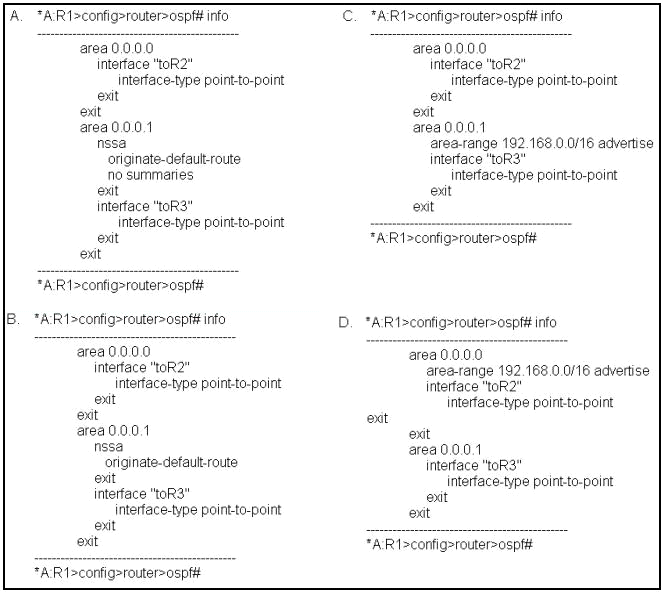
Correct Answer:
A
Explanation
For a VPWS service that originates and terminates on the same Nokia 7750 SR router, at least two SAPs are required, not just one. A VPWS is a point-to-point service that requires two endpoints connected through a service tunnel. Even when both endpoints exist on the same physical router, the service architecture mandates that two separate SAPs define the ingress and egress points of the service. This prevents the statement from being true and makes it the false option among the choices provided.
Click the exhibit button.
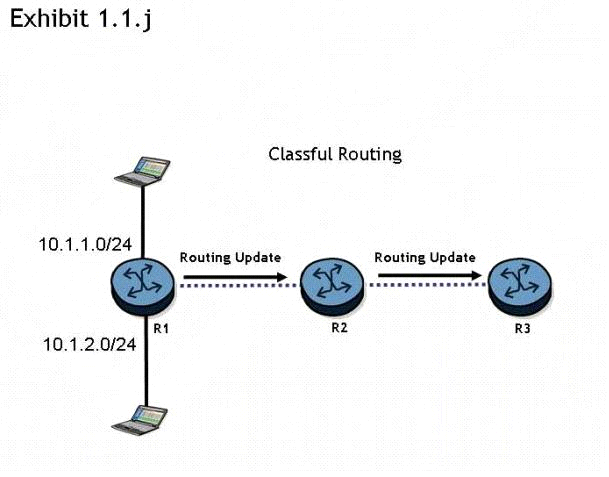
Routers R1 R2, and R3 are running a classful routing protocol between them. Assuming that router R1 advertises all directly connected networks, how will these networks be represented in router R3's routing table?
Correct Answer:
C
Explanation
In a classful routing protocol like RIPv1, subnets from the same classful network are automatically aggregated into a single entry. The networks 10.0.0.0 through 10.255.255.255 all belong to the class A network 10.0.0.0 with mask 255.0.0.0. When these are advertised and learned, the router combines them into one routing table entry showing 10.0.0.0 with the classful mask of /8.
Click the exhibit button.
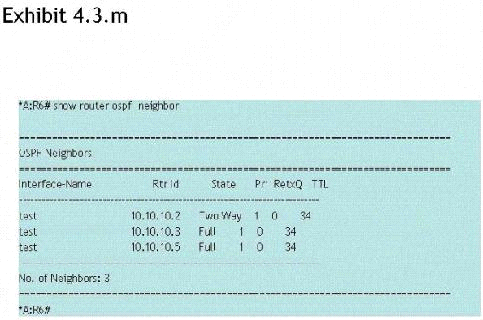
What can you deduce from the show command on router R6?
Correct Answer:
B
Explanation
The show command output indicates that router R6 is participating in OSPF on a multi-access network segment, evidenced by the state information and neighbor details. The fact that R6 is listed as neither DR nor BDR means it is a DRother router. The command shows the interface has elected neighbors but does not explicitly state which one is the DR and which is the BDR, so you cannot definitively determine their roles from this output alone.
Full Access
Get the complete 4A0-C04 question set
- 298 questions covering all exam domains
- Correct answers with explanations, like the free questions above
- PDF and online practice test
- 90 days of free updates
Domain 1: Nokia OSPF Routing Protocol
For network engineers and administrators working with Nokia systems, this exam section explores the core concepts of the OSPF routing protocol. It covers OSPF functionality, different area classifications, various LSA categories, and how to set up OSPF on Nokia routing equipment.
Sample questions from this domain above:
Q3Q5Q6Q7
Domain 2: Nokia Border Gateway Protocol Fundamentals for Services
For network architects and service providers utilizing Nokia hardware, this part concentrates on BGP and its service-related applications. The content encompasses BGP essentials, methods of route reflection, the use of BGP communities, and how to implement BGP for specific services on Nokia systems.
Domain 3: Nokia Multiprotocol Label Switching
For network engineers and designers working on Nokia MPLS solutions, this exam segment focuses on MPLS technology. Topics include the basics of MPLS, an overview of LDP, techniques for MPLS Traffic Engineering, and instructions for configuring MPLS VPNs on Nokia hardware.
Sample questions from this domain above:
Q1Q2
Domain 4: Nokia Services Architecture
This section examines Nokia's service architecture methodology for service architects and network designers working with the company's service-centric solutions. It includes different service categories, QoS implementation techniques, and service rollout strategies for Nokia platforms.
Sample question from this domain above:
Q4
FAQ
4A0-C04 Exam FAQ
Common questions about the exam itself
How difficult is the 4A0-C04 exam compared to taking the four individual NRS II exams separately?
The 4A0-C04 composite exam combines all content from the four individual NRS II exams (OSPF, BGP, MPLS, and Services Architecture) into a single 120-minute test with 70 questions. You are tackling the same body of knowledge but in one sitting rather than four separate exams, so the time pressure is more intense.
What experience do I need before sitting the 4A0-C04 exam?
There are no mandatory prerequisites listed for 4A0-C04. However, Nokia recommends attending the relevant courses or purchasing the course materials for each of the four content areas: OSPF Routing Protocol, BGP Fundamentals for Services, Multiprotocol Label Switching, and Services Architecture.
Which objective area in 4A0-C04 do most candidates struggle with?
MPLS concepts and configuration tend to be the most challenging for candidates because they build on foundational routing knowledge and involve more complex forwarding mechanics. Start with the MPLS and BGP sections during your study and allow extra time to work through practical lab scenarios.
How long should I prepare for the 4A0-C04 exam?
Most candidates spend 8 to 12 weeks preparing for the composite exam, depending on their existing knowledge of Nokia systems and routing protocols. If you are new to Nokia routing, plan for at least 12 weeks of study time.
What happens on exam day for 4A0-C04?
Your total appointment is 140 minutes. The first 20 minutes covers an introductory survey, and then you have 120 minutes to answer 70 questions. You can take the exam online proctored or at a Pearson VUE test centre.
Can I retake the 4A0-C04 exam if I fail, and how long must I wait?
The official Nokia exam page does not publish retake policies. Contact Nokia directly or check with the Pearson VUE test centre where you plan to sit the exam for their retake scheduling rules.
How long is the Nokia Network Routing Specialist II certification valid after passing 4A0-C04?
The Nokia exam page does not specify a validity period for the NRS II certification. You should contact Nokia training support to confirm whether the certification has an expiration date or renewal requirements.
What job role does the NRS II certification prepare me for?
The Nokia Network Routing Specialist II certification is designed for network engineers, administrators, and architects working with Nokia service routing platforms. It validates your ability to design, implement, and troubleshoot advanced IP, OSPF, BGP, MPLS, and service architectures on Nokia equipment.
How does 4A0-C04 fit into the broader Nokia certification path?
4A0-C04 grants credit toward the Nokia Network Routing Specialist II (NRS II) certification. You can use this composite exam as an alternative to passing the four individual exams separately, and NRS II is often a stepping stone toward the higher-level Nokia Service Routing Architect (SRA) certification.

