Each question shows the correct answer and an explanation of why it is right
VA
ValidExamDumps Editorial Team
Every question and its answer is checked by our 4A0-116 exam
preparation team, who also write the explanation shown with each one.
How we research and review these pages
Which of the following statements about Multi-Protocol Label Switching networks is FALSE?
Correct Answer:D
Explanation
The data is transparently carried from end to end: This statement is not true, MPLS does not provide data transparency, which means that the data is not carried unmodified from end to end. MPLS uses labels to forward data, so the original IP packets are encapsulated in new MPLS packets, and the original IP headers are not visible at the egress LSR.
Which of the following statements about enabling and using traffic engineering for Segment Routing is FALSE?
Correct Answer:C
Explanation
Bandwidth availability can be configured as a link attribute in SR-TE, it is used to control the amount of traffic that can be sent over a particular link.
Which of the following statements about Segment Routing tunnels is FALSE?
Correct Answer:D
Explanation
an intermediate router in a Segment Routing tunnel may forward packets based on the specific SIDs defined in the Segment Routing tunnel and not always the best IGP path.
Which of the following steps is NOT required when configuring IS-IS to support Segment Routing?
Correct Answer:B
Explanation
Enable interfaces used for Segment Routing under: This step is not required, enabling interfaces used for Segment Routing is not necessary as the IS-IS protocol already takes care of the flooding of the routing information.
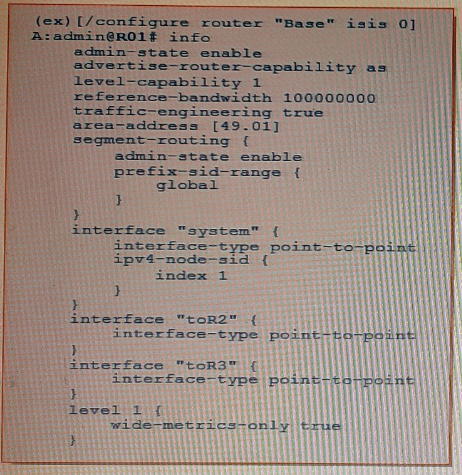
Based upon the exhibit, which of the following statements regarding the configuration is FALSE?
Correct Answer:A
Explanation
Traffic engineering information in Segment Routing is advertised for links that have TE extensions enabled on the IGP, not specifically requiring MPLS and RSVP to be enabled together. The statement is false because it incorrectly ties TE advertisement to the combination of MPLS and RSVP. TE attributes flow through IS-IS or OSPF TE extensions independently of whether RSVP is configured on those interfaces.
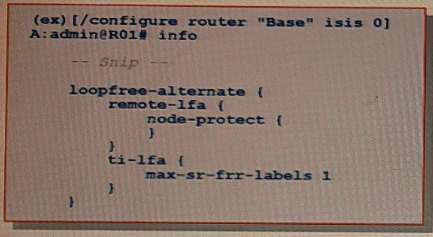
The exhibit shows the fast re-route configuration on router R1, in which both R-LFA and TI-LFA have been enabled. Assume that there are multiple potential backup paths for a given prefix. Which of the following options will router R1 use?
Correct Answer:D
Explanation
The exhibit shows that both R-LFA and TI-LFA have been enabled on router R1. R-LFA (Remote Loop-Free Alternate) is a method that is used to protect the active segment of a tunnel, and it allows the router to find a backup path that coincides with the path that will become active after IGP reconvergence. TI-LFA (Topology Independent LFA) is a method that is used to protect an end-to-end multi-segment tunnel, it allows the router to find a backup path that does not rely on the IGP topology, but on the segment routing topology.
With R-LFA and TI-LFA enabled, router R1 will use a D-LFA (Dual-Loop-Free Alternate) path, which is a combination of both R-LFA and TI-LFA, this path will coincide with the path after IGP re-convergence.
A standard LFA, R-LFA, and D-LFA which do not coincide with the path after IGP re-convergence are not the options.
Which of the following list of SR-TE attributes has to be advertised among routers?
Correct Answer:A
Explanation
In SR-TE, routers need to advertise certain attributes of their links to other routers in the network in order to calculate traffic-engineered paths. These attributes include:
Administrative groups that each link belongs to: This information is used to restrict the use of certain links to specific traffic types or groups.
TE metric of links: This information is used to calculate the cost of using a particular link for a traffic-engineered path.
Bandwidth availability of each link: This information is used to control the amount of traffic that can be sent over a particular link.
SRLG that each link belongs to: This information is used to avoid routing over the same physical link. Link status up/down is not needed to be advertised as it is part of the IGP protocol and is used to check the reachability of a link.
Full Access
Get the complete 4A0-116 question set
40 questions covering all exam domains
Correct answers with explanations, like the free questions above
Domain 1: Module 1 - Introduction to segment routing
Understand the drivers for data tunneling and how MPLS encapsulates and forwards data. Learn the fundamentals of segments, segment IDs, and how segment routing differs from traditional label signaling protocols like LDP and RSVP-TE.
Master IGP extensions needed for segment routing and configure IS-IS and OSPF to support it. Set up segment routing tunnels that automatically follow the shortest path calculated by your link-state routing protocol.
Apply traffic engineering to segment routing by configuring IS-IS and OSPF TE extensions, calculating TE-constrained paths, and reducing label stack overhead. Handle LSP path diversity, secondary paths, and failover behavior for SR-TE tunnels.
Domain 4: Module 4 - SR-TE with a path computation element
Delegate LSP path computation to a PCE using PCEP protocol instead of calculating paths locally on the PE router. Configure Nokia NSP to compute segment routing LSPs with traffic engineering constraints for cross-area and complex topologies.
Domain 5: Module 5 - Segment routing fast re-route
Implement local fast re-route protection using Loop-Free Alternates, Remote LFA, Directed LFA, and Topology-Independent LFA paths. Understand the precedence of different LFA options and when each provides the best protection.
Flexible algorithm basics; Flexible algorithm configuration; Advertisement of flex-algo information by IS-IS; Advertisement of flex-algo information by OSPF; Fast re-route for flex-algo instances; Steering traffic into flex-algo segment routing tunnels
FAQ
4A0-116 Exam FAQ
Common questions about the exam itself
What background do I need before taking 4A0-116?
Nokia lists no mandatory prerequisites, but you should have hands-on experience with Nokia IP/MPLS routers and solid understanding of segment routing concepts, IS-IS, OSPF, MPLS, and traffic engineering. The exam assumes you know how to navigate Nokia's 7750 SR or similar platforms.
Is 4A0-116 harder than the routing protocol exams like 4A0-112?
Yes, 4A0-116 requires intermediate to advanced knowledge of segment routing and focuses heavily on configuration and operational scenarios rather than theory. The scenario questions demand you understand how to combine constraints, policies, and path computations to solve real network problems.
Which module in 4A0-116 trips up most candidates?
Module 3 on SR-TE with traffic engineering constraints tends to be the hardest because it combines configuration syntax with understanding how constraint combinations and affinity values actually steer tunnels through specific paths in a topology. Scenario questions frequently test your ability to select the right constraint ordering.
How long should I study for 4A0-116?
Most candidates spend 4 to 8 weeks preparing, depending on their MPLS and routing background. If you are already familiar with MPLS TE and IGPs, you can prepare faster. The Nokia Segment Routing course takes several days of instructor-led training or self-paced study.
What happens on exam day for 4A0-116?
You have 90 minutes to answer 40 questions in the actual testing window. Your full appointment is 110 minutes, which includes a 20-minute introductory survey. Questions are multiple-choice and scenario-based, and you can take the exam online proctored or at an authorized testing center.
Can I retake 4A0-116 if I don't pass?
Nokia's retake policy is not published on the official exam page. Contact Nokia or your authorized testing center for details on how many times you can retake the exam and what waiting period applies between attempts.
How long does the Nokia Service Routing Architect certification stay valid after passing 4A0-116?
Nokia does not publish a validity period on the 4A0-116 exam page. You should check the certification track requirements for the Nokia Service Routing Architect to see if certifications need renewal or if 4A0-116 is a permanent credential.
What job role does 4A0-116 prepare me for?
4A0-116 is a step toward the Nokia Service Routing Architect certification, which targets network architects and senior engineers designing and operating carrier-grade IP/MPLS networks. It qualifies you to design and deploy segment routing in production networks using Nokia platforms.
How does 4A0-116 fit into the Nokia Service Routing Architect track?
4A0-116 is one of several exams required for the SRA certification. It covers segment routing specifically, while other exams cover IGPs, MPLS, and platform-specific skills. You may also need to complete IS-IS or OSPF routing protocol exams depending on the certification path structure.
Is PCE configuration in 4A0-116 practical or mostly theoretical?
Module 4 on SR-TE with a path computation element is practical and expects you to know how to configure Nokia NSP to compute LSPs using PCEP protocol. Questions test your understanding of when to delegate computation to a PCE versus calculating paths locally on the PE router, and how stateful versus stateless PCEs behave differently.