Key details for this exam, checked against the published exam outline
Each question shows the correct answer and an explanation of why it is right
Refer to the exhibit.
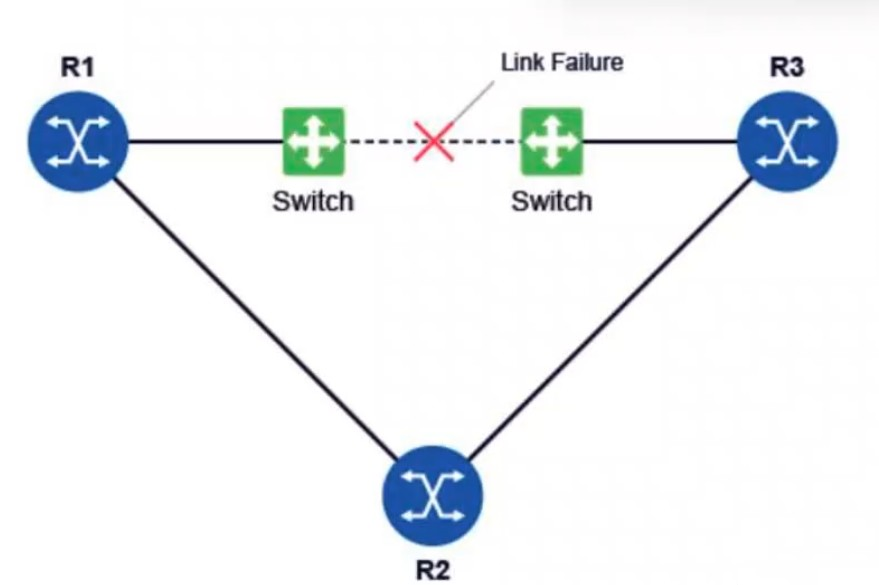
All routers in the diagram are running a link-state routing protocol. Before the link failure, all routers have operational adjacencies with each other and there is a BFD session between routers R1 and R3. After the link failure, which of the following affects the routing protocol's convergence time?
BFD (Bidirectional Forwarding Detection) is used to detect link failures quickly and helps improve convergence time in link-state routing protocols. The BFD session between routers R1 and R3 allows them to detect the failure of the link between them more quickly than the regular routing protocol hello timers. The transmit interval, receive interval, and multiplier settings determine how fast BFD detects a failure and triggers the routing protocol to converge, which directly impacts the convergence time.
On a broadcast interface, an IS-IS router receives an LSP that is newer than the one on its database. Which of the following statements best describes the actions taken by the router as a consequence?
When an IS-IS router receives a newer LSP (Link-State PDU) than the one already in its database, it takes the following actions:
Updates its link-state database with the new LSP.
Acknowledges the LSP with a PSNP (Partial Sequence Number PDU), which is sent to the router that originated the LSP, confirming the receipt of the newer LSP.
Floods a copy of the updated LSP to its neighbors on other interfaces to ensure all routers in the network have the updated topology information.
Which of the following is a valid alternative representation of the IPv6 address
2001:0da8:0000:0000:0024:0000:4ab9:0300?
In IPv6, consecutive sections of zeros can be abbreviated with a double colon (::) once in an address. Also, leading zeros in each hextet (group of four hexadecimal digits) can be removed.
The original address is 2001:0da8:0000:0000:0024:0000:4ab9:0300.
Removing leading zeros and applying the abbreviation:
A router running a link-state routing protocol detects that one of its neighbors is no longer connected to it. The router generates a new link-state advertisement to inform other routers of the topology change. Which of the following is NOT an action that is triggered by this event?
When a router receives a link-state advertisement (LSA), it does not update the age field before forwarding it. The age field in an LSA is typically updated by the originating router or during the process of forwarding the LSA within the network. Routers do not modify the age field upon receiving and forwarding an LSA.
When using IS-IS in native mode for routing in a dual-stack IPv4/IPv6 environment, which of the following statements is FALSE?
In a dual-stack IPv4/IPv6 IS-IS environment, the SPF (Shortest Path First) algorithm is only run once per router for each protocol (IPv4 or IPv6). The topology is shared, but the SPF calculations for IPv4 and IPv6 are separate. This means that the SPF algorithm will run twice (once for IPv4 and once for IPv6) for each L1/L2 router, not four times.
An IS-IS router receives a CSNP that references an older LSP than the one in its local database. What action is taken?
When a router receives a CSNP (Complete Sequence Number PDU) that references an older LSP (Link-State PDU) than the one in its local database, it indicates that the neighbor is missing newer information.
In response, the router sends back a PSNP (Partial Sequence Number PDU) to the neighbor, which includes a copy of the LSPs it has in its local database that the neighbor may not yet have. This helps to synchronize the link-state information between routers.
There are several differences between IS-IS Hello packets used on broadcast interfaces and on point-to-point interfaces.
Which of the following statements is FALSE?
In both broadcast and point-to-point interfaces, IS-IS routers identify neighbors using system IDs, not interface MAC addresses. The system ID is a unique identifier assigned to each router, and it is used to identify neighbors in both types of interfaces.
Exam domains verified against: Official Nokia 4A0-112 exam guide, last checked October 2026.
Master routing table population, ECMP behavior, and route redistribution using policies. Understand Nokia 7750 SR architecture and Layer-3 interface configuration.
Compare static route characteristics, failure detection options, and IPv6 static route configuration. Understand when static routing is appropriate in network design.
Distinguish between distance vector and link-state protocols. Learn shortest path first algorithm and link-state protocol message flooding and optimizations.
Sample question from this domain above: Q7
Master IS-IS hierarchy, message types, adjacency formation, and database synchronization. Configure route leaking, summarization, external prefix advertising, and LFA fast reroute.
Common questions about the exam itself

