Free Nokia 4A0-103 Exam Actual Questions & Explanations

Last updated on: Jul 13, 2026
Author: Matthew Evans (Nokia Certification Curriculum Specialist)

The Nokia 4A0-103 exam validates your expertise in Nokia Multiprotocol Label Switching (MPLS) and is a key milestone for professionals pursuing Nokia Network Routing Specialist I, Nokia Network Routing Specialist II, Nokia Service Routing Architect, or Nokia Triple Play Routing Professional certifications. This exam tests both theoretical knowledge and practical decision-making in MPLS design, configuration, and troubleshooting. This page provides a clear study roadmap, topic breakdown, and actionable preparation strategies to help you build confidence and pass on your first attempt.

4A0-103 Exam Syllabus & Core Topics

Use this topic map to guide your study for Nokia 4A0-103 (Nokia Multiprotocol Label Switching) within the Nokia Network Routing Specialist I, Nokia Network Routing Specialist II, Nokia Service Routing Architect, and Nokia Triple Play Routing Professional certification path.

  • MPLS Introduction: Understand the purpose of MPLS in modern networks, how it differs from traditional IP routing, and when to apply label switching in service provider and enterprise environments.
  • MPLS Fundamentals: Master label allocation, label switching operations, forwarding equivalence classes (FECs), and the role of label stacks in packet forwarding decisions.
  • Label Distribution Protocol (LDP): Learn to configure and verify LDP sessions, manage label advertisement modes (downstream unsolicited and downstream on demand), and troubleshoot LDP neighbor relationships and label bindings.
  • Resource Reservation Protocol (RSVP): Configure RSVP-TE for constraint-based routing, set up explicit label switched paths (LSPs), and manage bandwidth reservations across network links.
  • Traffic Engineering: Design and implement traffic engineering policies to optimize network utilization, apply affinity constraints, and balance load across multiple LSP paths in production networks.
  • Resiliency: Implement fast reroute (FRR) mechanisms, configure backup LSPs, and ensure service continuity during link or node failures using protection schemes.

Question Formats & What They Test

The 4A0-103 exam combines multiple-choice and scenario-based questions to measure both your foundational knowledge and your ability to apply MPLS concepts in real-world situations. Questions progress in difficulty and emphasize practical troubleshooting and design decisions.

  • Multiple choice: Test core MPLS definitions, protocol behavior, label operations, and key terminology across all six modules.
  • Scenario-based items: Present real-world network cases where you must analyze MPLS configurations, diagnose protocol issues, choose appropriate resiliency strategies, or optimize traffic engineering policies.
  • Configuration reasoning: Evaluate the impact of specific MPLS settings on network behavior, label distribution, and service quality.

Questions reward candidates who understand not just "what" MPLS does, but "why" and "when" to use specific features in production deployments.

Preparation Guidance

A structured study plan that maps topics to weekly milestones helps you retain information and build confidence. Dedicate time to both conceptual learning and hands-on practice, then validate your readiness with timed mock exams.

  • Allocate Week 1 to MPLS Introduction and Fundamentals; focus on understanding label allocation, FECs, and basic forwarding mechanics.
  • Dedicate Week 2 to LDP and RSVP; practice configuring label distribution and constraint-based routing in lab environments.
  • Use Week 3 for Traffic Engineering and Resiliency; work through design scenarios and failover simulations.
  • Review practice question sets weekly; study explanations to identify weak areas and reinforce connections between topics.
  • Link MPLS concepts across planning (topology design), execution (configuration and deployment), and troubleshooting (interpreting logs and metrics).
  • Complete a full-length, timed mock exam in Week 4 to assess pacing, identify remaining gaps, and reduce test-day anxiety.

Explore other Nokia certifications: view all Nokia exams.

Get the PDF & Practice Test

Strengthen your preparation with up-to-date resources from validexamdumps.com. These materials align to 4A0-103 and cover practical scenarios with clear explanations.

  • Q&A PDF with explanations: Topic-mapped questions that clarify why correct options are right and others aren't.
  • Practice Test: Realistic items, timed and untimed modes, progress tracking, and detailed review for each question.
  • Focused coverage: Aligned to MPLS Introduction, MPLS Fundamentals, Label Distribution Protocol, Resource Reservation Protocol, Traffic Engineering, and Resiliency so you study what matters most.
  • Regular updates: Content refreshes that reflect syllabus and product changes.

Visit the exam page to download the PDF, Online Practice Test, or get a bundle discount for both formats: Nokia Multiprotocol Label Switching.

Frequently Asked Questions

What topics carry the most weight on the 4A0-103 exam?

MPLS Fundamentals, LDP, and RSVP-TE typically account for the largest share of questions because they form the foundation of all MPLS operations. Traffic Engineering and Resiliency are equally important for real-world scenarios, so allocate study time proportionally across all six modules rather than skipping any topic.

How do LDP and RSVP-TE differ, and when should I use each?

LDP is a simple, dynamic protocol that distributes labels based on IGP routes; it requires minimal configuration and is ideal for basic MPLS deployments. RSVP-TE enables constraint-based routing and bandwidth reservation, making it the choice for traffic engineering and service-level guarantees. Many networks run both protocols together, so understand the strengths and trade-offs of each.

What hands-on experience is most valuable for passing 4A0-103?

Hands-on lab work with LDP neighbor configuration, RSVP LSP setup, and fast reroute failover testing directly translates to exam confidence. Prioritize labs that involve troubleshooting label binding issues, verifying MPLS forwarding tables, and analyzing traffic engineering decisions under failure conditions.

What are common mistakes that cost points on this exam?

Candidates often confuse label allocation modes (downstream unsolicited vs. on demand), misunderstand the role of affinity constraints in traffic engineering, or overlook the importance of IGP convergence in MPLS resiliency. Read scenario questions carefully to identify what protocol is in use and what the question is actually asking you to optimize or troubleshoot.

How should I pace my final week of preparation before the exam?

Spend the first three days reviewing weak topic areas identified in practice tests, then take two full-length mock exams on days four and five with minimal review between them to simulate test conditions. Use the final two days for a light review of key definitions, configuration commands, and protocol state diagrams rather than deep learning of new material.

Question No. 1

Which of the following about LDP sessions is TRUE?

Show Answer Hide Answer
Correct Answer: C

Question No. 2

Which of the following regarding per-platform label space is TRUE?

Show Answer Hide Answer
Correct Answer: B

Question No. 3

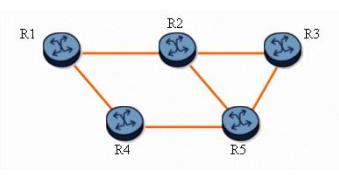
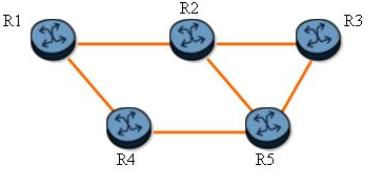
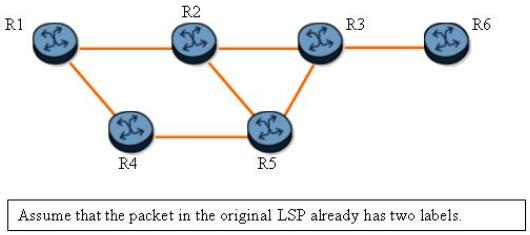
Click on the exhibit.

Which of the following is FALSE?

Show Answer Hide Answer
Correct Answer: A

Question No. 4

Which of the following about LSP path configuration on an Alcatel-Lucent 7750 SR is TRUE?

Show Answer Hide Answer
Correct Answer: B

Question No. 5

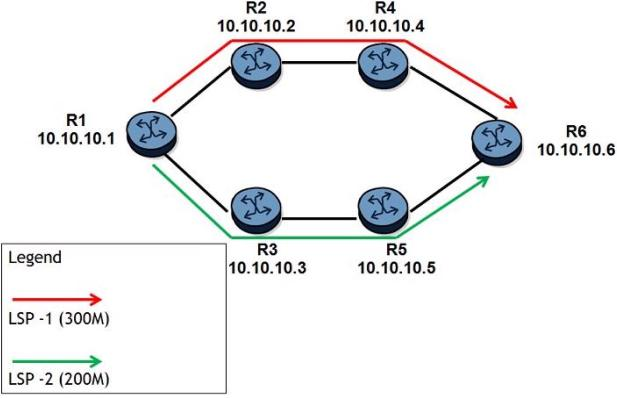
Click on the exhibit.

RSVP session state for LSP 1 has timed out on router R3. Which of the following actions will router R3 initiate to clear the RSVP session?

Show Answer Hide Answer
Correct Answer: D