At ValidExamDumps, we consistently monitor updates to the Nokia 4A0-100 exam questions by Nokia. Whenever our team identifies changes in the exam questions, objectives, focus areas or requirements, We immediately update our exam questions for both PDF and online practice exams. This commitment ensures our customers always have access to the most current and accurate questions. By preparing with these up to date and 100% exam domain coverage questions, our customers can successfully pass the Nokia IP Networks and Services Fundamentals exam on their first attempt without needing additional materials or study guides.
Other certification materials providers often include outdated or removed questions by Nokia in their 4A0-100 exam. These outdated questions lead to customers failing their Nokia IP Networks and Services Fundamentals exam. In contrast, we ensure our questions bank includes only precise and up-to-date questions. Our main priority is your success in the Nokia 4A0-100 exam, not profiting from selling obsolete exam questions in PDF or Online Practice Test.
Which compact flash on a control processing module (CPM) of a Nokia 7750 SR stores the runtime software image and the configuration file?
Which of the following routing protocols cannot be used between routers R2 and R4?
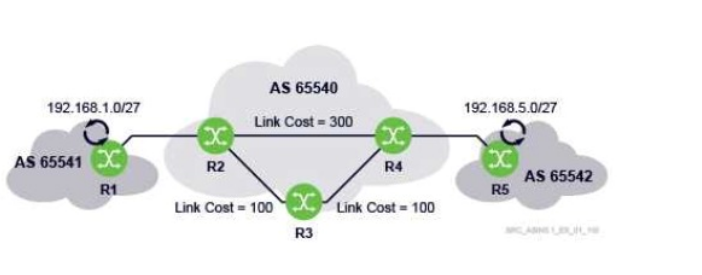
In the diagram:
R2 and R4 are both within AS 65540, which indicates that they are in the same Autonomous System.
eBGP (External Border Gateway Protocol) is designed for routing between different ASes (inter-AS routing).
Since R2 and R4 are in the same AS, you would use:
OSPF or IS-IS (both interior gateway protocols -- IGPs)
Static routing is also valid between any two routers if manually configured
eBGP is invalid between routers in the same AS.
The correct protocol in that case would be iBGP (internal BGP) if BGP were to be used within the AS.
Therefore, the correct answer is: D. eBGP
Nokia IP Routing Fundamentals -- BGP vs IGP
Nokia SRA Guide -- AS Concepts and Protocol Suitability
RFC 4271 -- BGP Specification
Which of the following enables service providers to support multiple customers with the same VLAN ID over the same backbone?
VLAN Stacking, also known as Q-in-Q tunneling, is a technology that allows multiple customers to use overlapping VLAN IDs while being transported over a shared service provider network.
Key Concepts:
Customer VLAN (C-VLAN): The VLAN used by the customer in their own network.
Service VLAN (S-VLAN): The VLAN used by the service provider to encapsulate the customer VLAN.
When VLAN stacking is applied:
A customer's Ethernet frame already tagged with a C-VLAN is encapsulated with an additional outer S-VLAN tag.
This way, multiple customers can use the same C-VLAN ID, but remain isolated by the unique S-VLAN assigned to them by the service provider.
Why Other Options Are Incorrect:
A . VLAN Trunking: Used to carry multiple VLANs over a single physical link but doesn't allow reuse of VLAN IDs across customers.
C . VLAN Tagging: Refers to the general process of adding a VLAN tag; it doesn't provide the isolation needed across shared infrastructure.
D . VLAN Routing: Refers to Layer 3 routing between VLANs, not to ID reuse or transport over a shared provider backbone.
Nokia Service Architecture and VPNs Study Guide -- Section: ''Q-in-Q VLAN Stacking''
IEEE 802.1ad Standard -- Provider Bridges (Q-in-Q)
In an MPLS network, which device is responsible for taking an unlabeled packet and encapsulating it with an MPLS label?
The Ingress Label Edge Router (LER) is the first router that:
Receives an unlabeled IP packet.
Applies an MPLS label based on its forwarding decision.
Forwards it into the MPLS core.
Option A is correct -- Ingress LER does MPLS label push.
Option B (Egress LER) -- removes labels at the end of the path.
Option C (LSR) -- switches labels, but doesn't push them onto unlabeled packets.
Option D -- is not a specific MPLS role.
Nokia IP/MPLS Fundamentals Guide -- Label Operations
RFC 3031 -- MPLS Architecture
Which of the following statements best describes a hub?
A hub is a physical layer (Layer 1) networking device used to connect multiple Ethernet devices in a network. Unlike switches or routers, hubs do not inspect or process frame headers. Instead, they perform a simple task:
Receive a signal (electrical or optical) on one port
Replicate that signal identically to all other ports
This means the hub does not examine Layer 2 (MAC addresses) or Layer 3 (IP addresses) and does not perform intelligent forwarding. It merely broadcasts all incoming traffic to every other connected device, often resulting in high collision domains and poor efficiency.
Option A describes a repeater, not a hub.
Option C describes a switch (Layer 2 device).
Option D describes a router (Layer 3 device).
Option B is correct: A hub does not inspect headers and replicates traffic blindly.
Nokia IP Networking Fundamentals Study Guide -- Chapter: 'Network Devices and OSI Model'
CompTIA Network+ and Cisco CCNA foundational guides (for universally accepted hardware behavior)

