Key details for this exam, checked against the published exam outline
Each question shows the correct answer and an explanation of why it is right
A construction project is one week away from the date of substantial completion as defined by an AIA A201 agreement. The owner comes forward with a major change to the work. The contractor and owner disagree on how much to extend the contract time. The project needs to proceed without delay while the contractor and owner work out the difference.
Which one of the following steps should the architect take?
When there is a disagreement over cost or time but the work must proceed, the architect can issue a Construction Change Directive (CCD). This allows the work to move forward while the owner and contractor negotiate terms. A Minor Change (B) is only for non-cost/time changes. Waiver of Subrogation (C) pertains to insurance.
CCDs are used under AIA A201 7.3 when immediate work is needed but consensus hasn't been reached.
This is the formal process to avoid delay in project delivery.
NCARB ARE 5.0 Handbook -- PjM Content Area 5
What is the architect's responsibility regarding code compliance during design?
The architect is responsible for preparing design documents that comply with applicable codes and regulations. Structural design is typically performed by engineers. Permitting and inspections are government responsibilities. Ensuring documents meet code requirements reduces the risk of delays or rework. ARE 5.0 PjM tests understanding of code compliance roles.
During the predesign phase of a project, the architect discovers that the owner's budget is insufficient to meet the program requirements.
Which of the following should the architect do?
Comprehensive Detailed Explanation:
During the predesign or programming phase, it is the architect's responsibility to advise the owner when the scope and budget are misaligned. The correct professional approach is to notify the owner that the program cannot be met within the current budget. Solutions (phasing or budget increase) may be discussed after this acknowledgment. The architect should not unilaterally scale down the program without owner input.
NCARB ARE 5.0 Handbook -- Budget evaluation in Programming/Predesign
Refer to the exhibit.
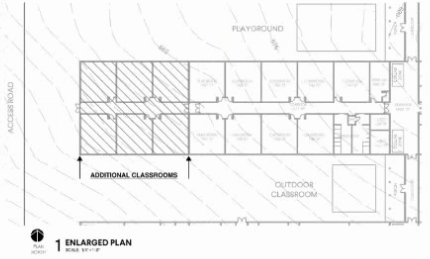
Refer to the exhibit
Twenty-five acres of undeveloped rural property was purchased for the site of a new elementary school. During the DD phase, the civil engineer and structural engineers make design proposals based on the information provided in the geotechnical report. The civil engineer indicates that several cubic yards of fill material should be installed within the proposed building footprint to make up for the change in topography (was uniformly). The structural engineer indicates a footing depth of 24 inches for the entire facility. During the CD phase, the owner asks the architect to add classrooms to one wing. The civil engineer proposes that extra fill should not be installed beneath the additional classrooms.
Which of the following should the architect do before completion of CDs? Check the three that apply.
A . Update the estimate of the cost of work
Adding classrooms affects scope and site preparation (e.g., fill material, grading, foundations), which affects cost. Per AIA B101 6.3, architects must update the estimate of the cost of the work as the design evolves.
C . Request an updated geotechnical evaluation
The original geotech report didn't account for this building extension. Without fill under the new addition, soil bearing capacity must be reassessed to avoid differential settlement or structural failure. This is a standard risk mitigation strategy.
D . Notify the structural engineer of the civil engineer's recommendation
The structural engineer must know that the site prep differs under the added classrooms, as this could affect foundation design. Coordination among consultants is a core architectural responsibility (per B101 3.1.2).
Incorrect Options:
B . Schedule a quality assurance meeting with the project team
While helpful, it's not critical or required specifically in this context before CDs are completed.
E . Increase the footing depth beneath the new classrooms
The architect should not unilaterally change structural design decisions. That's the structural engineer's responsibility, and any change should be based on engineering analysis and revised soil data.
F . Add general notes about structural bearing to the drawings
Premature. The structural engineer should first review the new geotechnical findings before any notes are added.
AIA B101 -- Article 3.1 & 3.2 (Architect's coordination & design responsibilities)
NCARB ARE 5.0 Handbook -- PjM Content Area 1: Project Coordination
Geotechnical coordination practices, CSI Spec Guidelines
A key Project Manager leaves an architectural firm halfway through a project. Several days of lost productivity pass while the new Project Manager determines the customized organization that the previous Project Manager used. The new Project Manager recommends implementing new office policies to create standards and quality control methods for the entire office.
Which methods should be implemented? Check the four that apply.
Comprehensive Detailed Explanation:
Best practices in quality management include:
A . Reviewing existing methods to identify inefficiencies
B . Standardizing workflow to prevent variability and loss of knowledge
D . Measuring performance to track productivity and outcomes
E . Continuous improvement ensures the office adapts and grows
C is incorrect as customization contradicts standardization and is the root of the issue. F is a drastic step not warranted by the situation.
NCARB ARE 5.0 PjM Handbook -- Quality management and office standards
Ballast ARE 5 Review Manual -- Project Management tools and quality assurance
AIA Best Practices -- Office workflow documentation and training
79 questions covering all exam domains
Exam domains verified against: Official NCARB Project-Management exam guide, last checked September 2026.
Analyze the agreements that define relationships among the architect, owner, contractors and consultants. Focus on evaluating adherence to owner-architect agreements, interpreting key elements of architect-consultant and owner-contractor relationships, and integrating consultant work into the overall project.
Develop and communicate effective work plans with the project team to complete the project on schedule. Establish project schedules, determine communication protocols for owner, contractor, consultants and internal staff, and maintain project documentation throughout delivery.
Sample question from this domain above: Q5
Manage the project's execution phase through administrative procedures rather than design decisions. Evaluate budget compliance, address scope changes and scope creep, ensure documentation supports the chosen delivery method, and obtain required approvals from authorities having jurisdiction.
Maintain proper Standard of Care through quality control methods and administrative procedures throughout the project. Apply procedures for legal and regulatory adherence, identify quality control steps to reduce risks and liabilities, and perform reviews of project documentation to maintain design integrity.
Sample question from this domain above: Q4
Determine the composition of the project team and how each member's time will be managed and allocated to execute the project. Establish criteria for assembling the team, assess requirements for allocating and managing project resources effectively throughout the engagement.
Sample question from this domain above: Q2
Common questions about the exam itself

