Key details for this exam, checked against the published exam outline
Each question shows the correct answer and an explanation of why it is right
Which elevator type is the most appropriate choice for a 15-story high-rise residential condominium where speed and noise are considerations?
For a 15-story high-rise where speed and noise matter, gearless traction elevators are the standard choice: highest speeds, smoother/quiet operation, and efficiency for taller buildings. Hydraulic (holed or hole-less) are limited to low-rise (2--6 stories) and are slower/noisier; geared traction is mid-rise with lower speeds and more noise than gearless.
PDD references: Vertical transportation selection criteria---rise vs. technology; ARE 5.0 PDD ''Building Systems---Elevators.''
Refer to the exhibit.
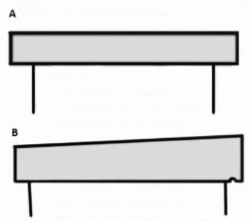
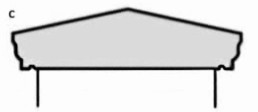
An architect is designing a school building that features a flat roof with a low parapet wall in a wet climate region. The client wants to minimize maintenance requirements and focus on keeping water from the walls.
What parapet coping detail would be most appropriate for the architect to select for this project?
Understanding the Problem
The question addresses parapet coping design in a wet climate with a focus on:
Minimizing maintenance
Preventing water from running down the face of the wall
Parapet copings protect the top of the parapet wall from water penetration and are designed to shed water away from the wall below.
Analysis of the Options
A . Flat Coping
A flat coping (Option A) has no slope and allows water to pool on the surface.
This pooling increases the likelihood of infiltration and material deterioration over time.
In wet climates, this is poor practice because standing water leads to freeze-thaw damage, staining, and faster degradation.
Maintenance needs are higher.
B . Single-Slope Coping
This coping (Option B) has a slope toward one side, which improves drainage.
However, if sloped toward the inside of the parapet, it increases roof drainage load and risk of water penetration at roof/wall junction.
If sloped toward the outside, water can run down the wall face, which the client specifically wants to avoid.
This design might also stain exterior wall finishes over time.
C . Double-Slope (Pitched) Coping with Drip Edges
This coping (Option C) is pitched toward both sides, with drip edges to break water runoff before it reaches the wall face.
Water is shed away efficiently, and drip grooves prevent capillary action that would pull water back toward the wall.
This is best practice in wet climates and greatly reduces maintenance by preventing staining and wall saturation.
Recommended by NRCA (National Roofing Contractors Association) and referenced in Architectural Graphic Standards for parapet detailing.
NCARB ARE 5.0 PDD Reference:
Content Area: Integration of Building Materials & Systems --- Building Envelope Detailing
Source Materials:
Architectural Graphic Standards --- Parapet Cap/Coping Details
Building Construction Illustrated by Francis D.K. Ching --- Water Management & Flashing
NRCA Roofing Manual --- Best Practices for Roof Edge & Parapet Design
Key Principle: Parapet copings in wet climates should always slope to shed water away, incorporate overhangs with drips, and prevent water from cascading down the building face.
Which of the following documents defines the responsibilities and duties of the contractor during construction?
A201 is the General Conditions of the Contract for Construction and outlines duties, rights, and responsibilities of the contractor. This includes site supervision, safety, and conformance with documents. ARE Handbook Objective 1.4 focuses on interpreting contract documents.
Owners of a busy two-story theater complex want to renovate. The new renovations include increasing the second floor lobby and doubling the number of second floor movie screens. The owner favors the use of escalators. Movies are scheduled to start simultaneously every three hours. The theater currently has a pair of 24-inch-wide parallel escalators, one of which goes up and the other down.
Which of the following should be proposed to accommodate the increased traffic to the second floor?
Given:
The theater doubles its second-floor movie screens, increasing patron traffic.
Existing escalators are two 24-inch wide units, one up and one down, with simultaneous movie start times every 3 hours.
To handle increased traffic:
Increasing existing escalator speed to 130 fpm (option A) is limited by safety and code limits (typically max around 100 fpm); also increases wear.
Installing a new elevator (option B) is helpful for accessibility but does not efficiently handle high flow of large crowds during peak.
Installing a new escalator that reverses direction (option C) (also called a 'dance' or 'two-way' escalator) allows flexibility to accommodate peak traffic flow---e.g., two escalators up during rush times and one down, or vice versa.
Extending balustrades (option D) improves safety but does not increase capacity.
Therefore, option C is the best solution to manage increased passenger flow.
NCARB ARE 5.0 Review Manual, Environmental Systems and Building Services chapter
Vertical transportation design principles in public assembly spaces
ASME A17.1 Safety Code for Elevators and Escalators
A family-owned apple farm in the Upper Midwest is taking advantage of a change in the local zoning code that added a new Agri-Tourism class in the existing farm zone. This allows the Owner to build a new facility on their existing site. The building will be open to the public and include a brewery, distillery, tap room, and market. The architect is ready to submit the drawings to the Owner for the 50% construction documents review.
To accommodate a compressed construction schedule, the Owner will be utilizing a design-build process. The Contractor has submitted the Pre-Engineered Metal Building (PEMB) shop drawings to the Architect for review, due to the lead time on this critical path item. Once construction begins, farming operations must be able to continue uninterrupted.
Key project information includes:
Brewing and distilling will operate year-round.
Brewery will initially include four fermenting tanks. Owner has requested space for at least two additional tanks. Potential expansion will be based on future sales.
Distillery will produce 16% alcohol, which is classified as a flammable liquid. Fire separations are required.
Tap Room is designed with seating for 300 people, not including exterior patio seating. It will have views to the working orchards and the historic buildings on site.
Tap Room is scheduled to be open from August through November. Owner would like options to extend operating dates based on popularity.
The Market area will feature local farm products and is not conditioned.
Entire building will be fully sprinklered.
Selected building materials are low-maintenance, as requested by the Owner, for durability and to reflect the nature of a working farm.
Mechanical and electrical systems will be hung from the building structure. These loads are included in PEMB shop drawings.
Public water and sewer is not available at the Project Site.
Occupancy sensors are included to reduce utility costs and achieve energy conservation requirements.
The following resources are available for your reference:
Architectural Drawings, including plans, elevations, sections, and schedules
Consultant Drawings, including structural, HVAC, power distribution, and plumbing
PEMB Shop Drawings
Design and Construction Schedule
Specification Excerpts, showing relevant spec sections
IBC and ADA Excerpts, showing relevant code and accessibility sections
After reviewing the documents, the architect discovers a coordination issue in the corridor.
The owner is concerned about elevated noise levels in the Tap Room when fully occupied. The current design utilizes a 2 x 2 acoustic ceiling tile system installed above the fans. An acoustical engineer recommends noise mitigation through limiting reverberation time (RT) to 2.0 seconds or less in the space. This can be achieved by the provided ceiling material options and their corresponding area.
What should the architect recommend that will minimize additional project costs while providing the recommended acoustical solution?
1. Problem Summary
Goal: Reduce reverberation time (RT) in the Tap Room to 2.0 seconds or less.
Current design: 2' x 2' acoustic ceiling tile system (RT = 2.0 seconds) installed above fans.
Constraint: Minimize additional project cost.
Recommendation from acoustical engineer: Use materials to achieve target RT without redesigning the space.
2. Review of Table Data
Material RT SF SF Cost
Cementitious Wood Fiber Panels (1') 2.0 448 $12.64
Cementitious Wood Fiber Panels (2') 1.8 384 $18.95
2x2 Acoustical Ceiling Tile (15/16') 2.0 900 $8.81
Acoustical Sound Board (1') 1.6 256 $18.23
3. Interpretation of RT Values
Current 2x2 Acoustic Ceiling Tile: RT = 2.0 seconds meets the target exactly.
However, fans may reduce the acoustic performance by reflecting or scattering sound, so supplemental absorption may be needed.
Adding Acoustical Sound Board (RT = 1.6) above the existing tile system will improve absorption and lower RT below 2.0 seconds.
4. Cost & Constructability
Retaining the current ceiling layout and simply adding a layer above is:
Least disruptive to current design.
Avoids redesign of the ceiling cloud layout.
Minimizes schedule impact (critical for design-build with compressed schedule).
Replacing with wood fiber panels (1' or 2') would require removal of existing tile, redesign of suspension, and higher cost/SF.
5. Why Other Options Are Incorrect
A . Remove fans: This addresses air movement, not RT. Removing them does not guarantee RT improvement and conflicts with HVAC design intent.
B . One cloud + 1' wood fiber panels: Reduces coverage area and may not meet RT goal; also costly and disruptive.
C . One cloud + 2' wood fiber panels: Even more costly, same redesign problem as B.
D . Retain tiles and add sound board above: Achieves RT < 2.0, minimal disruption, cost-effective vs. full replacement best option.
6. NCARB ARE 5.0 PDD Study Guide Reference
Content Area: Building Systems Integration --- Acoustics
Reference Sources:
Architectural Graphic Standards --- Acoustic material properties
Mechanical and Electrical Equipment for Buildings (MEEB) --- Room acoustics and reverberation control
ASTM C423 --- Sound Absorption and Sound Absorption Coefficients by the Reverberation Room Method
Which of the following admixtures is used to greatly increase the slump of concrete?
Comprehensive Detailed Explanation with all NCARB ARE 5.0 Project Development and Documentation (PDD) Study Guide Reference:
In concrete technology, admixtures are used to modify properties of fresh or hardened concrete:
Air-entraining agents: Introduce microscopic air bubbles to improve freeze-thaw resistance; they do not increase slump.
Water-reducing agents: Reduce water content while maintaining slump; increase workability but only moderately.
Calcium chloride: An accelerator, speeds up setting time; does not increase slump.
Superplasticizers (also called high-range water reducers): Significantly increase the slump (workability) of concrete without adding extra water, making the mix more flowable and easier to place.
Thus, to greatly increase slump while maintaining water-cement ratio, the superplasticizer is the correct choice.
Supporting Reference:
NCARB ARE 5.0 Review Manual, Materials and Assemblies section
Portland Cement Association publications on admixtures
ACI (American Concrete Institute) guidelines on admixtures
Exam domains verified against: Official NCARB PDD exam guide, last checked September 2026.
Resolve and detail architectural systems and assemblies, building materials, and engineering systems. Analyze how structural, mechanical, electrical, plumbing, and specialty systems integrate to meet project goals. Coordinate the size and detailing of multiple building systems and technologies together.
Develop project documentation necessary to assemble a complete set of construction drawings and maintain them throughout the project lifecycle. Determine appropriate documentation of building design, site features, and detailed drawings for individual systems. Apply standards to create clear coordinated documentation and communicate changes to the owner and design team.
Sample question from this domain above: Q3
Write, maintain, and refine the project manual and project specifications beyond construction drawings. Identify and prioritize components required for specification development. Coordinate specifications with construction documentation to ensure consistency across all project documents.
Sample question from this domain above: Q2
Analyze construction cost estimates to confirm alignment with project design. This section contains one objective and focuses on how estimated costs support the overall design and budget planning of the project.
Common questions about the exam itself

