Microsoft PL-400 Practice Exam Questions & Answers
7 Free Questions
· Last reviewed: October 19, 2026
· Prepared & Reviewed by the ValidExamDumps Editorial Team
Exam Facts
Microsoft PL-400 Exam Details
Key details for this exam, checked against the published exam outline
392
Practice Questions (Our Bank)
100 minutes
Exam Duration
700 out of 1000
Passing Score
USD 165
Official Exam Fee (regional pricing applies)
- Exam Code
- PL-400
- Full Name
- Exam PL-400: Microsoft Power Platform Developer
- Issuing Body
- Microsoft
- Question Format (Our Bank)
- Multiple Choice, Hotspot, Drag & Drop, Order List, Case Studies
- Delivery
- Online proctored and at Pearson VUE test centres
- Eligibility
- Development experience with Microsoft Power Platform services, JavaScript, JSON, TypeScript, C#, HTML, RESTful Web APIs, Visual Studio, Visual Studio Code, and Microsoft Azure required
- Validity
- Certification remains valid for 12 months and must be renewed by passing a renewal assessment on Microsoft Learn
Practice Questions
Free PL-400 Practice Questions
Each question shows the correct answer and an explanation of why it is right
VA
ValidExamDumps Editorial Team
Every question and its answer is checked by our PL-400 exam
preparation team, who also write the explanation shown with each one.
How we research and review these pages
You create a Power Apps app that integrates with Dynamics 365 Customer Service.
You update the app and run solution checker on the original solution. You receive an error stating solution checker cannot export the solution.
You need to determine the primary cause for the issue.
What is the primary cause?
Correct Answer:
A
Explanation
Solution checker fails to export patched solutions.
If a solution has had a patch applied, Solution Checker will fail to export the solution for analysis. When a solution has had a patch applied, the original solution becomes locked and it can't be changed or exported as long as there are dependent patches that exist in the organization that identify the solution as the parent solution.
To resolve this issue, clone the solution so that all patches related to the solution are rolled into the newly created solution. This unlocks the solution and allows the solution to be exported from the system.
https://docs.microsoft.com/en-us/powerapps/maker/common-data-service/common-issues-resolutionssolution-
checker#solution-checker-fails-to-export-solutions-with-model-driven-app-components
You deploy a Power Platform plug-in to a production environment. The plug-in code contains detailed tracing information. You are a member of the Environment Maker security role for the environment.
Users report unexpected results when they interact with confidential data by using the plug-in. You confirm that the plug-in works without errors in a development environment.
You need to investigate the root cause of the plug-in errors.
What should you do?
Correct Answer:
C
Explanation
Plug-in profiler is a solution that you can install on your environment that enables you to capture the execution context of a plug-in and then use that data to re-play the event within Visual Studio while debugging.
There are two tools available from which to run the Plug-in Profiler:
the Plug-in Registration Tool and Power Platform Tools for Visual Studio.
https://docs.microsoft.com/en-us/powerapps/developer/data-platform/tutorial-debug-plug-in
You are creating a Power Apps Component Framework (PCF) component.
You add the following markup to the component manifest. (Line numbers are included for reference only.)
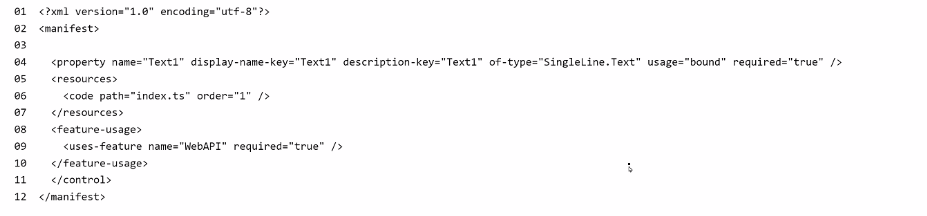
You need to complete the component manifest.
Which XML markup segment should you insert at line 03?
A.

B.

C.

D.

E.

Correct Answer:
B
You create a cloud flow to process a list of records using a loop.
You need to determine when to initialize a variable that is used to process the records.
When should you initialize the variable?
Correct Answer:
C
Explanation
Custom forms with client-side scripts reference web resources that contain the code for the Onload and OnSave functions. When you export a solution, these web resources must be included or the forms cannot function in the target environment. Without them, the solution import fails with a missing component error. Simply adding the forms to the solution is not enough if their dependencies are not included.
A company employs four Microsoft Power Platform developers. Each developer has an individual development environment. Each development environment is refreshed regularly from source control as a managed layer.
The developers must implement their changes in isolation within these environments. Development work must be merged into a base solution within a shared sandbox environment.
You need to ensure work carried out by each developer is deployed into the main solution in the sandbox environment.
What should you do?
Correct Answer:
D
Explanation
The Power Apps V2 trigger is designed to connect canvas apps directly to cloud flows. It receives data from the canvas app and initiates business logic in the flow. Other triggers like SQL or schedule-based options do not provide the direct app-to-flow communication needed here. Power Apps V2 is the standard connector for this scenario.
A company implements Dynamics 365 Supply Chain Management.
The company wants a button to display in the command bar when viewing accounts.
You need to add the button using the Ribbon Workbench.
In which three areas can you add a button for the Account entity? Each correct answer presents a complete
solution.
NOTE: Each correct selection is worth one point.
Correct Answer:
A, D, E
You create a Power Automate flow that retrieves data from a proprietary database.
You need to ensure that the flow works for other users.
Which two actions should you perform? Each correct answer presents part of the solution.
NOTE: Each correct selection is worth one point.
Correct Answer:
B, C
Full Access
Get the complete PL-400 question set
- 392 questions covering all exam domains
- Correct answers with explanations, like the free questions above
- PDF and online practice test
- 90 days of free updates
Domain 1: Build Microsoft Power Platform solutions
15% - 20%
Design technical architecture and authentication for solution components. Determine where to implement business logic across cloud services, client-side processing, business rules, plug-ins, and automation, and choose appropriate data storage methods and user experience technologies.
Sample questions from this domain above:
Q2Q6
Domain 2: Extend the user experience
25% - 30%
Build client scripting with the Client API object model and Dataverse Web API. Create Power Components Framework code components and Power Apps code apps with proper lifecycle management, configuration, and deployment practices.
Sample question from this domain above:
Q4
Domain 3: Extend Microsoft Power Platform
35% - 40%
Develop Dataverse plug-ins across execution pipeline stages and create custom APIs. Perform operations using platform APIs, Azure Functions, and Power Automate workflows while implementing proper authentication and error handling.
Sample questions from this domain above:
Q1Q5
Domain 4: Develop integrations
10% - 15%
Publish and consume Dataverse events through webhooks and message services. Implement data synchronization using change tracking and alternate keys, and create custom connectors with proper authentication and transformation logic.
Sample questions from this domain above:
Q3Q7
FAQ
PL-400 Exam FAQ
Common questions about the exam itself
What programming languages and skills do I need before taking PL-400?
You need solid development experience with C#, JavaScript, TypeScript, and JSON. You should also understand REST APIs, have hands-on work with Visual Studio or Visual Studio Code, and be familiar with Microsoft Azure basics. This is not an entry-level exam.
How difficult is PL-400 compared to other Microsoft Power Platform exams?
PL-400 is an intermediate to advanced level exam focused on code-first development with Power Platform services. It demands deeper technical knowledge than the fundamentals exam PL-900 and covers plug-ins, custom APIs, Power Apps code components, and cloud integrations.
What does the PL-400 exam fee cover and are there any discounts?
The exam costs USD 165 in most regions, though pricing varies by country. Microsoft occasionally offers beta exam discounts at 80 percent off with associated beta codes. Exam Replay bundles provide a retake within 12 months at a bundled price.
How long should I study to prepare for PL-400?
Most candidates with relevant development experience need 6 to 12 weeks of focused study, with hands-on labs being critical. Developers new to Power Platform components like plug-ins or custom connectors may need longer to gain practical experience.
What is the hardest objective area in PL-400 and how should I approach it?
Extending Microsoft Power Platform with plug-ins, custom APIs, and platform APIs is weighted 35-40 percent and typically challenges candidates most. Build practical skills by creating test plug-ins in a development environment and working through the execution pipeline stages hands-on.
Can I retake PL-400 if I fail and what is the retake policy?
Yes, you can retake the exam if you don't pass. Microsoft enforces a mandatory waiting period between retakes, and after multiple failed attempts within a timeframe you may face a temporary restriction. Check your exam history on the Microsoft certification dashboard for exact retake eligibility.
How long does the PL-400 certification stay valid and what renewal requires?
Your certification remains valid for 12 months. To renew it, you must pass a free online renewal assessment on Microsoft Learn within 30 days before expiry. You do not need to retake the full paid exam to renew.
What job role does PL-400 certification map to?
PL-400 certifies you as a Microsoft Power Platform Developer, suitable for roles like Dynamics 365 developer, Power Apps developer, or Power Platform solutions architect. It validates your ability to design, build, and troubleshoot custom Power Platform solutions for enterprise clients.
Is PL-400 being retired and what is happening with AB-400?
Yes, PL-400 is transitioning to a new exam AB-400 to align with Microsoft's certification portfolio. Registration for PL-400 closes on October 16, 2026, but candidates who register by that date can continue to take the exam through October 30, 2026.
What languages is the PL-400 exam available in?
PL-400 is available in English, German, Spanish, French, Italian, Japanese, Portuguese (Brazil), and Simplified Chinese. The language you choose is set when you register and cannot be changed after scheduling.

