At ValidExamDumps, we consistently monitor updates to the Microsoft MD-100 exam questions by Microsoft. Whenever our team identifies changes in the exam questions,exam objectives, exam focus areas or in exam requirements, We immediately update our exam questions for both PDF and online practice exams. This commitment ensures our customers always have access to the most current and accurate questions. By preparing with these actual questions, our customers can successfully pass the Microsoft Windows Client exam on their first attempt without needing additional materials or study guides.
Other certification materials providers often include outdated or removed questions by Microsoft in their Microsoft MD-100 exam. These outdated questions lead to customers failing their Microsoft Windows Client exam. In contrast, we ensure our questions bank includes only precise and up-to-date questions, guaranteeing their presence in your actual exam. Our main priority is your success in the Microsoft MD-100 exam, not profiting from selling obsolete exam questions in PDF or Online Practice Test.
Your company has an isolated network used for testing. The network contains 20 computers that run Windows 10. The computers are in a workgroup. During testing, the computers must remain in the workgroup.
You discover that none of the computers are activated.
You need to recommend a solution to activate the computers without connecting the network to the Internet.
What should you include in the recommendation?
You need to meet the technical requirement for the IT department users.
What should you do first?
You have a computer named Computer1 that runs Windows 10 and has Windows Assessment and Deployment Kit (Windows ADK) installed.
Computer1 has the drives shown in the following table.

You need to create Windows 10 unattended answer file.
What should you do first?
Note: This question is part of a series of questions that present the same scenario. Each question in the series contains a unique solution that might meet the stated goals. Some question sets might have more than one correct solution, while others might not have a correct solution.
After you answer a question in this section, you will NOT be able to return to it. As a result, these questions will not appear in the review screen.
Your company has an on-premises network that contains an Active Directory domain. The domain is synced to Microsoft Azure Active Directory (Azure AD). All computers in the domain run Windows 10 Enterprise.
You are logged on as the local administrator on a Computer named Computer1.
A user named Mia Hamm has a computer named Computer2. Mia Hamm reports that she is experiencing problems with Computer2.
You want to use Event Viewer on Computer1 to view the event logs on Computer2.
What should you do?
You are logged on as a local administrator. You need the required permissions to access Event Viewer logs on all remote Windows computers.
https://docs.microsoft.com/en-us/windows/win32/winrm/about-windows-remote-management
Note: This question is part of a series of questions that present the same scenario. Each question in the series contains a unique solution that might meet the stated goals. Some question sets might have more than one correct solution, while others might not have a correct solution.
After you answer a question in this section, you will NOT be able to return to it. As a result, these questions will not appear in the review screen.
Your network contains an Active Directory domain named contoso.com. The domain contains the users shown in the following table.
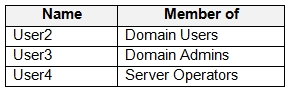
You have a computer named Computer1 that runs Windows 10 and is in a workgroup.
A local standard user on Computer1 named User1 joins the computer to the domain and uses the credentials of User2 when prompted.
You need to ensure that you can rename Computer1 as Computer33.
Solution: You use the credentials of User1 on Computer1.
Does this meet the goal?
Renaming a domain-joined computer will also rename the computer account in the domain. To do this, you need domain administrator privileges.
User4 is a server operator, not an administrator. Members of the Server Operators group can sign in to a server interactively, create and delete network shared resources, start and stop services, back up and restore files, format the hard disk drive of the computer, and shut down the computer.
Use User3's credentials instead.

