The AI-102 exam validates your ability to design and implement solutions using Microsoft Azure AI services. This certification, part of the Azure AI Engineer Associate path, demonstrates hands-on expertise in building intelligent applications across knowledge mining, natural language processing, computer vision, and generative AI workloads. This page guides you through the exam structure, core topics, and practical preparation strategies to help you succeed.
Use this topic map to guide your study for Microsoft AI-102 (Designing and Implementing a Microsoft Azure AI Solution) within the Azure AI Engineer Associate path.
The AI-102 exam measures both conceptual knowledge and practical decision-making through varied question types that reflect real-world scenarios.
Questions progress in difficulty and emphasize applied reasoning, you must connect concepts across design, implementation, and management phases to succeed.
An effective study plan maps each topic to dedicated study weeks, incorporates hands-on labs, and includes regular practice testing. Allocate more time to generative AI and agentic solutions, as these represent growing exam weight and require deeper conceptual understanding.
Explore other Microsoft certifications: view all Microsoft exams.
Strengthen your preparation with up-to-date resources from validexamdumps.com. These materials align to AI-102 and cover practical scenarios with clear explanations.
Visit the exam page to download the PDF, Online Practice Test, or get a Bundle Discount offer for both formats: Designing and Implementing a Microsoft Azure AI Solution.
Generative AI solutions and planning/managing Azure AI solutions typically account for 25-30% of the exam combined. Computer vision and natural language processing each represent 15-20%, while knowledge mining and agentic solutions round out the remaining coverage. Focus study time proportionally, but ensure you can handle scenario questions that blend multiple domains.
In practice, knowledge mining extracts raw data; natural language processing and computer vision enrich that data; generative AI synthesizes insights; agentic solutions automate decision-making; and planning/management ensures the entire pipeline scales and stays within budget. Understanding these dependencies helps you answer scenario questions that ask you to design end-to-end solutions rather than isolated features.
Aim for at least 4-6 weeks of hands-on work with Azure AI services. Prioritize labs on Azure Cognitive Search, Language service, Computer Vision, and OpenAI integration. Hands-on experience builds confidence in configuration questions and helps you recognize service-specific behaviors that appear in scenario items.
Candidates often confuse service boundaries (e.g., when to use Language service vs. Cognitive Search), underestimate the importance of cost and compliance planning, and rush through scenario questions without fully analyzing requirements. Take time to read each scenario completely, identify constraints, and eliminate options that don't align with stated goals before selecting your answer.
Review weak areas identified in practice tests, do a final timed mock exam, and skim official Microsoft documentation for any recent service updates. Avoid learning new topics in the final week; instead, reinforce concepts you already understand and build confidence through targeted review of your most challenging question types.
You have a local folder that contains the files shown in the following table.
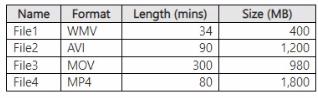
You need to analyze the files by using Azure Ai Video Indexer. Which files can you upload to the Video Indexer website?
You have a Video Indexer service that is used to provide a search interface over company videos on your company's website.
You need to be able to search for videos based on who is present in the video. What should you do?
Video Indexer supports multiple Person models per account. Once a model is created, you can use it by providing the model ID of a specific Person model when uploading/indexing or reindexing a video. Training a new face for a video updates the specific custom model that the video was associated with.
Note: Video Indexer supports face detection and celebrity recognition for video content. The celebrity recognition feature covers about one million faces based on commonly requested data source such as IMDB, Wikipedia, and top LinkedIn influencers. Faces that aren't recognized by the celebrity recognition feature are detected but left unnamed. Once you label a face with a name, the face and name get added to your account's Person model. Video Indexer will then recognize this face in your future videos and past videos.
https://docs.microsoft.com/en-us/azure/media-services/video-indexer/customize-person-model-with-api
You have an Azure subscription.
You plan to build an app that will use the Azure Al DALL-E model.
You need to deploy the model.
What should you use?
You have a collection of 50,000 scanned documents that contain text.
You plan to make the text available through Azure Cognitive Search.
You need to configure an enrichment pipeline to perform optical character recognition (OCR) and text analytics. The solution must minimize costs.
What should you attach to the skillset?
The Computer Vision API uses text recognition APIs to extract and recognize text information from images. Read uses the latest recognition models, and is optimized for large, text-heavy documents and noisy images.
You are building an app that will process scanned expense claims and extract and label the following data:
* Merchant information
* Time of transaction
* Date of transaction
* Taxes paid
* Total cost
You need to recommend an Azure Al Document Intelligence model for the app. The solution must minimize development effort.
What should you use?

