Key details for this exam, checked against the published exam outline
Each question shows the correct answer and an explanation of why it is right
What are the differences between Ingress and Gateway API?
Ingress provides a comparatively simple API for exposing HTTP and HTTPS applications through host- and path-based routing. Gateway API is a broader, extensible family of resources that separates infrastructure configuration from application routing. Resources such as GatewayClass, Gateway, HTTPRoute, GRPCRoute, TLSRoute, TCPRoute, and UDPRoute model listeners, routes, protocols, ownership, and attachment relationships explicitly.
Gateway API was designed around operational roles. An infrastructure provider can manage the GatewayClass, a cluster operator can provision a Gateway, and an application team can own a route attached to that Gateway. This offers clearer delegation than the single Ingress resource and supports protocols and traffic-management functions beyond the original Ingress model.
The two APIs are not simply different names for identical functionality, so A is false. Option C is also inaccurate because Cilium's implementations of both Ingress and Gateway API integrate with its eBPF datapath and Envoy; Ingress is not inherently an iptables-only implementation. Option D incorrectly limits Gateway API to internal routing. It can expose internet-facing applications through generated LoadBalancer or NodePort Services or through host-network listeners.
Official references
Migrating from Ingress to Gateway; Gateway API Support.
Study Guide topic: Service Mesh.
What is correct about this Cilium Network Policy?
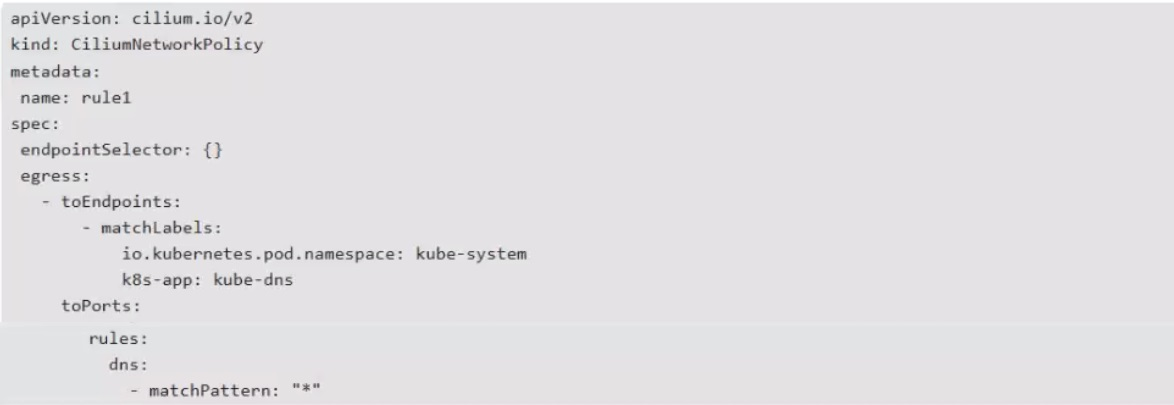
Question 21 Cilium Network Policy exhibit
The intended policy selects every Cilium-managed endpoint in the namespace where the CiliumNetworkPolicy is created because endpointSelector: {} is empty. The manifest does not specify metadata.namespace; if it is applied normally in the default namespace, the selected endpoints are therefore all pods in default, not pods across every namespace. The egress destination selector identifies pods in kube-system carrying k8s-app: kube-dns, while matchPattern: "*" allows all DNS query names handled by the DNS rule. This supports the intended answer A.
There is, however, a material defect in the exhibit: toPorts is a list in the Cilium policy schema, but the image shows rules directly beneath toPorts without a preceding list marker. The official form is toPorts:, followed by - ports: and rules: within that list item. Port 53 and its protocol should also be stated explicitly. Exactly as displayed, the manifest should not be treated as a valid deployable policy.
The question should be corrected before examination use. Once the missing list item and port definition are restored, A accurately describes its scope and effect.
Official references
Using Kubernetes Constructs in Policy; Layer 7 Protocol Visibility.
Study Guide topic: Network Policy.
Which one of the following best describes the role Cilium provides in Kubernetes?
Cilium functions as a Kubernetes Container Network Interface implementation. When Kubernetes creates or removes a pod sandbox, the container runtime invokes the configured CNI plugin. Cilium establishes the pod's network connectivity, connects the workload to the node's networking environment, allocates or obtains an address through the configured IPAM mode, and coordinates the endpoint with the Cilium agent. Its eBPF datapath then supplies routing, service load balancing, policy enforcement, and network visibility.
Cilium provides substantially more functionality than the minimum CNI contract, but those additional capabilities do not change its primary Kubernetes networking role. Hubble supplies integrated network observability, yet Cilium is not merely a container-metrics monitor. Resource utilization such as CPU and memory is normally handled through Kubernetes metrics and monitoring systems.
Cilium is also not a Container Storage Interface. CSI drivers manage storage volumes, attachment, mounting, and lifecycle operations, which are unrelated to Cilium's primary responsibilities. Nor is Cilium simply a pod-operation logging mechanism. It can emit datapath events and diagnostic logs, but those are supporting capabilities.
Accordingly, D provides the correct architectural classification for Cilium in a Kubernetes cluster.
Official references
Introduction to Cilium and Hubble; Cilium Helm Installation.
Study Guide topic: Architecture.
What would be a benefit of using remote service affinity in a Cluster Mesh deployment?
Remote service affinity directs a global Service to prefer healthy backend endpoints located in remote clusters. This can support maintenance or staged rollouts in which the local copy of an application is temporarily unavailable or intentionally removed from service. Requests originating in the local cluster continue through the same global Service but are forwarded to the preferred remote backends, matching the use case described by D.
Cilium configures this behavior through the service.cilium.io/affinity: "remote" annotation. The preference affects backend selection; it does not require clients to use a different Service address. If remote backends are available, they are marked as preferred. This provides operators with a controlled way to direct traffic away from the local deployment during an update.
Option A describes local affinity from the perspective of the cluster containing the client, not remote affinity. Option B incorrectly introduces the Egress Gateway, which provides controlled source addresses and routing for outbound traffic rather than Cluster Mesh global-Service affinity. Option C describes the normal none affinity behavior, under which Cilium has no local-or-remote preference and can load-balance across both categories.
Remote affinity therefore enables temporary cross-cluster continuity while local application instances are updated or otherwise unavailable.
Official references
Cluster Mesh Service Affinity.
Study Guide topic: Cluster Mesh.
What is correct about the Kubernetes Host Scope IP Address Management (IPAM) mode?
Kubernetes host-scope IPAM can be used with both Cilium tunnel routing and native direct routing. The IPAM mechanism determines how each node receives and locally allocates pod addresses; it does not inherently require a particular packet-forwarding model. The current IPAM feature matrix explicitly marks both tunnel routing and direct routing as supported for Kubernetes host-scope mode.
In this mode, Kubernetes allocates a PodCIDR to each node and publishes it through the standard v1.Node resource, normally in spec.podCIDR or spec.podCIDRs. The Cilium agent waits for the relevant range and allocates individual pod addresses from that node-specific CIDR. The correct configuration is ipam: kubernetes or the Helm equivalent ipam.mode=kubernetes, not ipam: crd; therefore, C is false.
The documented feature matrix does not provide multiple CIDRs per cluster or multiple CIDRs per node for this mode, eliminating A and B. Multi-pool IPAM is the Cilium mode designed for allocating per-node CIDRs from multiple configurable pools.
Because Kubernetes host-scope IPAM supports either overlay tunneling or direct routing while the other statements contradict its capabilities or configuration, D is correct.
Official references
IP Address Management; Kubernetes Host Scope.
Study Guide topic: Installation and Configuration.
60 questions covering all exam domains
Exam domains verified against: Official Linux Foundation Cilium-Associate exam guide, last checked September 2026.
Understand the role of Cilium in Kubernetes environments, Cilium architecture, IP address management with IPAM, component roles, and datapath models. Focus on how Cilium integrates with your cluster infrastructure.
Interpret Cilium network policies using identity-based security model. Understand policy enforcement modes, rule structure, and how Cilium network policies differ from standard Kubernetes network policies.
Sample question from this domain above: Q2
Know how to use Ingress or Gateway API for ingress routing, understand service mesh use cases and benefits of Gateway API over traditional Ingress, encrypting traffic in transit, and sidecar-based versus sidecarless architectures.
Sample question from this domain above: Q1
Understand the observability capabilities of Hubble, enabling layer 7 protocol visibility, and how to use Hubble from the command line or UI to monitor and troubleshoot your clusters.
Know how to use Cilium CLI to install Cilium, run connectivity tests, query and modify configuration, and monitor cluster status. Get comfortable with practical installation workflows.
Understand the benefits of cluster mesh for multi-cluster connectivity, achieve service discovery and load balancing across clusters. Learn when and how to deploy cluster mesh in your infrastructure.
Sample question from this domain above: Q4
Understand the role of eBPF in Cilium, its key benefits, and how eBPF-based platforms compare to traditional iptables-based platforms. Grasp why eBPF is fundamental to Cilium's approach.
Understand egress connectivity requirements and the options available to connect Cilium-managed clusters with external networks using BGP and other external networking mechanisms.
Common questions about the exam itself

