Key details for this exam, checked against the published exam outline
Each question shows the correct answer and an explanation of why it is right
You have several switches in your network that use Cisco's PVST+ protocol. You want your Juniper switches to interoperate with those devices.
In this scenario, which protocol would you use?
To interoperate with Cisco switches running Per-VLAN Spanning Tree Plus (PVST+), Juniper devices must use VLAN Spanning Tree Protocol (VSTP).
PVST+ Compatibility: VSTP is specifically designed to handle the per-VLAN BPDU requirements of Cisco's PVST+. It generates a separate spanning tree instance for each VLAN and uses the same multicast destination MAC address as Cisco devices.
Other Protocols: MSTP (B) is used for grouping VLANs into regions; RSTP (D) is a single-instance protocol (IEEE 802.1w) and is generally incompatible with per-VLAN BPDU requirements without additional configuration.
Exhibit
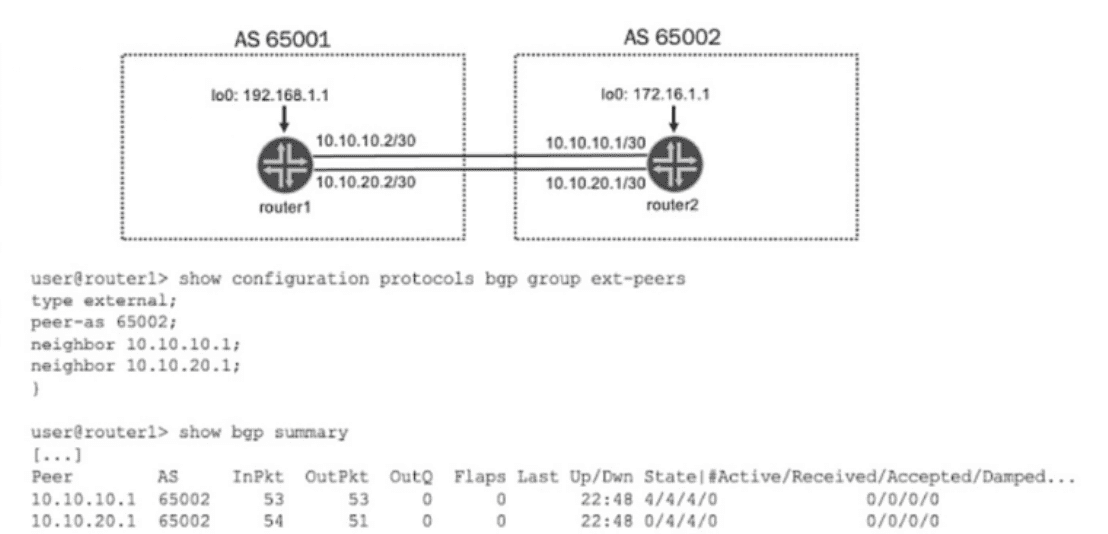
Referring to the exhibit, what will enable active routes from both peers?
The exhibit shows router1 (AS 65001) connected to router2 (AS 65002) via two parallel physical links. The show bgp summary output indicates that sessions are established with two neighbors: 10.10.10.1 and 10.10.20.1. Currently, for the second neighbor (10.10.20.1), there are 0 active routes despite having 4 accepted routes, which indicates that BGP has selected only one 'best path' via the first neighbor for forwarding.
BGP Best Path Selection: By default, BGP only selects a single best path for any given destination prefix and installs that one path into the forwarding table. In a topology with parallel links to the same AS, this leads to underutilization of available bandwidth.
Multipath Solution (Option B): To enable active routes from both peers and allow for load-balancing (ECMP) across both links, you must enable the multipath feature.
When the multipath statement is configured under the protocols bgp group ext-peers hierarchy, it tells Junos OS to install multiple equal-cost BGP paths into the routing table and subsequent forwarding table.
Since both neighbors belong to the same peer group (ext-peers) and the same AS (65002), configuring multipath at the group level will apply to both sessions, allowing paths from both neighbors to be marked as 'active'.
Incorrect Options:
Option A: 172.16.1.1 is the loopback address of router2. The exhibit shows peering is currently done using physical interface addresses (10.10.10.1 and 10.10.20.1), so this address is irrelevant to the current active sessions.
Option C: Configuring the neighbor address alone without the multipath parameter will not change the best-path selection behavior.
Option D: 10.10.20.2 is the local interface IP of router1, not the neighbor's IP. BGP multipath must be configured to point to remote peer paths.
Configuration Example for Junos OS 24.4: To implement this, apply the following command: set protocols bgp group ext-peers multipath
You are configuring CoS throughout your enterprise network using DSCP. You have configured MF classification on your edge devices and are using BA classifiers throughout the core You are using the EZQoS template provided on your EX Series switches that are acting as your edge devices. You have loaded the configuration group and applied it to the appropriate interfaces. Classification and scheduling are working properly on your edge devices; however, traffic is not being classified correctly when it reaches your core devices
In this scenario, which statement is correct about solving this problem?
In an end-to-end CoS (Class of Service) design, there is a clear distinction between classification at the ingress and rewrite rules at the egress.
The Problem: Your edge devices are successfully classifying traffic (assigning packets to internal forwarding classes). However, the core devices---which use BA (Behavior Aggregate) classifiers---are not classifying correctly. BA classifiers look at the bits in the packet header (like DSCP or 802.1p) to determine priority.
The Missing Link (Option C): When a packet leaves the edge device, its internal forwarding class and loss priority must be 'written' back into the packet header so that the next-hop (the core device) can see it. By default, Junos may not preserve or set these bits correctly on egress. You must apply rewrite rules on the edge switches' egress interfaces facing the core. These rules ensure the DSCP values in the headers match the forwarding class determined by the edge's MF classifier, allowing the core's BA classifier to function properly.
Other Options: Option A (policer) handles rate limiting, not classification. Option B is incorrect because core devices often have different hardware or scaling needs than edge switches, and standard BA configuration is preferred over templates in the core. Option D is incorrect because MF classifiers are standard for edge devices where deep packet inspection is needed to identify traffic types.
You are evaluating a BGP routing policy that has a route-filter clause that includes its own action (e.g.. accept) within the filter block. The policy is also using a then clause.
Which statement is correct in this scenario?
In Junos OS routing policies, the order of evaluation and the impact of terminal actions are critical for predictable control.
Immediate Execution (Option D): When a route-filter contains an explicit action like accept or reject within its block, that action is considered terminal if a match is found.
Evaluation Flow: The policy engine processes terms and conditions from top to bottom. If a prefix matches a route-filter that has an embedded accept action, the policy executes that action immediately and stops further evaluation of that specific term. Consequently, any subsequent then clause in the same term is completely ignored.
Best Practice: To ensure a then clause (which might include modifications like changing a preference or community) is executed, the route-filter should be defined without an internal action, allowing the match to fall through to the term's common then statement.
Exhibit
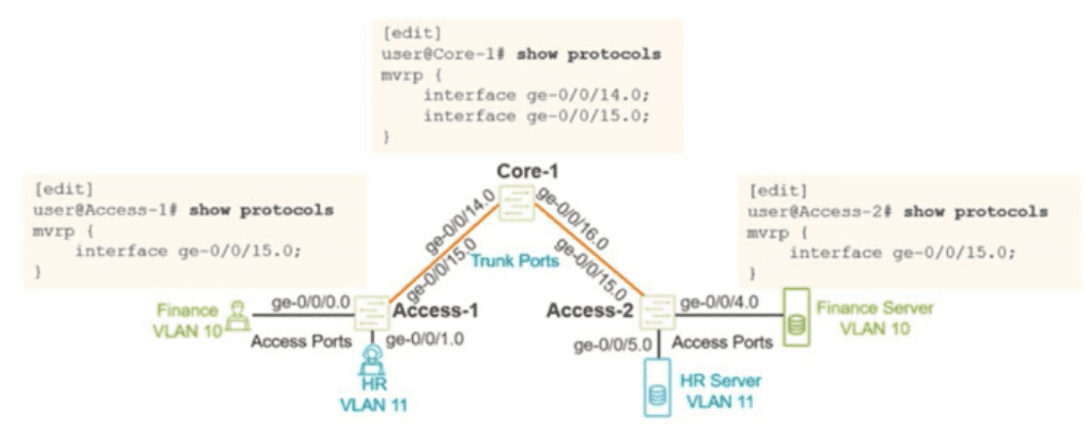
You configured MVRP in your Layer 2 network using the configuration shown in the exhibit. You verified that the appropnate VLANs are configured and applied on the two access switches. You are using RSTP as your loop prevention mechanism. Unfortunately, the users are not able to communicate with their corresponding server attached to the Access-2 switch.
In this scenario, what should you do to solve this problem?
The exhibit shows a network topology where Multiple VLAN Registration Protocol (MVRP) is used to dynamically manage VLANs across switches Core-1, Access-1, and Access-2.
Identifying the Missing Configuration: According to the diagram, the trunk link between Core-1 and Access-2 uses interface ge-0/0/16.0 on the Core-1 side.
Output Analysis: However, the show protocols mvrp output for Core-1 only lists interfaces ge-0/0/14.0 and ge-0/0/15.0.
MVRP Requirements: For MVRP to successfully propagate VLAN information between Access-2 and the rest of the network, the protocol must be enabled on every trunk interface in the path.
Solution: Because ge-0/0/16.0 is missing from the Core-1 MVRP configuration, VLAN registration messages from Access-2 are not being processed by Core-1. Configuring this interface under MVRP on Core-1 will solve the communication problem.
Exhibit
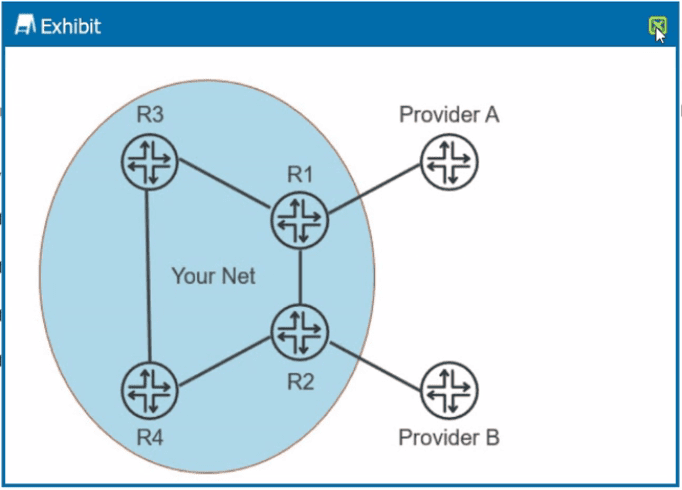
Your network receives the full Internet BGP routing table from two different ISPs. You want your local routers to use Provider A to forward all Internet traffic as long as Provider A is available.
Referring to the exhibit, which two actions would satisfy this requirement? (Choose two.)
In BGP path selection, the Local Preference attribute is one of the most common ways to influence outbound traffic from an Autonomous System (AS). It is a well-known discretionary attribute that is propagated throughout the AS to tell internal routers which path is preferred for a specific destination.
Priority Rule: In the BGP selection algorithm, a higher local preference value is always preferred over a lower one. The default value in Junos OS is 100.
Influencing Outbound Traffic (Option A): To ensure that Provider A is always preferred, you would apply an import policy on R1 (the router connected to Provider A) to set the local preference of all received routes to a value higher than the default (e.g., 200). Since 200 > 100, R3 and R4 will prefer the path via R1.
Alternative Method (Option C): Conversely, you can achieve the same result by applying an import policy on R2 (the router connected to Provider B) to set the local preference to a value lower than the default (e.g., 50). Since the routes from R1 remain at the default of 100, and 100 > 50, the path via R1 (Provider A) is preferred.
Why B and D are incorrect: Setting a higher local preference on R2 (Option B) would make Provider B the preferred exit point. Setting a lower local preference on R1 (Option D) would make Provider A the least preferred exit point.
Your Layer 2 network uses 802.1X to authenticate user devices connecting to the network. You are asked to include a new Layer 2 interface connection from the conference room in your network. You must ensure that only a single device is allowed to authenticate on this port at one time to avoid users from being able to plug in a rogue switch to this port.
In this scenario, which 802.1X method would you use for the new interface?
This question focuses on port security and preventing 'rogue switches' or multiple devices from accessing a single physical port simultaneously.
Single-Secure Supplicant Mode (Option A): This is the most restrictive 802.1X mode in Junos OS. It allows exactly one MAC address to be authenticated on the port at a time. If a device successfully authenticates, the switch will drop any traffic coming from any other MAC address on that same physical interface. If a user tries to plug in a switch, only the first device that authenticates will have access; all other devices behind that switch will be blocked.
Single Supplicant Mode (Option C): This mode allows the first authenticated user to 'open' the port for all other users. This would actually allow a rogue switch to function once the first device is authorized.
Multiple Supplicant Mode (Option B): This allows multiple devices to connect, provided each one authenticates individually. While secure, it does not prevent a user from connecting multiple devices to the port, which violates the requirement to allow only one.
MAC-RADIUS (Option D): This is an authentication method, not a port-access mode that limits the number of supplicants.
Exam domains verified against: Official Juniper JN0-650 exam guide, last checked October 2026.
Understand the operation and configuration of OSPF and IS-IS in enterprise networks. Troubleshooting IGPs requires deep knowledge of link-state fundamentals and routing policy application to control protocol behavior across large deployments.
Master BGP route selection, next hop resolution, and community-based attribute manipulation. Advanced BGP scenarios demand hands-on troubleshooting of path selection issues and policy implementation in multi-AS environments.
Learn PIM-SM operation, RP election, MSDP, and IGMP configuration from first principles. Many candidates struggle with multicast RPF logic and source-to-RP discovery. practice with live tree state debugging is essential.
Configure and monitor advanced VLANs, MSTP or VSTP, and Layer 2 tunneling. Understanding filter-based VLAN binding and Q-in-Q encapsulation requires hands-on lab work beyond reading documentation.
Implement 802.1x, MAC RADIUS, captive portal, and guest VLAN fallback mechanisms. Real-world scenarios test your ability to diagnose authentication state machine failures and server integration issues.
Sample question from this domain above: Q7
Configure Power over Ethernet, LLDP-MED, and voice VLAN to support unified communications deployments. Exam questions test both the configuration commands and the protocol discovery process used by IP phones.
Design and troubleshoot CoS policies covering classification, queuing, dropping, and shaping across Layer 2 and 3 networks. CoS requires strong understanding of packet header fields and forwarding class manipulation throughout the pipeline.
Sample question from this domain above: Q3
Deploy VXLAN with EVPN route types and multi-homing in data center or campus fabrics. Configuration scenarios test your ability to integrate EVPN with BGP and validate MAC and IP reachability across VXLAN overlays.
Common questions about the exam itself

