Key details for this exam, checked against the published exam outline
Each question shows the correct answer and an explanation of why it is right
Referring to the exhibit,
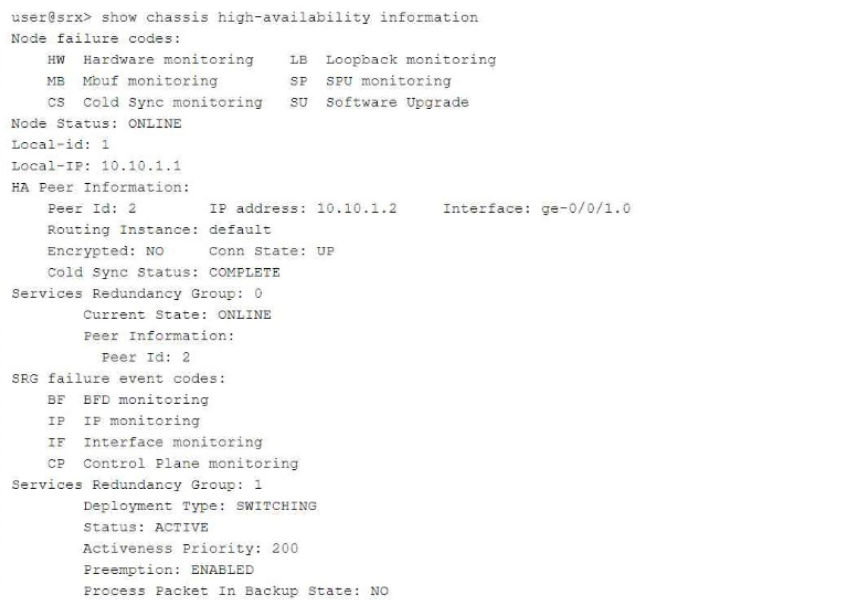
which three statements about the multinode HA environment are true? (Choose three.)
Referring to the exhibit for a multinode HA environment, we can conclude the following about the HA setup:
Two Services Redundancy Groups (Correct: Option A):
The output shows the status of SRG 0 and SRG 1, confirming that there are two services redundancy groups in the HA configuration.
Node 1 Hosting SRG 1 (Correct: Option C):
The exhibit indicates that Node 1 is currently active for SRG 1. According to the configuration, Node 1 will continue to host SRG 1 unless it becomes unavailable.
Session State Synchronization (Correct: Option D):
In this HA setup, session state synchronization is enabled between the two nodes. This ensures that sessions remain active and seamless failover can occur if one node fails.
Juniper Reference:
Juniper HA Documentation: Provides details on multinode HA setups, SRG configurations, and session synchronization.
Referring to the exhibit, you have been assigned the user LogicalSYS1 credentials shown in
the configuration.
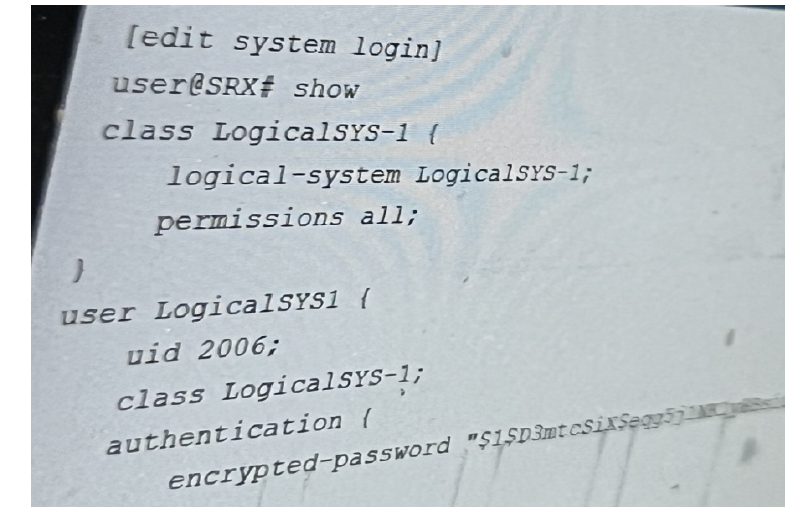
In this scenario, which two statements are correct? (Choose two.)
Exhibit:
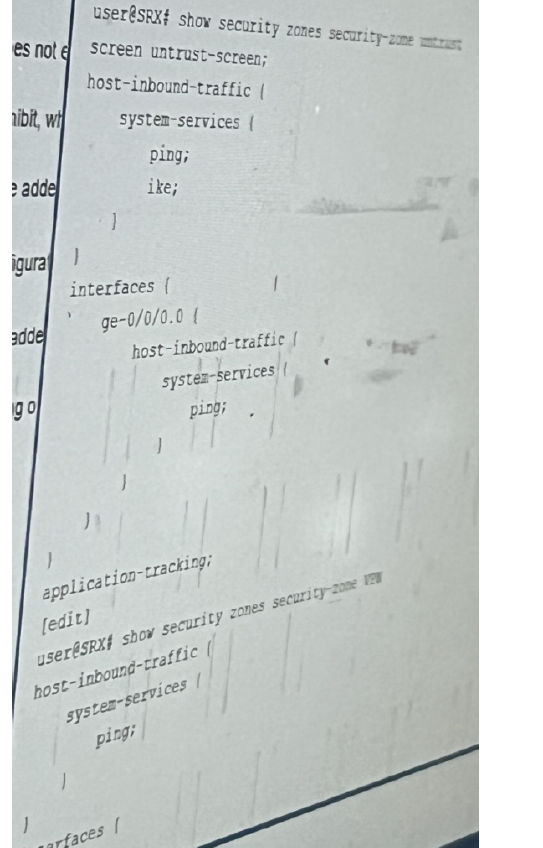
The Ipsec VPN does not establish when the peer initiates, but it does establish when the SRX
series device initiates. Referring to the exhibit, what will solve this problem?
Your customer needs embedded security in an EVPN-VXLAN solution.
What are two benefits of adding an SRX Series device in this scenario? (Choose two.)
The SRX Series can inspect traffic within VXLAN tunnels, providing in-depth security services across multiple layers. Adding SRX in the overlay network allows comprehensive control, leveraging advanced firewall capabilities. For more details, see Juniper EVPN-VXLAN Security.
When integrating an SRX Series device into an EVPN-VXLAN solution, it offers several security benefits:
Layer 4-7 Security Services (Answer A): The SRX can provide deep packet inspection for VXLAN encapsulated traffic, enhancing security by offering services such as intrusion prevention, application layer filtering, and antivirus scanning. This allows security monitoring of the encapsulated traffic at higher layers of the OSI model (Layers 4-7), which is essential for advanced threat detection.
Security in the Overlay Network (Answer C): The SRX adds security by functioning as an enterprise-grade firewall within the EVPN-VXLAN overlay. This means that traffic flowing between virtualized segments or networks can be inspected and filtered using SRX firewall rules, ensuring that the VXLAN overlay remains secure.
These features make the SRX a powerful addition for securing EVPN-VXLAN environments, providing comprehensive security for encapsulated traffic and ensuring that both the underlay and overlay networks are protected.
You Implement persistent NAT to allow any device on the external side of the firewall to
initiate traffic.
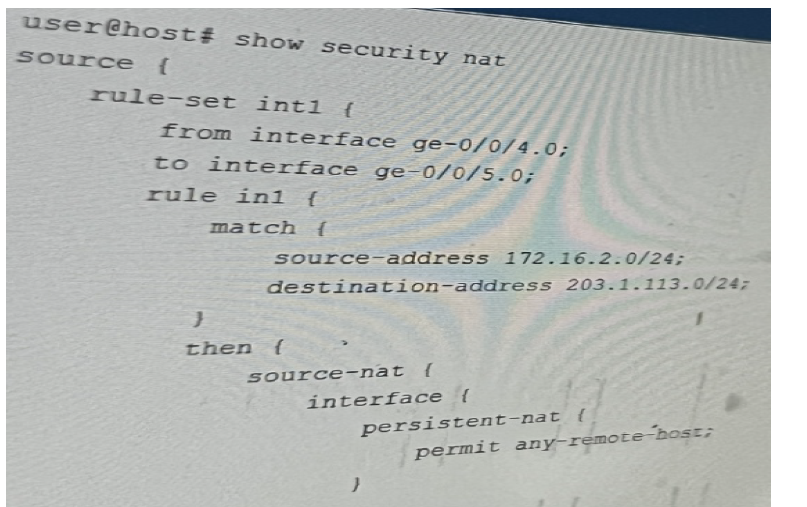
Referring to the exhibit, which statement is correct?
Which two statements are correct about the ICL in an active/active mode multinode HA environment? (Choose two.)
Exhibit:
You have deployed a pair of SRX series devices in a multimode HA environment. You need to enable IPsec encryption on the interchassis link.
Referring to the exhibit, which three steps are required to enable ICL encryption? (Choose three.)
A . Install the Junos IKE package on both nodes. While I previously stated that IKE is usually included in the base Junos OS image, it's essential to ensure that the necessary IKE package is indeed installed and enabled on both SRX nodes to support ICL encryption.
C . Configure a VPN profile for the HA traffic and apply it to both nodes. This dedicated VPN profile defines the security parameters (encryption algorithms, authentication, etc.) specifically for the ICL traffic.
D . Enable HA link encryption in the IPsec profile on both nodes. Within the IPsec profile, you must explicitly enable ICL encryption to ensure that all traffic traversing the interchassis link is protected.
Why E is incorrect:
E . Enable HA link encryption in the IKE profile on both nodes. While securing IKE negotiations is important, it's typically handled within the IPsec profile itself when configuring ICL encryption on SRX devices.
Exam domains verified against: Official Juniper JN0-637 exam guide, last checked October 2026.
Use logging and tracing tools to diagnose security policy and zone issues in logical and tenant systems. Develop proficiency in monitoring outputs and identifying configuration problems that affect traffic flow and access control.
Sample question from this domain above: Q2
Configure and manage logical systems with multiple routing instances and administrative roles. Understand tenant system architecture, capacity planning, and the communication patterns between primary and tenant administrators.
Sample question from this domain above: Q1
Deploy transparent mode, mixed mode, secure wire, and MACsec in Layer 2 environments. Configure and monitor EVPN-VXLAN security to protect switched networks and prevent unauthorized access at the data link layer.
Sample question from this domain above: Q7
Implement persistent NAT, DNS doctoring, and IPv6 NAT in complex network scenarios. Troubleshoot NAT configuration issues and monitor address translation to ensure proper traffic flow and application functionality.
Sample question from this domain above: Q6
Configure hub-and-spoke VPN topologies and auto discovery VPNs with PKI. Handle overlapping IP addresses and troubleshoot IPsec tunnel issues in enterprise VPN deployments with multiple remote sites.
Design and deploy policy-based routing profiles and policies across routing instances. Configure various APBR options to direct traffic based on source, destination, and other criteria to achieve granular traffic management.
Distinguish between chassis clusters and multinode HA deployments and their architectural differences. Configure service redundancy groups and active node behavior to ensure continuous availability of security services.
Sample question from this domain above: Q4
Integrate third-party and multi-cloud threat intelligence services with Juniper security platforms. Implement automated response mechanisms to block threats and enforce secure enterprise security practices.
Common questions about the exam itself

