Key details for this exam, checked against the published exam outline
Each question shows the correct answer and an explanation of why it is right
You want to use a Python package or module.
In this scenario, which statement would accomplish this task?
In Python, to use a package or module, you use the import statement. This statement allows you to load a module into your script so that you can use its functions, classes, and variables. For example, if you wanted to use the math module, you would write import math. This makes all the functions and constants in the math module available for use in your program.
Option A (reap), B (dir), and C (input) do not serve the purpose of importing modules. dir is used to list the attributes of an object, input is used to get user input, and reap is not a valid Python command related to importing modules.
Supporting Reference:
Python Documentation on Imports: The Python documentation provides clear guidelines on how to use the import statement to include modules in your Python scripts.
Which two statements about Ansible are correct? (Choose two.)
Which Junos configuration database is updated by PyEZ by default?
An event script is used to automate responses to system events in Junos, such as an interface going down. These scripts are triggered automatically when a specified event occurs, making them suitable for tasks like monitoring interface status and executing actions when the status changes.
Option B (event) is correct because event scripts are designed for reacting to system events like an interface going down.
Option A (commit) is used for configuration changes, Option C (operation) is used for operational tasks, and Option D (SNMP) is not applicable in this context.
Supporting Reference:
Juniper Networks Event Scripts Documentation: Details how event scripts are used to automate responses to specific system events in Junos
Exhibit.
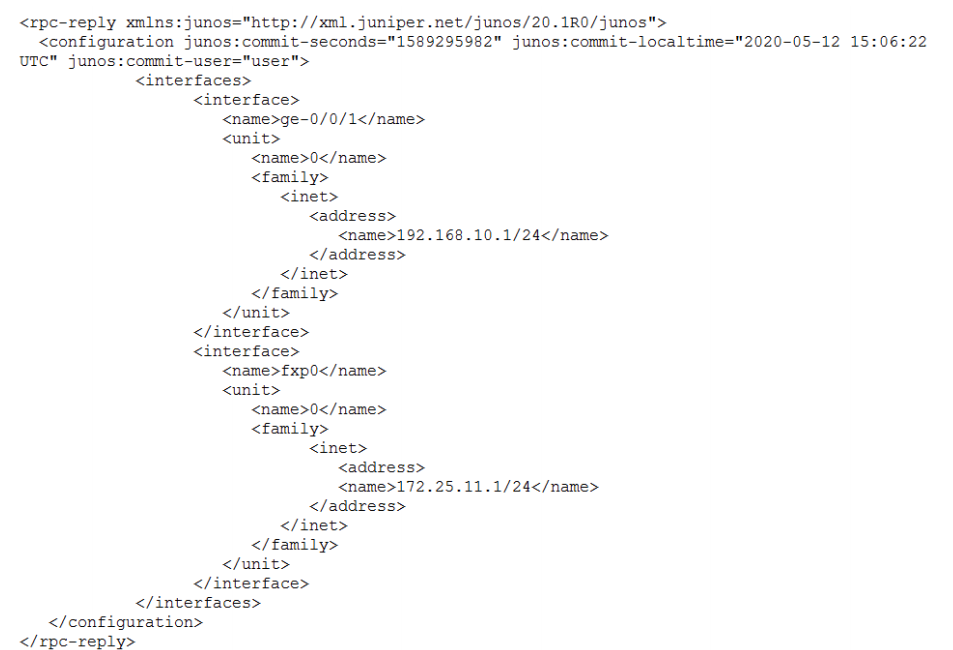
Referring to the exhibit, which XML XPath expression will only show the IP address XML elements?
YAML uses which two data structures? (Choose two.)
YAML (YAML Ain't Markup Language) primarily uses two data structures:
Mappings: These are key-value pairs, similar to dictionaries or hashes in programming languages. In YAML, mappings are used to represent associative arrays or objects. They are defined with a colon (:) separating the key from the value.
Example:
key: value
name: John Doe
Sequences: These are ordered lists of items, equivalent to arrays or lists in other programming languages. Sequences in YAML are denoted by a dash (-) followed by a space and then the item.
Example:
fruits:
- Apple
- Banana
- Cherry
Detailed Explanation:
Mappings (B) allow you to define relationships between keys and values, making it possible to represent more complex data structures like dictionaries or objects.
Sequences (C) allow you to represent ordered collections, which is important for listing elements that must maintain a specific order.
YAML is often used in configuration files and data serialization in DevOps environments, such as in Ansible playbooks, Kubernetes manifest files, and CI/CD pipeline definitions. Its simplicity and human-readable format make it a popular choice for these applications.
YAML Official Documentation: YAML's specification outlines these core data structures.
Juniper Automation and DevOps Documentation: Provides best practices for using YAML in network automation scripts and configuration management.
Your organization is developing an application to automate management of Junos network appliances. You want to use the existing PyEZ libraries to improve the development process. Which API would satisfy this requirement?
Given the following Python script:
a = [1,2,3,4,5,6,7,8,9]
print(a[0])
What is the output of this print command?
In Python, lists are zero-indexed, meaning the first element of the list is at index 0. The given script is:
pythona = [1, 2, 3, 4, 5, 6, 7, 8, 9]
print(a[0])
a[0] refers to the first element in the list a, which is 1.
So, the output of the print(a[0]) command is 1.
Option A is correct because Python indexing starts at 0, making the first element of the list at index 0.
Python Official Documentation: Covers list indexing and operations.
Python Programming Tutorials: Provide examples of list indexing.
Exam domains verified against: Official Juniper JN0-224 exam guide, last checked October 2026.
Understand automation tools, frameworks, and APIs used in Juniper environments. Learn DevOps culture, practices, and the tools that support modern network operations and software delivery alongside infrastructure changes.
Master XML syntax and XPath for querying structured data. Understand NETCONF as a protocol for network device configuration and XML APIs as the mechanism for programmatic interaction with Junos devices.
Sample question from this domain above: Q3
Learn YAML and JSON as human-readable and widely supported formats for configuration and data exchange. Understand why serialization matters when moving data between systems and automation tools.
Write Python scripts using PyEZ to automate Junos device configuration and monitoring. Master JSNAPy for assertions, Jinja2 for templating, RPC calls for direct device interaction, and exception handling for robust automation.
Understand the Junos REST API as a modern way to interact with Junos devices. Use cURL and the REST API Explorer to query device state, trigger RPCs, and explore available endpoints without writing Python code.
Common questions about the exam itself

