Juniper JN0-1103 Practice Exam Questions & Answers
7 Free Questions
· Last reviewed: October 12, 2026
· Prepared & Reviewed by the ValidExamDumps Editorial Team
Exam Facts
Juniper JN0-1103 Exam Details
Key details for this exam, checked against the published exam outline
65
Practice Questions (Our Bank)
90 minutes
Exam Duration
- Exam Code
- JN0-1103
- Full Name
- Design, Associate (JNCIA-Design)
- Issuing Body
- Juniper Networks
- Question Format (Our Bank)
- Multiple Choice
- Delivery
- Pearson VUE
- Eligibility
- None
Practice Questions
Free JN0-1103 Practice Questions
Each question shows the correct answer and an explanation of why it is right
VA
ValidExamDumps Editorial Team
Every question and its answer is checked by our JN0-1103 exam
preparation team, who also write the explanation shown with each one.
How we research and review these pages
Which two statements are correct about the Juniper Connected Security strategy? (Choose two.)
Correct Answer:
A, D
Explanation
Juniper Connected Security is a strategy that integrates security across the entire network infrastructure. It extends attack mitigation beyond traditional security appliances to routers and switches, which become active security enforcement points. The strategy also ensures security is applied at every point where devices connect to the network, whether at the edge, core, or data center. This distributed approach means security is not siloed in one device but woven throughout the network architecture.
In which two instances should you use Postman as part of network automation? (Choose two.)
Correct Answer:
A, D
Explanation
Postman is a tool used for API testing and development. In network automation, Postman helps connect network infrastructure with cloud applications by testing and validating API calls between systems. It is also valuable for prototyping API requests before deploying them into production automation workflows. This allows engineers to verify that REST API calls work correctly before building them into larger automation scripts or tools.
What are two fundamental functions of Cloud Access Security Broker (CASB)? (Choose two.)
Correct Answer:
A, D
Explanation
Cloud Access Security Broker (CASB) functions as a security gateway between users and cloud applications. Two of its fundamental functions are providing visibility into cloud service usage and data flows, allowing organizations to see what is happening. It also ensures compliance by monitoring cloud services against organizational policies and regulatory requirements. CASB fills the gap that traditional network security tools cannot cover when users access cloud services directly.
Multiple customer sites are connected through your service provider network using a Layer 3 VPN. You must design the Layer 3 VPN so that the traffic sent between sites is encrypted.
Which technology would you use to accomplish this task?
Correct Answer:
C
Explanation
When designing a Layer 3 VPN across a service provider network, you need to protect traffic between customer sites. IPsec with ESP (Encapsulating Security Payload) provides both encryption and authentication for this traffic. While other security measures like TLS or simple encryption might be considered, IPsec is the standard technology specifically designed to encrypt traffic in Layer 3 VPNs. ESP is the protocol within IPsec that handles the actual encryption of the data payload.
Click the Exhibit button.
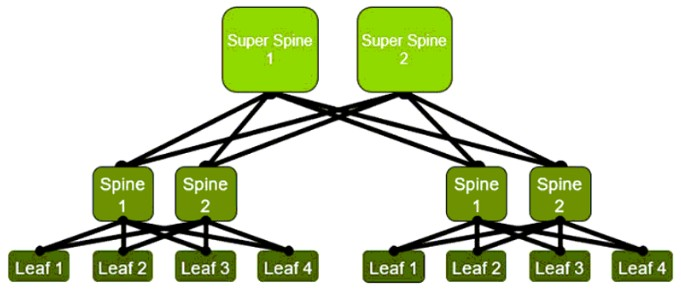
Which type of IP fabric is shown in the exhibit?
Correct Answer:
C
Explanation
A large global banking institution faces extreme consequences from outages including lost revenue and customer attrition. Business continuity is the appropriate design focus for this scenario. Capacity planning or performance optimization would not address the core concern of preventing downtime. Redundancy, failover capabilities, and resilient architectures all flow from a business continuity focus. Design decisions must prioritize uptime above other factors.
Which two switches should you recommend as leaf nodes for a small data center where cost is a factor? (Choose two.)
Correct Answer:
A, C
Explanation
For a small data center with cost constraints, you need leaf switches that balance capability with price. The EX4300 and EX4400 are both cost-effective switching platforms suitable for small deployments. The EX4300 is an older generation platform that is economical, while the EX4400 offers improved performance and features at a slightly higher price point but still remains affordable for small data centers. Other options like the EX5400 or QFX series would be overspecified and too expensive.
Click the Exhibit button.
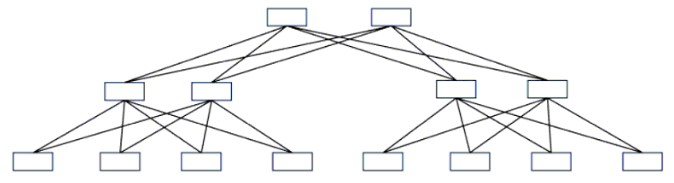
Referring to the exhibit, what are two accurate descriptions of this topology? (Choose two.)
Correct Answer:
A
Full Access
Get the complete JN0-1103 question set
- 65 questions covering all exam domains
- Correct answers with explanations, like the free questions above
- PDF and online practice test
- 90 days of free updates
Domain 1: Customer Network Design Requirements
Identify initial network design requirements including Juniper Networks life-cycle service approach, proposal boundaries and considerations, and greenfield and brownfield deployment strategies. This foundation determines how well the subsequent design meets business objectives and technical constraints.
Domain 2: Capacity planning
Identify the roles of different Juniper products and solutions including routers, switches, security appliances, WLAN controllers, software-defined networking, and network management tools. Understanding product capabilities and positioning ensures optimal resource allocation and performance.
Domain 3: Securing the Network
Identify security design principles for general network security, data center hardening, campus WAN protection, zero-trust architecture, and secure access service edge deployment. Modern security requires integrated protection across all network layers and access points.
Sample questions from this domain above:
Q1Q3
Domain 4: Network Management or Reliability
Identify network design considerations for business continuity including high-resiliency patterns, link and device redundancy, multihomed ESI LAGs, SRX Firewall redundancy, and virtual chassis clustering. Reliability design prevents downtime and ensures consistent service delivery.
Domain 5: Campus redundancy best practices
Identify design considerations for network automation including benefits and Juniper automation products. Learn about Junos XML, REST, and JSD APIs for both on-box and off-box automation. Automation reduces operational overhead and improves consistency across campus networks.
Domain 6: Junos OS on-box and off-box automation
Identify design considerations for network management strategies, including:; Network management methodologies; Separation of production and management traffic; Configuration backups; Remote console access; Juniper network management strategies
Sample question from this domain above:
Q2
Domain 7: Campus and Branch LAN Design
Identify considerations for wired campus or branch LAN design including modular architecture principles, subnet and VLAN design, access control strategy, EVPN-VXLAN deployment, and oversubscription planning. Proper LAN design balances cost, performance, and scalability.
Domain 8: Campus design architectures
Identify considerations for wireless LAN design covering design phases, business and technical requirements gathering, device types, secondary coverage, real-time location services, access point coverage patterns, co-channel contention, and RF modeling. WLAN design requires understanding both RF characteristics and user behavior.
Domain 9: Campus and Branch WAN Design
Identify considerations for wired campus or branch LAN design including modular architecture principles, subnet and VLAN design, access control strategy, EVPN-VXLAN deployment, and oversubscription planning. Proper LAN design balances cost, performance, and scalability.
Sample question from this domain above:
Q4
Domain 10: Campus active/active and active/passive high availability (HA)
Identify considerations for SD-WAN design including design considerations, device options, assurance models, and intersite connectivity patterns. SD-WAN enables flexible, cost-effective WAN architectures with built-in performance and security.
Domain 11: Data Center Network Design
Identify considerations for general data center networks including design best practices, traffic pattern analysis, virtual chassis deployment, and environmental considerations. Data center design must accommodate both current workloads and future growth.
Domain 12: Data center fabric architectures
Identify considerations for IP fabric-based data center networks including benefits over traditional architectures, design options, spine-and-leaf device placement, underlay and overlay design, routing protocol selection, and scaling strategies. IP fabric provides a modern, scalable foundation for data center networks.
Sample questions from this domain above:
Q5Q6Q7
FAQ
JN0-1103 Exam FAQ
Common questions about the exam itself
What network design background do I need before taking JN0-1103?
JN0-1103 requires no formal prerequisites, but you should have practical experience with network design fundamentals, Juniper product families, and enterprise networking concepts. Most candidates have several years working with network architecture, routing, switching, or security before attempting this design-focused exam.
How does JN0-1103 differ from JN0-1102, and can I skip straight to JN0-1103?
JN0-1103 is the current Design Associate exam that replaced JN0-1102. You can take JN0-1103 directly without completing JN0-1102. However, if you have previous study material for JN0-1102, be aware that exam objectives have evolved and you should focus on the published JN0-1103 objectives.
Which exam objective area in JN0-1103 requires the most preparation time?
Data Center Network Design and Campus and Branch LAN Design typically demand the most study effort because they require understanding complex architectures like EVPN-VXLAN, IP fabric design, and modular topology patterns. Candidates with data center or large campus experience find these areas more approachable.
How long should I spend preparing for the JN0-1103 exam?
Most candidates need four to eight weeks of structured study combining official Juniper training, hands-on lab work, and practice exams. The exact timeline depends on your network design experience. Candidates with strong fundamentals but lacking design experience often need the longer end of that range.
What format is the JN0-1103 exam, and what can I expect on exam day?
JN0-1103 consists of 65 multiple-choice questions delivered in 90 minutes through Pearson VUE, either online proctored or at a test centre. You receive an instant pass or fail result, and the exam tests design decision-making across campus, branch, data center, and security scenarios.
What is the passing score for JN0-1103, and how is it calculated?
Juniper does not publish the exact passing score for JN0-1103. The exam uses adaptive scoring where question difficulty affects the point value. Your detailed score report shows performance by objective area, helping you identify weak spots if you need to retake.
Can I retake JN0-1103, and what is the waiting period between attempts?
You can retake JN0-1103 as many times as needed. Juniper allows you to retake within 24 hours of your previous attempt without penalty, though scheduling another session at your preferred test centre may take longer. Each attempt requires a separate exam fee.
How long does the JN0-1103 JNCIA-Design certification remain valid?
The JNCIA-Design certification is valid for three years from the date you pass the exam. To renew, you can retake the exam, pass an advanced-level certification like JNCIS-Design, or complete Juniper-approved recertification activities.
What job roles does the JN0-1103 JNCIA-Design certification support?
JN0-1103 prepares network architects, senior network engineers, and design consultants to validate expertise in Juniper-based network architecture. The certification demonstrates competency in designing enterprise networks, data centers, campus LANs, WAN solutions, and security architectures using Juniper products.
Is there an expert-level Design exam after JNCIA-Design (JN0-1103)?
Yes, the JNCIS-Design (JN0-1104) exam is the specialist level that builds on JNCIA-Design. JNCIS-Design goes deeper into advanced architecture patterns, complex troubleshooting scenarios, and multi-vendor integration. You do not need JNCIA-Design to attempt JNCIS-Design, but the knowledge is cumulative.

