iSQI CPUX-F Practice Exam Questions & Answers
6 Free Questions
· Last reviewed: October 8, 2026
· Prepared & Reviewed by the ValidExamDumps Editorial Team
Exam Facts
iSQI CPUX-F Exam Details
Key details for this exam, checked against the published exam outline
99
Practice Questions (Our Bank)
75 minutes
Exam Duration
70%
Passing Score
- Exam Code
- CPUX-F
- Full Name
- UXQB Certified Professional for Usability and User Experience - Foundation Level
- Issuing Body
- iSQI (International Software Quality Institute) on behalf of UXQB (International Usability and User Experience Qualification Board)
- Question Format (Our Bank)
- Multiple Choice, Fill in the Blank
- Delivery
- Online proctored exam
- Eligibility
- No specific requirements or prerequisites. Practical experience in usability and UX is an advantage.
Practice Questions
Free CPUX-F Practice Questions
Each question shows the correct answer and an explanation of why it is right
VA
ValidExamDumps Editorial Team
Every question and its answer is checked by our CPUX-F exam
preparation team, who also write the explanation shown with each one.
How we research and review these pages
The interviewer should use open and neutral interview questions rather than closed and__________ questions
Correct Answer:
A
Explanation
Quantitative user requirements are specific, measurable targets that define what the system must achieve in terms of usability and user experience metrics. Option A correctly identifies that they set measurable goals. Option B is also correct because these requirements provide the basis for design decisions and can be objectively verified through evaluation against the finished system. Both answers together show that quantitative requirements bridge the gap between understanding user needs and creating solutions that can be objectively tested.
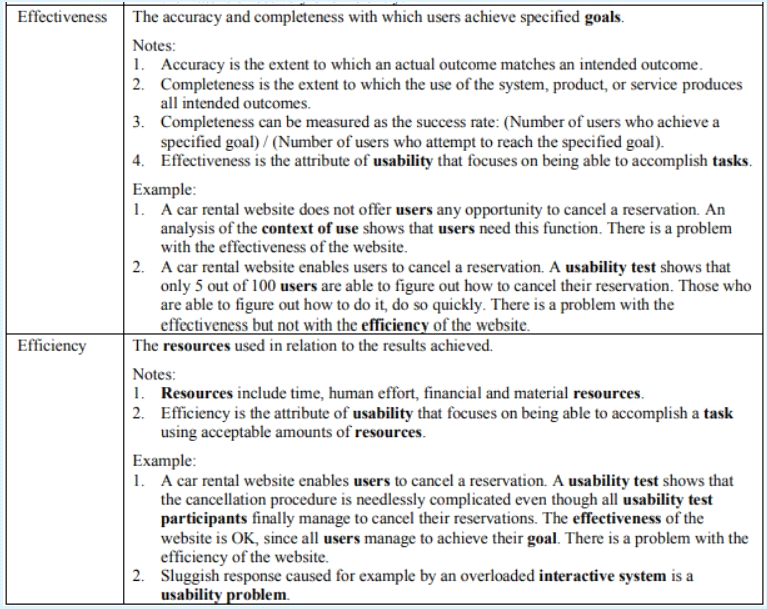
A car rental website does not offer users the opportunity to cancel a reservation. An analysis of the context of use shows that users need this function. Which one aspect of the ISO 9241 definition of usability is violated by this website?
Correct Answer:
D
Explanation
ISO 9241 -A family of standards covering human-centred design.
Note: 1.
ISO 9241 includes standards related to
a. Software ergonomics;
b. The human-centred design process;
c. Displays and display related hardware;
d. Physical input devices;
e. Workplace ergonomics;
f. Environment ergonomics;
g. Control centres
Which one of the following methods is NOT suitable for determining the context of use of a cash machine?
Correct Answer:
A
Which one of the following statements demonstrates the importance of user interface guidelines?
Correct Answer:
C
Explanation
User interface guidelines are low-level, specific rules or recommendations for user interface design that leave little room for interpretation, allowing designers to implement them consistently.
Style guides are collections of user interface guidelines; they are used to ensure consistency in the appearance and behaviour of user interfaces across interactive systems produced by the same organisation.
______________is based upon an explicit understanding of users, goals, tasks, resources and environments. Users are involved throughout the design. The design is driven and refined by usability evaluation. The process is iterative -that is, it continues until the user requirements are met. The design addresses the whole user experience (UX).
Correct Answer:
A
8. Gerry works in a bank. One of his responsibilities is to check the amount of cash in the cash machine and reload it to the required level. He does this each morning and on Friday afternoons, in preparation for the weekend. Which one of the following best describes Gerry?
Correct Answer:
A
Explanation
Primary user
A user who uses the interactive system for its intended purpose.
Examples of primary users:
1. A bank customer who uses a cash dispenser to withdraw money is a primary user of the cash dispenser.
2. A call centre operative who uses a reservation system to reserve cars for customers is a primary user of the reservation system.
Secondary user
A user who carries out support tasks with the interactive system, for example to maintain it or to train primary users.
Note: 1.
Secondary users - in particular maintenance staff - typically interact with a different user interface than primary users. This user interface also requires context analysis and specification of user requirements to be usable.
Examples of secondary users:
1. A user who prints a document on a printer is a primary user of the printer. When the same user a moment later changes the ink on the printer, he or she is a secondary user of the printer.
2. A bank employee who restocks a cash dispenser with cash is a secondary user of the cash dispenser.
3. A trainer who teaches a call centre operative how to use a car reservation system is a secondary user of the reservation system.
Indirect user
A user who uses the output of the interactive system, but who does not interact directly with the interactive system.
Examples of indirect users:
1. A bank customer who receives a paper or electronic statement is an indirect user of the bank's computer system.
2. A customer who contacts the call centre to reserve a car is an indirect user of the computer system used by the call centre operative to make the reservation
Full Access
Get the complete CPUX-F question set
- 99 questions covering all exam domains
- Correct answers with explanations, like the free questions above
- PDF and online practice test
- 90 days of free updates
Domain 1: Topic 1:
The human-centred design process
Domain 2: Topic 2:
Definitions, concepts and guidelines
Sample questions from this domain above:
Q2Q6
Domain 3: Topic 3:
Understanding and specifying the context of use
Sample questions from this domain above:
Q3Q5
Domain 4: Topic 4:
Specifying the user requirements
Domain 5: Topic 5:
Producing design solutions
Sample questions from this domain above:
Q1Q4
Domain 6: Topic 6:
Usability tests
Domain 7: Topic 7:
Usability inspections and user surveys
FAQ
CPUX-F Exam FAQ
Common questions about the exam itself
What background do I need to take the CPUX-F exam?
There are no specific prerequisites or required prior certifications. Practical experience in usability and user experience principles is helpful but not mandatory. The exam is designed for professionals seeking to formalize their foundational UX knowledge across product design, development, project management, and related roles.
How long should I prepare for CPUX-F?
Most candidates benefit from 3 to 5 days of formal training from a recognized UXQB training provider, combined with self-study and practice. The exact time needed depends on your existing UX background. Many candidates find that reviewing the seven topic areas and practising with mock exams helps consolidate knowledge before the exam.
What is the passing score for CPUX-F?
You need to achieve 70% or higher to pass the exam. This means you must answer at least 28 out of 40 questions correctly.
How difficult is CPUX-F compared to other UX certifications?
CPUX-F is designed as a foundation-level exam, making it accessible to professionals new to formal UX qualifications. The main challenge is breadth rather than depth. You are expected to understand seven distinct topic areas from user research through to evaluation, but questions do not require deep expertise in any single area.
Which topics do candidates struggle with most on CPUX-F?
Topic 3 (Understanding and specifying the context of use) typically requires careful study because it involves practical research methods like persona development and scenario analysis. Topic 6 (Usability tests) also demands hands-on understanding of test planning and data interpretation. Spending extra time working through examples of user research techniques helps strengthen these areas.
How does CPUX-F relate to the advanced level CPUX exams?
CPUX-F is the required foundation for all three advanced CPUX certifications: CPUX-UR (User Requirements Engineering), CPUX-UT (Usability Testing and Evaluation), and CPUX-DS (Designing Solutions). You must pass CPUX-F before enrolling in any advanced course or exam. The foundation covers the complete UX process, while advanced exams specialize in specific phases.
What happens if I fail the CPUX-F exam?
You can retake the exam. If you purchase the 2TRY option when booking, you receive one free retake within 90 days if you do not pass on your first attempt. Otherwise, you must purchase a new exam seat to try again.
How long is the CPUX-F certification valid?
The validity period and renewal requirements for CPUX-F have not been published on the official iSQI pages. Contact iSQI directly at
[email protected] for current information about how long your certification remains active and what renewal process applies.
Can I take CPUX-F in languages other than English?
The exam is offered in multiple languages. English and German are confirmed. For a complete list of available languages and whether your language is supported, check the iSQI booking page or contact
[email protected], as language availability may vary by region and testing window.
What job roles is CPUX-F designed for?
CPUX-F is suitable for UX designers, usability professionals, product managers, software developers, business analysts, and project managers involved in creating or evaluating user-centred products. It formalizes the knowledge of anyone whose work touches product development from a user perspective.

