Free Informatica PR000041 Exam Actual Questions & Explanations

Last updated on: Jul 1, 2026
Author: Bjorn Kim (Informatica Certification Specialist)

The Informatica PR000041 exam validates your expertise in PowerCenter Data Integration 9.x as a Developer Specialist and is a key milestone within the Informatica Certified Professional credential path. This exam assesses your ability to design, build, and optimize data integration solutions using PowerCenter's core development features. Whether you're advancing your career or deepening your technical foundation, this page provides a structured study roadmap and practical resources to help you prepare effectively.

PR000041 Exam Syllabus & Core Topics

Use this topic map to guide your study for Informatica PR000041 (PowerCenter Data Integration 9.x:Developer Specialist) within the Informatica Certified Professional path.

  • Introduction to PowerCenter Data Integration: Understand the architecture, core components, and role of PowerCenter in enterprise data environments. You must recognize how sources, targets, and transformation logic fit into end-to-end integration workflows.
  • PowerCenter Development Tools: Master the Designer, Workflow Manager, and Repository tools. Learn to navigate the interface, configure connections, and manage metadata across development environments.
  • Designing Mappings and Transformations: Build mappings that extract, transform, and load data accurately. Apply transformations such as filters, aggregators, and lookups to solve real business requirements and handle complex data logic.
  • Working with Workflows and Sessions: Configure workflows and sessions to orchestrate data movement. Set up error handling, conditional logic, and dependencies so integrations run reliably in production.
  • Advanced Transformations and Techniques: Implement complex transformations including stored procedures, custom expressions, and dynamic lookups. Optimize data flow logic for accuracy and maintainability in large-scale projects.
  • Performance Tuning and Optimization: Diagnose bottlenecks, adjust cache settings, and refine SQL queries to improve integration speed. Apply best practices for memory management and parallel processing to meet SLA requirements.

Question Formats & What They Test

The PR000041 exam combines knowledge-based and scenario-driven items to assess both your conceptual understanding and practical decision-making ability in real-world integration challenges.

  • Multiple Choice: Test your recall of PowerCenter terminology, feature behavior, transformation properties, and configuration best practices. Questions focus on core definitions and when to use specific tools.
  • Scenario-Based Items: Present realistic integration problems and ask you to select the best design approach, troubleshooting step, or optimization technique. These items require you to apply knowledge across multiple topics and justify your reasoning.
  • Simulation-Style Questions: May ask you to interpret mapping logic, predict workflow outcomes, or identify the correct configuration for a given business requirement. These reinforce hands-on familiarity with the PowerCenter interface and process flows.

Difficulty increases progressively, with later items requiring integration of concepts across modules and judgment about trade-offs between performance, maintainability, and accuracy.

Preparation Guidance

An effective study plan spreads learning across the six core modules over 4-6 weeks, balancing concept review with practical application. Dedicate time each week to one or two modules, then revisit earlier topics to build connections across the entire platform.

  • Map modules to weekly goals: Week 1-2 cover Introduction and Development Tools; Week 3 focuses on Mappings and Transformations; Week 4 addresses Workflows and Sessions; Week 5 dives into Advanced Transformations; Week 6 covers Performance Tuning. Track your progress weekly to stay on pace.
  • Work through practice question sets after completing each module. Review explanations for every answer, especially incorrect choices, to identify and close knowledge gaps.
  • Link features across modules: understand how a mapping design decision affects workflow performance, or how a transformation choice impacts session execution time. This systems thinking is critical for scenario-based items.
  • Complete a timed mini-mock exam in your final week to build pacing confidence and reduce test-day anxiety. Aim to finish within the allotted time while maintaining accuracy.

Explore other Informatica certifications: view all Informatica exams.

Get the PDF & Practice Test

Strengthen your preparation with up-to-date resources from validexamdumps.com. These materials align to PR000041 and cover practical scenarios with clear explanations.

  • Q&A PDF with explanations: Topic-mapped questions that clarify why correct options are right and others aren't.
  • Practice Test: Realistic items, timed and untimed modes, progress tracking, and detailed review of each answer.
  • Focused coverage: Aligned to Introduction to PowerCenter Data Integration, PowerCenter Development Tools, Designing Mappings and Transformations, Working with Workflows and Sessions, Advanced Transformations and Techniques, and Performance Tuning and Optimization so you study what matters most.
  • Regular reviews: Content refreshes that reflect syllabus and product changes.

Visit the exam page to download the PDF, Online Practice Test or get Bundle Discount offer for both formats: PowerCenter Data Integration 9.x:Developer Specialist.

Frequently Asked Questions

Which modules carry the most weight in the PR000041 exam?

Designing Mappings and Transformations and Performance Tuning and Optimization typically account for the largest share of exam items because they directly impact production reliability and efficiency. However, all six modules are essential; weakness in foundational topics like Development Tools or Workflows will limit your ability to answer scenario questions correctly.

How do the six modules connect in a real PowerCenter project?

In practice, you begin with Introduction concepts to understand the platform architecture, then use Development Tools to set up your environment and connections. You design Mappings and Transformations to implement business logic, orchestrate them with Workflows and Sessions, apply Advanced Transformations for complex requirements, and finally tune Performance to meet SLAs. Understanding this flow helps you see why a mapping design choice affects workflow execution and why performance optimization requires knowledge of transformation behavior.

How much hands-on experience is needed, and which labs should I prioritize?

Ideally, you should have 6-12 months of practical PowerCenter development experience. If you are newer to the platform, prioritize labs that involve building simple mappings, configuring sessions, and running workflows end-to-end. Then move to advanced labs covering complex transformations and performance diagnostics. Hands-on practice reinforces how the interface works and builds confidence for scenario-based exam items.

What are common mistakes that cost points on this exam?

Many candidates confuse transformation properties or misunderstand when to use specific tools (e.g., Aggregator vs. Lookup). Others overlook error-handling strategy in workflows or choose optimization techniques without considering trade-offs. A frequent pitfall is not reading scenario questions carefully, leading to incorrect answers even when you know the concept. Slow down on scenario items, re-read the problem, and eliminate obviously wrong options before selecting your answer.

What is an effective review strategy for the final week before the exam?

In your final week, avoid learning new material; instead, review weak topic areas using your practice test results. Spend 30 minutes daily on flashcards or quick Q&A reviews to reinforce terminology and key decision points. Take one full-length timed practice test 2-3 days before the exam to identify any remaining gaps. Get adequate sleep the night before the exam and arrive early to settle in and review your test-taking strategy.

Question No. 1

Which of the following is not a Transaction Control Variable?

Show Answer Hide Answer
Correct Answer: B

Question No. 2

What is a pipeline lookup transformation?

Show Answer Hide Answer
Correct Answer: C

Question No. 3

Which of the following are supported file types, from which, an XML definition can be imported? Choose 3 answers

Show Answer Hide Answer
Correct Answer: A, B, C

Question No. 4

Given the picture shown below: How many columns would be selected from the database using PowerCenter's generated sql statement?
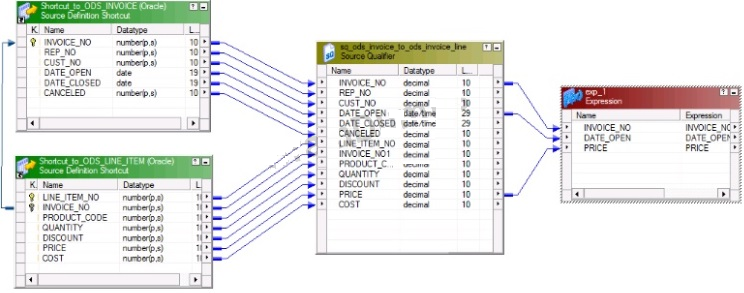
Show Answer Hide Answer
Correct Answer: C

Question No. 5

If after running a session task, it has been determined that the incorrect mapping was run for that session task, which of the following actions could be attempted?

Show Answer Hide Answer
Correct Answer: A
