Key details for this exam, checked against the published exam outline
Each question shows the correct answer and an explanation of why it is right
Which of the following statements is correct about the differences between NSR and NSF?
Comprehensive and Detailed In-Depth
NSR (Non-Stop Routing) and NSF (Non-Stop Forwarding) are high-availability mechanisms used to maintain network stability during routing process failures:
NSR (Non-Stop Routing):
Operates within the local router only.
Keeps routing information synchronized between the active and standby processes.
Does not require collaboration from neighboring routers.
NSF (Non-Stop Forwarding):
Requires collaboration from neighboring routers that support graceful restart.
The router undergoing failover relies on its neighbors to maintain forwarding tables while control plane recovery takes place.
Neighboring routers must support GR (Graceful Restart) for NSF to function correctly.
Therefore, the correct answer is B because NSF requires neighboring router collaboration, while NSR does not.
Huawei HCIE Datacom Official Certification Guide
Huawei High-Availability Configuration and Maintenance Guide
Which of the following types of EVPN routes does not carry MPLS labels?
Comprehensive and Detailed
Ethernet VPN (EVPN) is an advanced L2VPN technology that enhances MAC learning and forwarding in data center and enterprise networks. Different EVPN route types are used for various functions:
Ethernet A-D (Auto-Discovery) Route: Used for auto-discovery of PE devices and does carry labels.
MAC/IP Advertisement Route: Distributes MAC-to-IP mappings and carries labels for forwarding decisions.
Ethernet Segment Route: Does not carry MPLS labels as it is used to signal multi-homing and redundancy information.
Inclusive Multicast Route: Used for multicast forwarding and carries labels for tunnel identification.
Since Ethernet Segment Route is used only for multi-homing signaling and does not carry MPLS labels, the correct answer is C.
Reference: Huawei HCIE Datacom Study Guide - EVPN Route Types
Fill in Blank
The ingress VTEP performs both Layer 2 and Layer 3 table lookup for packet forwarding. The forwarding mode is _____ IRB forwarding. (Capitalize the first letter.)
Understanding IRB (Integrated Routing and Bridging) Forwarding in VXLAN
VXLAN (Virtual Extensible LAN) supports Layer 2 and Layer 3 forwarding between Virtual Network Identifiers (VNIs).
IRB (Integrated Routing and Bridging) enables inter-subnet communication within a VXLAN fabric.
There are two modes of IRB forwarding:
Symmetric IRB
Asymmetric IRB
Why the Answer is 'Symmetric' IRB Forwarding?
Ingress VTEP performs both Layer 2 and Layer 3 lookups:
Symmetric IRB requires both ingress and egress VTEPs to perform Layer 3 lookups.
The ingress VTEP (source gateway) performs a Layer 2 MAC lookup, then a Layer 3 lookup to find the destination VTEP.
The egress VTEP (destination gateway) performs another Layer 3 lookup before forwarding the packet to the destination.
Asymmetric IRB does not perform two lookups at the ingress VTEP:
In Asymmetric IRB, the ingress VTEP performs both Layer 2 and Layer 3 forwarding and sends a Layer 2 packet to the egress VTEP.
The egress VTEP only does a Layer 2 lookup, not a Layer 3 lookup.
Since the question states that both L2 and L3 lookups occur at the ingress VTEP, asymmetric IRB is incorrect.
Why Symmetric IRB is More Common?
Scalability: Supports any-to-any communication across VXLAN networks.
More Efficient Routing: Uses Layer 3 VXLAN encapsulation, ensuring efficient routing between VNIs.
Reference: Huawei HCIE Datacom -- VXLAN Symmetric and Asymmetric IRB Forwarding
Which of the following commands needs to be run in the BGP view to enable a VPN instance to advertise IP routes to the BGP-EVPN address family?
In BGP EVPN configuration for VXLAN-based networks, Huawei uses the command:
[bgp] advertise l2vpn evpn
This command enables the BGP process to advertise routes from a VPN instance into the EVPN (L2VPN) address family, which is used for VXLAN control-plane operations like MAC/IP advertisement.
Option A (advertise irbvfi) --- invalid command.
Option B (advertise vpnv4) --- used for MPLS VPNs, not EVPN.
Option C (advertise irb) --- not a recognized Huawei command.
Option D is the correct and officially used command.
Correct answer: D. advertise l2vpn evpn
OSPF is deployed on a campus network to implement network interconnection. An engineer configures R2 as shown in the figure. Which of the following statements is incorrect about LSAs on the OSPF network?
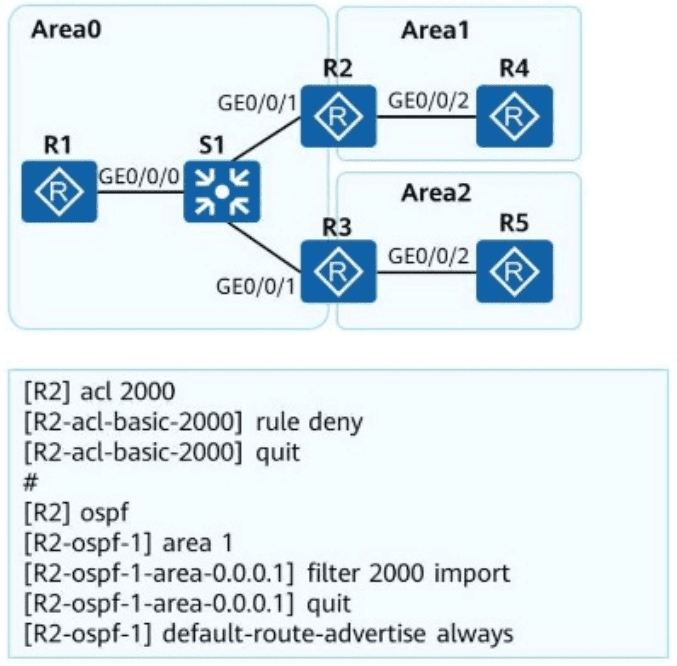
Analyze the Configuration:
[R2] acl 2000
[R2-acl-basic-2000] rule deny
[R2] ospf
[R2-ospf-1] area 1
[R2-ospf-1-area-0.0.0.1] filter 2000 import
[R2-ospf-1-area-0.0.0.1] quit
[R2-ospf-1] default-route-advertise always
Understanding Key Concepts:
Type 3 LSAs (Inter-Area Routes):
Generated by ABRs to advertise summary routes between areas.
Filtering Type 3 LSAs is possible using import filters (like in Area 1).
Type 5 LSAs (External Routes):
Flooded only within the same AS but do not enter stub or NSSA areas.
Breakdown of the Options:
A . Type 5 LSAs are flooded in Area 1 Incorrect
If Area 1 is a stub or NSSA, then Type 5 LSAs are not allowed.
Although the diagram does not explicitly say Area 1 is a stub/NSSA, real deployments often use stub areas at the edge (like Area 1).
More importantly, the filter is applied to Area 1, and there is no redistribution of external routes into Area 1 in the config.
Therefore, Type 5 LSAs would not be flooded there.
B . Type 3 LSAs are not flooded in Area 1 Correct
The command filter 2000 import with ACL rule deny means Type 3 LSAs are filtered from Area 0 into Area 1.
C . Type 3 LSAs are not flooded in Area 2 Correct
There is no filter applied to Area 2, so this could be false, but since the question asks for the incorrect statement, this is not the answer.
D . Type 5 LSAs are flooded in Area 2 Correct
Area 2 is not shown to be stub or NSSA, and there's no filter or restriction configured.
Hence, Type 5 LSAs are allowed and flooded in Area 2.
Correct Answer: A. Type 5 LSAs are flooded in Area 1.
Which of the following statements is incorrect about intranet security design for a large or medium-sized virtualized campus network?
Comprehensive and Detailed
Traffic suppression is used to control broadcast storms, but shutting down interfaces is NOT the correct way to block broadcast traffic.
Correct Statements:
(B) Intranet security covers both wired and wireless networks.
(C) CAPWAP tunnels use DTLS encryption for security.
(D) Wireless security requires air interface protection against attacks.
Reference: Huawei HCIE Datacom -- Intranet Security Design
The NETCONF content layer contains device configuration data.
Which of the following statements are correct about the following NETCONF configuration?
Comprehensive and Detailed
Breakdown of the NETCONF Configuration:
(B) Huawei-YANG Model Used: The namespace contains http://www.huawei.com/netconf/vrp/huawei-vlan, indicating Huawei's YANG model.
(C) VLAN 10 is Created: <vlanId>10</vlanId> confirms VLAN 10 is configured.
(D) Merge Operation Used: The xc:operation='merge' tag ensures changes are merged rather than replacing the entire config.
(A) Incorrect: The <edit-config> operation modifies the running configuration, not the startup configuration.
Reference: Huawei HCIE Datacom -- NETCONF Configuration Management
5 domains from the Huawei H12-891_V1.0 exam outline, with approximate weightings. Every sample question above is tagged with the domain it comes from
Covers advanced IGP and BGP features, network security, and MPLS deployment. Includes Inter-AS MPLS, EVPN, IPv6 routing, and network operations and migration processes. This is the most heavily weighted section on the exam.
Sample question from this domain above: Q6
Focuses on enterprise campus network virtualization and design. Covers VXLAN, network admission control, free mobility, and virtualized campus network design for large and medium-sized enterprises using Huawei solutions.
Sample question from this domain above: Q3
Covers WAN interconnection solutions and key technologies. Includes SD-WAN solutions and their planning and design for enterprise networks.
Focuses on enterprise bearer WAN solutions, architecture, and key technologies. Covers segment routing and provides introduction to SRv6 fundamentals and configuration.
Encompasses network automation tools and protocols including SSH, NETCONF YANG, Telemetry, OPS, and RESTful practices. Provides comprehensive understanding of modern network automation techniques.
Common questions about the exam itself

