Key details for this exam, checked against the published exam outline
Each question shows the correct answer and an explanation of why it is right
A customer wants to prevent 'man-in-the-middle' attacks based on Layer 2 addressing. What will help address that concern?
Comprehensive Detailed Explanation:
To prevent man-in-the-middle attacks based on Layer 2 (Ethernet) addressing, enabling ARP inspection in the VLAN context is recommended. ARP inspection validates ARP packets and ensures only legitimate ARP responses are forwarded.
Enabling ARP inspection at VLAN level allows granular control.
Interface-level or global context is less typical or supported for ARP inspection on Aruba CX switches.
ArubaOS-CX Security Features Guide
HPE Aruba ARP Inspection Best Practices
Network Security Documentation for Aruba CX Switches
You need to find which change was made to the HPE Aruba Networking CX switch from the GUI. Which option can you use?
To find which changes were made on an HPE Aruba CX switch from the GUI, the correct command is:
show checkpoint diff --- this compares the running configuration with stored saved-config revisions.
Using 'saved-config revisions' as the comparison base allows the GUI to show what has changed since the last saved configuration.
Other options mix checkpoint and saved-config terminology incorrectly.
ArubaOS-CX Checkpoint and Configuration Revision Guide
HPE Aruba CLI User Guide
Aruba CX Configuration Management Best Practices
You recently added HPE Aruba Networking ClearPass as an authentication server to a group in HPE Aruba Networking Central. RADIUS authentication with Local User Roles (LUR) works fine, but the same access points cannot use Downloadable User Roles (DUR).
What should be corrected in this configuration to fix the issue with DUR?
You configured a mixed-mode SSID with WPA3-Enterprise and EAP-TLS security. When you connect a client, HPE Aruba Networking ClearPass shows the following error:
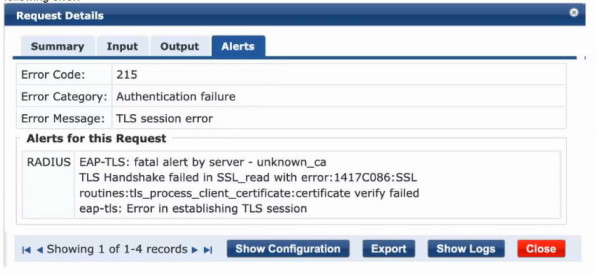
What is needed to resolve this issue?
A customer is experiencing authentication failures when clients connect to a new EAP-TLS SSID.
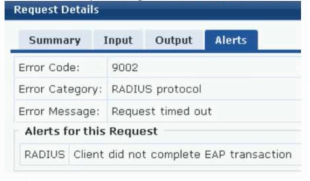

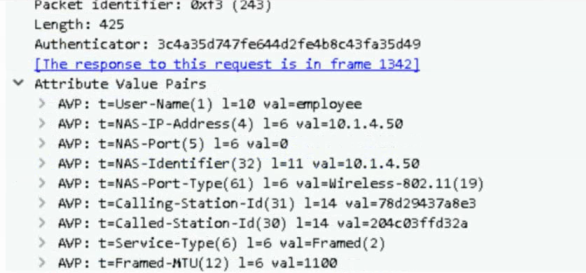
Based on the logs and packet capture above, what is the cause of the failure?
Refer to the exhibit:
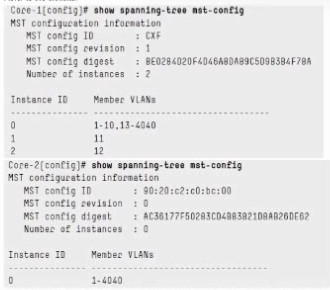
Both switches, Core-1 and Core-2, are configured with default spanning-tree priorities. Both switches appear as primary root bridges. What must be done to have only one spanning tree domain?
If both switches are configured with default spanning-tree priorities and both appear as primary root bridges, to have a single spanning tree domain, matching MST configuration (Multiple Spanning Tree) must be created on Core-2 to align with Core-1.
Setting priority to 1 on one switch can help but matching MST configurations is the recommended approach for multiple VLANs.
Creating MST instances on only one switch will not ensure consistency.
Matching MST configurations ensures consistent root bridge election and stable spanning tree.
Aruba MSTP Configuration Guide
IEEE 802.1s Multiple Spanning Tree Protocol
HPE Aruba Network Design Best Practices
When configuring a multicast solution on HPE Aruba Networking CX switches, what needs to be configured on the core switch to enable L3 multicast routing locally?
To enable Layer 3 multicast functionality on an AOS-CX switch, it is essential to understand the roles of different protocols and where they are applied in the hierarchy of the switch configuration.
L3 vs. L2 Multicast:
IGMP (Internet Group Management Protocol): This is a Layer 3 protocol used by hosts to report their multicast group memberships to adjacent routers. It is configured on a Layer 3 interface, such as an SVI (Switch Virtual Interface) or a routed port.
IGMP Snooping: This is a Layer 2 optimization feature. It allows a switch to 'listen in' on IGMP conversations between hosts and routers to constrain multicast traffic to only those ports that have requested it, preventing the traffic from flooding the entire VLAN.
Enabling L3 Multicast Locally: When the 'core switch' acts as the default gateway for multicast receivers, it must be able to process membership reports from those receivers. By enabling IGMP on the SVI (e.g., interface vlan 100), the switch begins listening for IGMP Join/Leave messages from clients on that subnet. This is a prerequisite for the switch to populate its multicast routing table and, when combined with a routing protocol like PIM (Protocol Independent Multicast), forward traffic from a source to those local receivers.
Analysis of Options:
Option A (Correct): IGMP must be enabled on the SVI so the switch can function as a multicast-aware gateway for that specific subnet.
Option B: In AOS-CX syntax, you do not configure 'IGMP' under the L2 vlan [ID] context; it is an L3 function.
Option C: Enabling IGMP-snooping on a VLAN only manages the L2 delivery of traffic; it does not enable L3 routing or the processing of multicast packets across different subnets.
Option D: While IGMP-snooping is often used in conjunction with L3 multicast, it is technically a VLAN-level configuration, not a property of the SVI itself.
Key CLI Commands:
To fully enable this, a professional would typically use:
Bash
router multicast
routing
!
interface vlan 100
ip igmp
ip pim-sm
Exam domains verified against: Official HP HPE7-A08 exam guide, last checked October 2026.
Understand the HPE switching portfolio and product offerings, then assess customer requirements and design scenarios to determine appropriate implementation approaches. Focus on how to match products to customer needs and develop actionable deployment strategies.
Master provisioning through HPE Aruba Networking Central and CLI-based configuration, including physical setup, Layer 2 technologies, Layer 3 interfaces and routing, multicast, security, QoS, and solution integration. This is the largest domain and requires hands-on familiarity with actual HPE Aruba switches.
Diagnose network failures such as IP mismatches, VLAN issues, hardware problems, and port configuration errors, then determine and explain remediation plans. Identify performance problems caused by QoS, configuration, or hardware issues and trace them to their root cause.
Sample question from this domain above: Q5
Implement configuration management strategies including maintenance, auditing, backup, and archiving. Interpret operational state data to determine appropriate actions and audit or configure switches programmatically.
Sample question from this domain above: Q2
Common questions about the exam itself

