- Home
- GED
- GED-Mathematical-Reasoning Exam Questions
GED GED-Mathematical-Reasoning Practice Exam Questions & Answers
6 Free Questions
· Last reviewed: October 1, 2026
· Prepared & Reviewed by the ValidExamDumps Editorial Team
Exam Facts
GED GED-Mathematical-Reasoning Exam Details
Key details for this exam, checked against the published exam outline
299
Practice Questions (Our Bank)
115 minutes
Exam Duration
145 out of 200
Passing Score
USD 30-40 per subject
Official Exam Fee (varies by state)
- Exam Code
- GED-Mathematical-Reasoning
- Full Name
- GED Mathematical Reasoning Exam
- Issuing Body
- GED Testing Service
- Question Format (Our Bank)
- Multiple Choice
- Delivery
- Computer-based at authorized testing centers and online proctored
- Eligibility
- No formal prerequisites. open to adults without a high school diploma or equivalent
- Validity
- Does not expire. credential is permanent
Practice Questions
Free GED-Mathematical-Reasoning Practice Questions
Each question shows the correct answer and an explanation of why it is right
VA
ValidExamDumps Editorial Team
Every question and its answer is checked by our GED-Mathematical-Reasoning exam
preparation team, who also write the explanation shown with each one.
How we research and review these pages
A local electric company charges $0.07893740 for each kilowatt-hour of electricity used. To the nearest cent, what is the kilowatt-hour charge for electricity?
Correct Answer:
D
Explanation
This question requires rounding a decimal to the nearest cent. The price $0.07893740 has a digit 9 in the thousandths place (the third decimal place), which is 5 or greater. This means you round the hundredths place up from 7 to 8. The answer is $0.08. Other options show common rounding errors, like stopping at the wrong decimal place or rounding down when rounding up was required.
In the diagram below, K is a point on line AD.
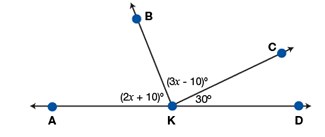
What is the measure, in degrees, of angle BKC?
Correct Answer:
D
Explanation
This geometry problem involves angles formed by intersecting lines. When two lines intersect at a point, adjacent angles are supplementary if they form a straight line. You need to use the properties of angles on a straight line and the relationship between the angles marked in the diagram. Without seeing the exact diagram, the answer 80 degrees comes from applying angle relationships such as supplementary angles or vertical angles to find the measure of angle BKC.
To create a corral for horses, a rancher plans to enclose an 80-square-meter portion of his ranch with fencing. How many meters of fencing will he need?
Correct Answer:
E
Explanation
To calculate fencing needed, you must know the perimeter of the enclosed area. The question tells you only the area is 80 square meters, but many different shapes have the same area yet require different amounts of fencing. A square, a rectangle, or even a circle could all have 80 square meters of area with very different perimeters. You cannot determine perimeter from area alone without knowing the shape or dimensions. The answer is E.
Seats in an auditorium are numbered in order from 1 to 150. The seat that is numbered 7 and every 35th seat thereafter has a card taped beneath it to indicate that the person sitting there has won a prize.
What is the highest numbered seat in which a person can win a prize?
Correct Answer:
A
Explanation
This is a pattern problem where winning seats start at 7 and continue every 35 seats after that. The winning seats are at positions 7, 42, 77, 112, 147, and so on. You add 35 repeatedly until you exceed 150. Since 147 is less than 150 but 147 plus 35 equals 182 which exceeds 150, the highest numbered winning seat is 147. This requires understanding arithmetic patterns and knowing when to stop adding.
Petra earns $75 per week while working at a pizza parlor on Monday, Tuesday, and Friday evenings.
If Petra receives a promised raise of $0.50 per hour, how much will she then earn per week?
Correct Answer:
E
Explanation
The question states Petra earns $75 per week but does not specify how many hours per week she works. Without knowing the number of hours, you cannot calculate her hourly wage or determine how much a $0.50 per hour raise will increase her weekly earnings. You could earn $75 per week for 10 hours or for 20 hours, and these would result in different raises. The answer is E because critical information is missing.
Exhibit.
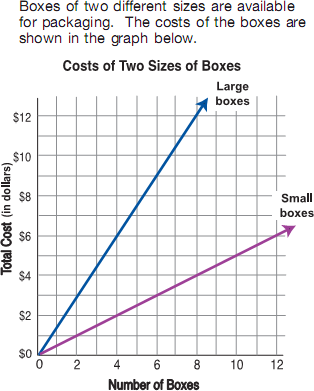
The slope of each line shows the cost per box. What is the cost of each LARGE box?
Correct Answer:
C
Explanation
This question uses a graph where the slope of each line represents the cost per box. To find the cost of a large box, you read the slope directly from the graph or calculate it by finding the rise over run using two points on the line. The slope tells you the unit price. For large boxes, the slope of the corresponding line is 1.50, meaning each large box costs $1.50. Reading graphs and interpreting slope as a rate of change is fundamental to this domain.
Full Access
Get the complete GED-Mathematical-Reasoning question set
- 299 questions covering all exam domains
- Correct answers with explanations, like the free questions above
- PDF and online practice test
- 90 days of free updates
Domain 1: Basic Math
Covers foundational operations with whole numbers, fractions, decimals, percentages, ratios, and basic arithmetic. Includes positive and negative numbers, order of operations, and real-world applications like money, measurement, and data interpretation. Emphasizes accuracy and confidence in calculations and numerical information in practical contexts.
Sample questions from this domain above:
Q1Q4Q5
Domain 2: Geometry
Focuses on shapes, angles, perimeter, area, surface area, and volume. Covers lines, polygons, circles, and coordinate geometry. Includes solving problems involving measurements, spatial reasoning, and geometric formulas applied to real-life scenarios, interpreting diagrams and identifying figure properties.
Sample questions from this domain above:
Q2Q3
Domain 3: Basic Algebra
Covers algebraic expressions, equations, inequalities, and variables representing unknown values. Includes simplifying expressions, solving linear equations, patterns, exponents, and formulas. Emphasizes translating real-world situations into algebraic models and using mathematical relationships to solve word problems.
Domain 4: Graphs and Functions
Focuses on reading, interpreting, and analyzing graphs, charts, tables, and coordinate planes. Covers understanding functions and relationships between variables. Includes identifying trends, evaluating function rules, and solving problems using graphical and numerical data representations.
Sample question from this domain above:
Q6
FAQ
GED-Mathematical-Reasoning Exam FAQ
Common questions about the exam itself
How difficult is the GED Mathematical Reasoning exam and what makes it challenging?
The math exam is typically considered the most challenging of the four GED subjects. The difficulty comes from the combination of mental math required in the no-calculator section and the algebraic and quantitative reasoning needed in the calculator section. Many candidates struggle with translating real-world word problems into mathematical equations and managing time across 46 questions in 115 minutes.
What math background do I need before taking the GED Mathematical Reasoning test?
There are no formal prerequisites for the GED. The exam assumes basic high school-level math skills, so if you have been away from school for years, you should plan time to review foundational arithmetic, fractions, decimals, and basic algebra before attempting the full test.
Which topic on the GED Mathematical Reasoning exam is hardest for most candidates?
Algebraic reasoning, which makes up 55% of the test, is typically the hardest area for candidates. This includes solving equations, working with functions, and analyzing patterns. Spending extra study time on multi-step algebraic problems and practicing how to set up equations from word problems pays off on test day.
How long does it typically take to prepare for the GED Mathematical Reasoning exam?
Most candidates benefit from 8 to 12 weeks of consistent study, dedicating 3 to 5 hours per week to math review and practice. The actual timeline depends on your starting comfort level with math. If you are strong in arithmetic but weak in algebra, dedicate more study hours to algebraic reasoning and less to basic operations.
What is the format of the GED Mathematical Reasoning exam on test day?
The 115-minute exam has two parts taken back-to-back with a short break. Part 1 has about 5 questions with no calculator and covers basic math. Part 2 has about 41 questions with a calculator allowed. You receive a formula sheet, a calculator reference sheet, and a wipe-off board with dry-erase marker to write your work.
Can I retake the GED Mathematical Reasoning exam if I fail?
Yes. You can take two subsequent retests with no waiting period between them. If you fail a third time, you must wait 60 days before attempting again. Each retake involves a separate testing fee, which varies by state but is typically USD 30-40 per subject.
How long does the GED certification stay valid after I pass Mathematical Reasoning?
The GED credential does not expire. Once you achieve a passing score of 145 on Mathematical Reasoning and pass the other three subjects, your high school equivalency certificate is permanent and recognized across all 50 US states.
What jobs or careers does passing GED Mathematical Reasoning qualify me for?
GED certification itself does not directly qualify you for specific roles, but the credential opens doors to employment requiring a high school diploma or equivalent. The Mathematical Reasoning score also signals your ability to work with numbers, making you eligible for roles in accounting, data entry, trades, and technical fields that ask for basic quantitative skills.
What is the relationship between GED Mathematical Reasoning and the other GED subjects?
GED Mathematical Reasoning is one of four independent subject tests you must pass to earn your high school equivalency diploma. The other three are Reasoning Through Language Arts, Science, and Social Studies. You can take them in any order and do not need to pass all four at once. Each subject requires a minimum score of 145 to pass.
Do I need to memorize formulas for the GED Mathematical Reasoning exam?
No. You are provided with a formula sheet that includes geometric and algebraic formulas. The exam focuses on your ability to apply formulas and reasoning to solve problems, not to memorize them. However, you do need to understand what the formulas mean and how to use them correctly.

